Page:NIOSH Manual of Analytical Methods - 5516.pdf/3
2,4- and 2,6-TOLUENEDIAMINE: METHOD 5516, Issue 2, dated 15 August 1994 - Page 3 of 5
SAMPLE PREPARATION:
6. Add 25 μL acetic anhydride to acetylate the 2,4- and 2,6-toluenediamine and excess 1-(2-methoxy phenyl)piperazine. Allow 4 hours for completion of reactions. Evaporate sample to dryness under a gentle stream of nitrogen while warming to 40 to 50 °C on a hotplate. Redissolve residue in 1.5 mL methanol. NOTE: The acetylation reaction for 2,4-toluenediamine to produce 2,4-bisacetamidotoluene is:
| CH3C6H3(NH2)2 | + | 2CH3COOCOCH3 | → | CH3C6H3(NHCOCH3)2 | + | 2CH3COOH |
| 2,4-toluenediamine | + | acetic anhydride | → | 2,4-bisacetamidotoluene | + | acetic acid. |
CALIBRATION AND QUALITY CONTROL:
7. Calibrate daily with at least six working standards.
a. Using aliquots of calibration stock solution, prepare working standards of 2,4- and 2,6- bisacet amidotoluene in methanol covering the range 0.1 to 3 μg/mL each.
b. Analyze these with the unknown and blank samples (steps 9 through 11).
c. Prepare calibration graphs (peak height vs. μg 2,4- and 2,6-toluenediamine per sample). Multiply the concentration (µg/mL) of bisacetamidotoluene by 0.889 mL to obtain the quantity (µg) of toluenediamine per sample.
NOTE: The factor 0.889 includes the MW of toluenediamine (122.17), the MW of bisacetamidotoluene (206.24), and the 1.5-mL solution volume from step 6.
8. Prepare three quality control samples by adding known quantities of 2,4- and 2,6-toluenediamine to 15 mL of sampling medium and analyze (steps 9 through 11).
MEASUREMENT:
9. Set up the HPLC system according to the manufacturer’s recommendations and to the conditions given on page 5516-1. The mobile phase program is:
a. Linear gradient 100% A to 90% A over t = 0 to 8 min.
b. 90% A to 40% A over t = 8 to 19 min following the convex gradient.
c. Hold at 40% A for 1 min, or as long as necessary to clear the column.
d. Return to 100% A and hold for 7 min before the next run.
NOTE: If only 2,4- and 2,6-toluenediamine are to be quantified, the mobile phase program may be modified to hasten elution of the ureas derived from the isocyanates.
10. Inject a 10-μL aliquot of solution from step 6 or step 7b.
11. Measure the peak heights. Adjusted retention times for some compounds of interest are:
| 2,6-bisacetamidotoluene | 5.2 min, |
| 1,4-bisacetamidobenzene | 7.8 min, |
| 1,3-bisacetamidobenzene | 9.4 min, |
| 2,4-bisacetamidotoluene | 9.7 min, |
| 1-acetyl-4-(2-methoxyphenyl)piperazine | 14.3 min, |
| urea derivative of 2,6-toluene diisocyanate | 17.0 min, |
| urea derivative of 2,4-toluene diisocyanate | 18.3 min. |
CALCULATIONS:
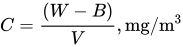
12. Using the calibration graphs, determine the mass, μg, of 2,4- and of 2,6-toluenediamine in each sample (W) and in the average media blank (B). 13. Calculate the concentration, C, of 2,4- and of 2,6-toluenediamine in the air volume sample, (L):
NIOSH Manual of Analytical Methods (NMAM), Fourth Edition