Page:NIOSH Manual of Analytical Methods - 7074.pdf/3
TUNGSTEN (soluble and insoluble): METHOD 7074, Issue 2, dated 15 August 1994 - Page 3 of 3
- Calibrate with at least six working standards over the range 0.05 to 12 mg W per sample.
a. Add known amounts of calibration stock solution to 100-mL volumetric flasks containing 10 mL 0.5 M NaOH and 10 mL 20% Na₂SO4; dilute to volume with distilled, deionized water. - Analyze three quality control blind spikes and three analyst spikes to ensure that the recovery and calibration graph are in control (steps 6 through 14 and 17 through 19).
b. Analyze together with samples and blanks (steps 17 through 19).
c. Prepare calibration graph (absorbance vs. solution concentration, μg/mL).
17. Set spectrophotometer to conditions on page 7074-1.
18. Aspirate standards and samples. Record absorbance readings.
19. If the absorbance values for the samples are outside of the range of the standards, dilute the solutions with 0.05 M NaOH/2% Na₂SO₄ solution, reanalyze, and use the appropriate dilution factor in calculations.
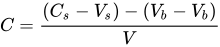
20. Determine the solution concentrations of tungsten in the sample, C s (μg/mL), and average media blank, C b (μg/mL), from the calibration graph.
21. Using the solution volumes, mL of the sample (V s) and media blank (V b), calculate the concentration of tungsten, C (mg/m 3), in the air volume sampled, V (L)
, mg/m³
This method is based on P&CAM 271 [3,4] and was further evaluated and ruggedized under contract [1]. Laboratory testing with spiked samples over the ranges of 0.17 to 0.8 mg per sample (soluble) and 0.34 to 7.9 mg per sample (insoluble) gave precisions (Sr) of 0.079 (soluble) and 0.076 (insoluble) [1]. Both soluble and insoluble tungsten species collected on filters were stable for two weeks [1].
[1] Carlin, L. M., G. Colovos, D. Garland, M. Jamin, M. Klenck, T. Long, and C. Nelson. Analytical Methods Evaluation and Validation: Arsenic, Nickel, Tungsten, Vanadium, Talc and Wood Dust, NIOSH Contract No. 210-79-0060 (1981), available as Order No. PB 83-155325 from NTIS, Springfield, VA 22161.
[2] User check, UBTL, Inc., NIOSH Sequence #4213-M (unpublished, May 23, 1984).
[3] NIOSH Manual of Analytical Methods, 2nd ed., Vol. 4, P&CAM 271, U.S. Department of Health, Education, and Welfare, Publ. (NIOSH) 78-175 (1978).
[4] Hull, R. D. Analysis of Tungsten by Atomic Absorption Spectrophotometry: A Feasibility Study, NIOSH, DPSE, MRB, IMDS Technical Report (unpublished, December, 1977).
R. DeLon Hull, Ph.D., NIOSH/DBBS; additional data obtained under NIOSH Contract 210-79-0060.
NIOSH Manual of Analytical Methods (NMAM), Fourth Edition 8/15/94