Page:NIOSH Manual of Analytical Methods - 7900.pdf/3
This page has been proofread, but needs to be validated.
ARSENIC and compounds, as As: METHOD 7900, Issue 2, dated 15 August 1994 - Page 3 of 3
- Analyze working standards together with the blanks and samples (steps 18 through 25).
- Prepare calibration graph (absorbance vs. solution concentration, μg/mL).
- Analyze a standard for every 10 samples.
- Check analytical recoveries with at least one spiked media blank per 10 samples.
- Use method of standard additions occasionally to check for interferences.
ANALYTICAL PROCEDURE:
- Set spectrophotometer according to manufacturer's recommendations and to conditions on page 7900-1.
- Set up arsine generator per manufacturer's instructions.
- Pipet 5 mL aliquot of the 25-mL sample into the arsine generation flask.
- Add 25 mL distilled or deionized water, 3 mL conc. HCl, and mix well.
- Connect the flask to the generation system.
- Introduce a single sodium borohydride pellet or sodium borohydride solution to the sample solution.
- Allow the gases to flush into the flame of the atomic absorption instrument.
- Record the absorbance readings.
NOTE: If the absorbance values of the samples are above the linear range of the standards, dilute the solutions, or use a smaller aliquot, reanalyze, and use the appropriate dilution factor in calculations.
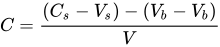
CALCULATIONS:
, mg/m³
EVALUATION OF METHOD:
This method was evaluated in July, 1976, over the range 0.02 to 3 mg per sample by laboratory testing with spiked filters. Precision and accuracy data are given on page 7900-1 [1].
REFERENCES:
[1] NIOSH Manual of Analytical Methods, 2nd. ed., V. 1, P&CAM 139, U.S. Department of Health, Education, and Welfare, Publ. (NIOSH) 77-157-A (1977).
[2] Criteria for a Recommended Standard...Occupational Exposure to Inorganic Arsenic, U.S. Department of Health, Education, and Welfare, Publ. (NIOSH) 75-149 (1975).
METHOD WRITTEN BY:
Mark Millson, NIOSH/DPSE.
NIOSH Manual of Analytical Methods (NMAM), Fourth Edition 8/15/94