230
the mathematical principles
[Book I.
the hyperbolic curve ab. And the chord ba being drawn, will inclose the area aba equal to the area sought ANB.
Example 2. If the centripetal force tending to the several particles of the sphere be reciprocally as the cube of the distance, or (which is the same thing) as that cube applied to any given plane; write  for V, and 2PS
  LD for PE²; and DN will become as
 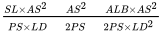 that is (because PS, AS, SI are continually proportional), as
 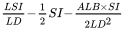 . If we draw then these three parts into the length AB, the first
  will generate the area of an hyperbola; the second ½SI the area ½AB SI; the third
  the area
 , that is, ½AB SI. From the first subduct the sum of the second and third, and there will remain ANB, the area sought. Whence arises this construction of the problem. At the points L, A, S, B, erect
 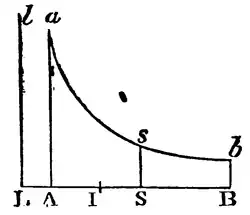 the perpendiculars Ll Aa Ss, Bb, of which suppose Ss equal to SI; and through the point s, to the asymptotes Ll, LB, describe the hyperbola asb meeting the perpendiculars Aa, Bb, in a and b; and the rectangle 2ASI, subducted from the hyberbolic area AasbB, will leave ANB the area sought.
Example 3. If the centripetal force tending to the several particles of the spheres decrease in a quadruplicate ratio of the distance from the particles; write  for V, then
  for PE, and DN will become as
  . These three parts drawn into the length AB, produce so many areas, viz.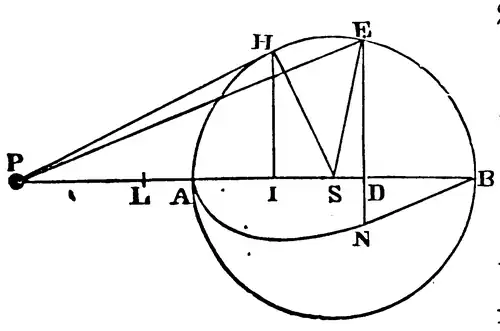
 into
into  ;
;  into
into  ; and
; and  into
into  . And these after due reduction come forth
  , SI², and SI² +