170
MR. W.H.L. RUSSELL ON THE THEORY OF DEFINITE INTEGRALS.
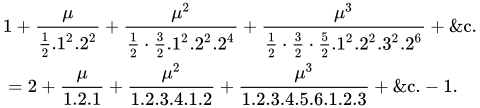
Again, from Laplace's theorem, we have

| where
|
 |
|
These theorems of course suppose the series from whence they were derived to be convergent.
As examples we may take the following.
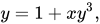
| Let
|
 |
|
| then
|
 |
|
![{\displaystyle =2\pi {\frac {d}{dx}}\left\{{\sqrt[{3}]{{\Biggl (}{\frac {1}{2x}}+{\sqrt {\left({\frac {1}{4x^{2}}}-{\frac {1}{27x^{3}}}\right)}}{\Biggr )}}}+{\sqrt[{3}]{{\Biggl (}{\frac {1}{2x}}-{\sqrt {\left({\frac {1}{4x^{2}}}-{\frac {1}{27x^{3}}}\right)}}{\Biggr )}}}\right\}.}](../_assets_/db6b8ca4642277e24bf325c25a7f562138fbb490.svg)
| Also let
|
 |
|
| then
|
 |
|
which we may modify thus; by eliminating 

Analogous methods apply to series involving Bernouilli's numbers; thus we have
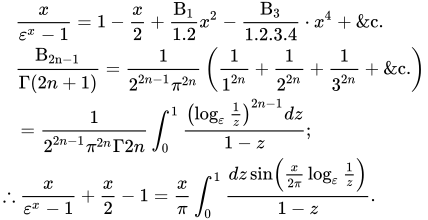
| Hence we have
|
 |
|
In this formula  must lie between 0 and 1, as it is necessary for the convergence of the above series that
  should be less than
  .
.
I now enter upon the consideration of the processes I have before mentioned for reducing multiple integrals to single ones. We easily see the truth of the following equation:—