mr. w.h.l. russell on the theory of definite integrals.
177
| Again, we have
|

|
|
We must transform the element  thus:
thus:

| Again,
|

|
|
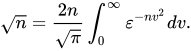
| Lastly,
|
|
|
Hence, combining these integrals together, and substituting for  as before, we are able to transform the above series into one which can be summed by the ordinary rules. The resulting definite integral will of course be equal to zero.
Cauchy has applied the methods of the residual calculus to the determination of the sum of the series whose general term is

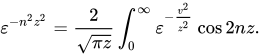
in finite terms. We may transform the element  thus:
thus:

| Again,
|
|
|
Wherefore, combining these integrals, and transforming the other elements as before, we may find its sum by means of definite integrals. We may resolve  into its partial fractions, and then find the sum of the series, which would be simpler.
The transformation of  which I have used above, is due to Professor Kummer, who has applied it in the seventeenth volume of Crelle's Journal, in a paper to
which I am indebted for many ideas relative to the connexion of definite integrals with series, to the expression of the series
which I have used above, is due to Professor Kummer, who has applied it in the seventeenth volume of Crelle's Journal, in a paper to
which I am indebted for many ideas relative to the connexion of definite integrals with series, to the expression of the series

and others of a similar nature by means of a definite integral. The integral 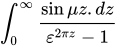 was first applied to the summation of series, whose terms involve elements of the form
  by Poisson in his Memoir on the Distribution of Electricity in two electrized spheres, which mutually act upon each other. He proves that the cal-