This page has been proofread, but needs to be validated.
November 25, 1914.]
PUNCH, OR THE LONDON CHARIVARI.
433
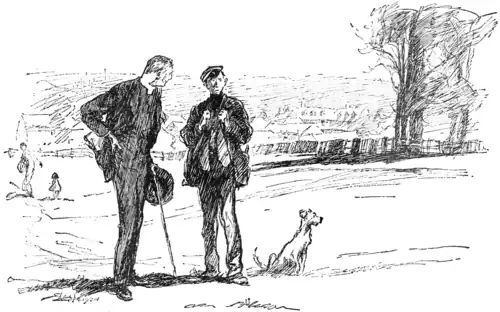
The Worst Character in the village (who has repeatedly been pressed by the inhabitants to enlist)."I dunna believe there ain't no war. I believe it's just a plot to get me out of the village."
"Here no howitzers speak in stern styles,Light and gay is the leathorn bomb,We pay our sixpences down at the turnstiles,And that is our centre, name of Tom;Wild thunder rollsWhen he scores his goals,And up in the air go Alf and Ern's tiles;But what is this rumour of war? Whence cometh it from?"
So said Bottlesham, best of citiesWatching the ball from seats above."Belgium ruined? A thousand pities!Bother the Kaiser's mailéd glove!"But it left no stingsWhen they heard these things,Though they wept as the brown bird weeps for ItysOn the day that the Wanderers whacked them two to love.
Suddenly then the news came flying,"English mariners meet the Dutch,Tars interned, with the neutrals vieing,Beaten at Gröningen." Wild hands clutchAt the evening sheetsAnd the swift pulse beats;Is the fame of Hawke and Frobisher dying?The heart of the town is stirred by the Nelson touch.
Six-five. It's true. And the tears bedizenThe smoke-stained cheeks, and there comes a scream,"If our English lads in a far-off prisonAre matched one day with a German teamAnd the Germans win,They will say in BerlinThat a brighter than all our stars has risen;Will even the Bottlesham Rovers stand supreme?
"Infantry, cavalry, guard and lancer—Who on that day will bear the brunt,With twinkling feet like a tip-toe dancerDribbling about while the half-backs grunt?There is only oneWho can vanquish the IIun!"And Bottlesham town with a cry made answer,"There is only one; we must send our Tom to the front."Evoe.
While much has been written of the songs that inspire our own brave troops on the march, little is heard of those affected by our Allies.
Happily Mr. Punch's Special Eye-witness with General Headquarters in the Eastern Area has been enabled to send us the words of a song which, set to an old Slav air, is rendered with immense élan by the gallant Russians as they go into battle. It is as follows:—
It's a hard nut is Cracow,It's a hard nut to crack,But it's not so hard to crack, oh!When once you've got the knack.Good-bye, Przemysl;Farewell, Lomborg (Lwow);It's a hard, hard nut to crack is Cracow,But we'll soon crack it now.
By the more cultured Russian regiments, i.e., those recruited in the neighbourhood of the German frontier, the last line is rendered:—
But we'll crack it right off,
to rhyme with Lvoff—the correct pronunciation Lwow, according to a contemporary.