Page:Punch Vol 148.djvu/146
to back her fanaticism, and Delia is a spirited handful of a ward. Loyalty to her consecration and to her friend outlast her belief in the methods of the revolting ones. Her defences are finally ruined by Cupid, for Mark is a handsome athletic man of forty or so, a paragon of knightly courtesy and persuasive speech and silences, and compares very favourably with the policemen in Parliament Square. Poor Gertrude makes a tragic end in a fire of her own kindling, so that the moral for the younger generation cannot be said to be set forth in ambiguous terms.
Arundel (Fisher Unwin) is one of those stories that begins with a Prologue; and as this was only mildly interesting I began to wonder whether I was going to be as richly entertained as one has by now a right to expect from Mr. E. F. Benson. But it appeared that, like a cunning dramatist, he was only waiting till the audience had settled into their seats; when this was done, up went the curtain upon the play proper, and we were introduced to Arundel itself, an abode of such unmixed and giddy joy that I have been chortling over the memory of it ever since. Arundel was the house at Heathmoor where lived Mrs. Hancock and her daughter Edith; and Mrs. Hancock herself, and her house and her neighbourhood and her car and her servants and her friends—all, in fact, that is hers, epitomize the Higher Suburbia with a delicate and merciless satire that is beyond praise. I shall hurry over the actual story, because that, though well and absorbingly told, is of less value than the setting. Next door to the Hancocks lived a blameless young man called Edward, whom for many reasons, not least because their croquet-lawns, so to speak, "marched," Mrs. Hancock had chosen as her daughter's husband. So blamelessly, almost without emotion, these were betrothed, walking among the asparagus beds on a suitable May afternoon "ventilated by a breath of south-west wind and warmed by a summer sun," and the course of their placid affection would have run smooth enough but for the sudden arrival, out of the Prologue, of Elizabeth, fiercely alive and compelling, the ideal of poor Edward's dreams. Naturally, therefore, there is the devil to pay. But, good as all this is, it is Mrs. Hancock who makes the book, first, last and all the time. She is a gem of purest ray serene, and my words that would praise her are impotent things. Only unlimited quotation could do justice to her sleek self-deception and little comfortable meannesses. In short, as a contemporary portrait, the mistress of Arundel seems to be the best thing that Mr. Benson has yet given us; worth—if he will allow me to say so—a whole race of Dodos. For comparison one turns instinctively to Jane Austen; and I can sound no higher praise.
Love never seems to run a smooth course for girls of the name of Joan; their affairs of heart, whatever the final issue may be, have complex beginnings and make difficult, at times dismal, progress. I attribute the rejection of the great novel of my youth to the fact that the heroine, a rosy-cheeked girl with no more serious problems in life than the organisation of mixed hockey matches, was ineptly given that unhappy name. Miss Mary Agnes Hamilton's Joan Traquair is true to the type. From the start she is handicapped by a bullying father, an invalid sister, a lack of means and an excess of artistic temperament, the last of these being not just a casual tendency to picture galleries and the opera, but the kind of restless passion which causes people to prefer sunsets to meals and to neglect their dress. In due course she falls in love with a man called Sebastian, another name which, if less familiar, is yet a sufficient warning to the world that its owner is bound to be a nuisance on the hearth. This Sebastian was an artist, ambitious and of course poor; worse, he had a touch of genius and—worst of all—he knew it. Nevertheless Joan became his wife, supposing that this was just the sort of man to make her happy. Instead, he made her thoroughly miserable, at any rate for a good long time; but I doubt if any reader, even with all the facts before him, will anticipate exactly how he did it. I certainly didn't myself, although I feel now that I ought to have done. The point of Yes (Heinemann) is both new and true; I recommend the book with confidence to all interested in the Joans and Sebastians of this world.
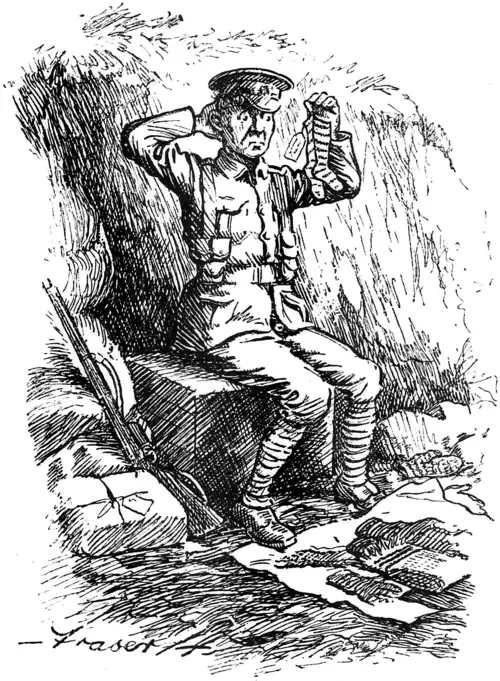
Our Cheery Allies.
A letter from a Japanese firm:—
"Dear Sirs,—Since writing you last we have no favours to acknowledge, however, we are pleased to enter into business relation with your respectable firm. We were delighted that the Allies always behaved bravely in the recent battle and now are in the very favourable condition. Our army took the possetion of Tsingtau and our only hope remaindered is to hear the annihiration of the enemy force. We trust the Allies will beat the Enemy in near future though we cannot assert the time. If there are any samples of Japanese goods as substitute of German's, kindly let us know, and we shall send the same as soon as possible."
ENCYCLOPAEDIA GERMANICA.