This page has been proofread, but needs to be validated.
__
PUNCH, OR THE LONDON CHARIVARI.
__
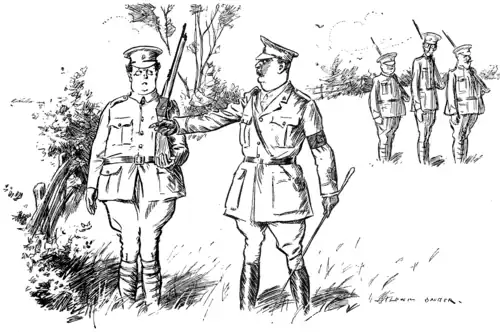
A FIELD DAY WITH OUR VOLUNTEERS.
Officer (who has not lunched)."Now, Sir, you've got to stand here and keep a sharp look-out all over the country. But you're on no account to see the enemy till half-past two."
THE WOODS OF FRANCE.
Midsummer, 1915.
Not this year will the hamadryads singThe old-time songs of Arcady that ranDown the Lycæan glades; the joyous ringOf satyr dancers call away their clan;Not this year follow on the ripened SpringThe Summer pipes of Pan.
Cometh a time―as times have come before―When the loud legions rushing in array,The flying bullet and the cannon roar,Scatter the Forest Folk in pale dismayTo hie them far from their green dancing floorAnd wait a happier day.
Yet think not that your Forest Folk are dead;To this old haunt, when friend has vanquished foe,They will return anon with lightsome treadAnd labour that this place they love and know,All broken now and bruised, may raise its headAnd still in beauty grow.
Wherefore they wait the coming of good timeIn the green English woods down Henley way,In meadows where the tall cathedrals chime,Or watching from the white St. Margaret's Bay,Or North among the heather hills that climbAbove the Tweed and Tay.
And you, our fighters in the woods of France,Take heart and smite their enemy, the Hun,Who knows not Arcady, by whom the danceOf fauns is scattered, at whose deeds the sunHides in despair; strike boldly and perchanceThe work will soon be done.
To you, so fighting, messengers will bringThe comfort of quiet places; in the dinOf battle you shall hear the murmuringOf the home winds and waters; there will winThrough to your hearts the word, "Still Pan is king;His Midsummner is in."
A Little Learning.
"A Wozzleite's 'Neugma.'―Apropos of our recent 'Turnover' by 'A Wozzleite' a correspondent writes: Lest any of your readers should need a bit of hustling as regards their 'Humanities,' I may point out that there is a pretty instance of what grammarians call 'Neugma' in what 'A Wozzleite' wrote about Mr. Johnson: 'The Secretary was Mr. Johnson, our organist, who is always ready to accompany anything, from "God Save the King" to the young
ladies home from the choral class.'
'Neugma' is when one meaning of a word is made to accompany another meaning. It is a playful practice indulged in by Virgil (Aen vi., 680, 682, and 683), and very frequently by Thomas Hood and Captain Basil Hood."―The Globe.
It seems to us that the correspondent and the printer between them have rather over hustled the Humanities. Zeugma we know, and also Syllepsis, but what is "Neugma"?