Page:Rolland - Beethoven, tr. Hull, 1927.pdf/143
This page has been proofread, but needs to be validated.
THE NINE SYMPHONIES
111
subject is much firmer and the subjects themselves are more striking.

The Larghetto is full of lovely curves,
![\new GrandStaff <<
\new Staff {
\tempo Larghetto
\clef violin
\key a \major
\time 3/8
<cis' e'>8 \p
(<e' a'>8
<e'~ gis' b'>8)
<< <a' cis''>4. {e'4 r8}>>
|
<<
\new Voice { \voiceOne \trill cis''8 e''16. d''32 cis''8 }
\new Voice { \voiceTwo r8 b' cis''8 }
>>
|
<gis' b'>4.
}
\new Staff {
\clef bass
\key a \major
\time 3/8
<<
\new Voice { \voiceOne [a8 cis'8 r8]}
\new Voice { \voiceTwo a4.}
>>
a8 (cis'8 e'8)
a'8 (gis'8 a'8)
e'8 (dis'8 d'8)
}
>>](../_assets_/edc6da1496c0c06a247e34b8bae818c9.png)
and there is some charming conversational work between the wood-wind instruments. The horn passage is the precursor of many fine symphony subjects of a martial nature for the horns.
Whilst the chromatic harmony is purely Mo-zartian, the Scherzo is a genuine Beethovenian outburst, full of verve and piquant in touch.
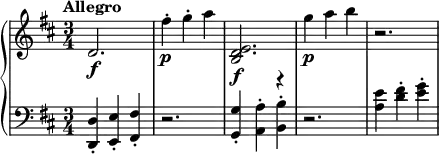
There is a feeling of broadness about the brilli-ant and energetic Finale which is absent from the Finale of the First Symphony.