Page:Rolland - Beethoven, tr. Hull, 1927.pdf/147

This page has been proofread, but needs to be validated.
THE NINE SYMPHONIES
115

bass. It is not until the close, after the melody has been given at a slow rate on the wood-wind in its proper setting, that it is taken up triumphantly and carried victoriously into the coda. Beethoven used this particular theme four times—in a Contretanz, in his Finale to the Men of Prometheus, as the theme for his set of variations for piano, Opus 35 and in this Symphony. This curious method of writing a set of variations recurs 20 years later in the Ninth Symphony. A somewhat similar process has been adopted by Elgar in his Enigma Variations, as the theme used there is said to be the counter-subject of a concealed melody.

4th Symphony in B flat, Opus 60..

Dedicated to Count Oppensdorf.

Adagio—Allegro vivace—Adagio—Menuetto—Finale.

This happy and serene work has been undeservedly overshadowed by its two towering neighbours. Schumann has called it a slender Greek maiden between two Norse giants. The opening Adagio sounds the only dark mood in the Symphony
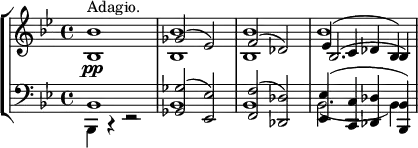

\new StaffGroup <<
\new Staff = "right" {
        \key bes \major
        \time 4/4
        <bes bes'>1^\markup{Adagio.} \pp
        <<
                \new Voice { \voiceTwo <bes bes'>1}
                \new Voice { \voiceOne (ges'2 es'2)}
        >>
        <<
                \new Voice { \voiceTwo <bes bes'>1}
                \new Voice { \voiceOne (f'2 des'2)}
        >>
        <<
                \new Voice { \voiceTwo bes'1}
                \new Voice { \voiceOne (es'4 c'4 des'4 bes4)}
                \new Voice { \voiceThree (bes2. bes4)}
        >>
}
\new Staff ="left" {
        \clef bass
        \key bes \major
        \time 4/4
        <<
                \new Voice { \voiceOne bes,1}
                \new Voice { \voiceTwo bes,,4 r4 r2}
        >>
        <<
                \new Voice { \voiceTwo bes,1}
                \new Voice { \voiceOne (<ges ges,>2) (<es es,>2)}
        >>
        <<
                \new Voice { \voiceTwo bes,1}
                \new Voice { \voiceOne (<f f,>2) (<des des,>2)}
        >>
        <<
                \new Voice { \voiceOne (<es es,>4 <c c,>4 <des des,>4 <bes, bes,,>4)}
                \new Voice { \voiceTwo (bes,2. bes,4)}
        >>
}
>>