Page:Rolland - Beethoven, tr. Hull, 1927.pdf/156
This page has been proofread, but needs to be validated.
124
BEETHOVEN


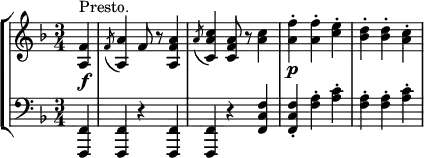
\new StaffGroup <<
\new Staff = "right" {
        \key f \major
        \time 3/4
        \partial 4
        <a f'>4^\markup{Presto.} \f
        |
        \acciaccatura f'8 <a' a>4
        f'8
        r8
        <a f'a'>4
        |
        \acciaccatura a'8 <c' a' c''>4
        <c' f' a'>8
        r8
        <a' c''>4
        |
        <a' f''>4\staccato \p
        <a' f''>4\staccato
        <c'' e''>4\staccato
        |
        <bes' d''>4\staccato
        <bes' d''>4\staccato
        <a' c''>4\staccato
}
\new Staff ="left" {
        \clef bass
        \key f \major
        \time 3/4
        \partial 4
        <f,, f,>4
        |
        <f,, f,>4
        r4
        <f,, f,>4
        |
        <f,, f,>4
        r4
        <f, c f>4
        |
        <f, c f>4 \staccato
        <f a>4 \staccato
        <a c'>4 \staccato
        |
        <f a>4 \staccato
        <f a>4 \staccato
        <a c'>4 \staccato
}
>>

making it a kind of Rondo—A, B, A, B, A—to say nothing of the humorous juxta-position of the two subjects near the end.

The Finale is also planned on the big scale, colossal in force and mighty in stride. There is a curious perversity of scale in the First Subject as though Beethoven was no longer satisfied with the ordinary major. The marvellous stride of the Bass at the end is not the least amazing of the features in this wonderful movement. Perhaps, this symphony holds together as one complete whole more than any other. It gives one the impression of having been written uninterruptedly from the first movement to last.

8th Symphony, in F major, Opus 93.

Allegro vivace e con brio—Allegretto—Presto—Allegro vivace.

"The little one," as Beethoven affectionately called this symphony, was written during four