88
EQUILIBRIUM OF HETEROGENEOUS SUBSTANCES.
If we differentiate (93) in the most general manner, and compare the result with (86), we obtain

|
(97)
|
or
|
(98)
|
Hence, there is a relation between the  quantities
  , which, if known, will enable us to find in terms of these quantities all the ratios of the quantities
  . With (93), this will make
  independent relations between the same
  variables as at first.
Any equation, therefore, between the quantities
    
|
(99)
|
or 
|
(100)
|
or 
|
(101)
|
or
|
(102)
|
or 
|
(103)
|
is a fundamental equation, and any such is entirely equivalent to any other.[1] For any homogeneous mass whatever, considered (in general) as variable in composition, in quantity, and in thermodynamic state, and having  independently variable components, to which the subscript numerals refer (but not excluding the case in which
  and the composition of the body is invariable), there is a relation between the quantities enumerated in any one of the above sets, from which, if known, with the aid only of general principles and relations, we may deduce all the relations subsisting for such a mass between the quantities
  . It will be observed that, besides the equations which define
  , and
, and  , there is one finite equation, (93), which subsists between these quantities independently of the form of the fundamental equation.
- ↑ The distinction between equations which are, and which are not, fundamental, in the sense in which the word is here used, may be illustrated by comparing an equation
between

with one between

As, by (86)
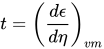
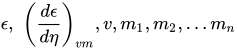
|
|
is equivalent to one between
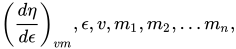
 in terms of the other variables.