EQUILIBRIUM OF HETEROGENEOUS SUBSTANCES.
205
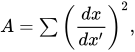
|
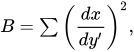
|
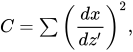
|
(418)
|
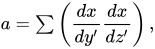
|
|
|
(419)
|
The determination of the fundamental equation for a solid is thus reduced to the determination of the relation between  or of the relation between
  .
.
In the case of isotropic solids, the state of strain of an element, so far as it can affect the relation of  and
and  or of
or of  and
and  , is capable of only three independent variations. This appears most distinctly as a consequence of the proposition that for any given strain of an element there are three lines in the element which are at right angles to one another both in its unstrained and in its strained state. If the unstrained element is isotropic, the ratios of elongation for these three lines must with determine the value , or with determine the value of .
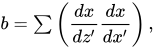
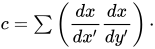
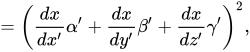
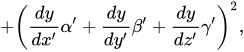
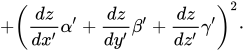
To demonstrate the existence of such lines, which are called the principal axes of strain, and to find the relations of the elongations of such lines to the quantities  , we may proceed as follows. The ratio of elongation
  of any line of which
  are the direction-cosines in the state of reference is evidently given by the equation
 |
|
|
|
|
|
Now the proposition to be established is evidently equivalent to this—that it is always possible to give such directions to the two systems of rectangular axes  , and
, and  , that
 |
 |
 |
 (421) (421)
|
 |
 |

|
We may choose a line in the element for which the value of is at least as great as for any other, and make the axes of  and
and  parallel to this line in the strained and unstrained states respectively.
Then

(422)