EQUILIBRIUM OF HETEROGENEOUS SUBSTANCES.
235
where the symbols  , etc., are used for greater distinctness to denote the values of
  , etc., as determined by a dividing surface placed so that
  . Now we may consider all the differentials in the second member of this equation as independent, without violating the condition that the surface shall remain plane, i.e., that
  . This appears at once from the values of
  and
and  given by equation (98). Moreover, as has already been observed, when the fundamental equations of the two homogeneous masses are known, the equation
  affords a relation between the quantities
  , etc. Hence, when the value of
  is also known for plane surfaces in terms of , etc., we can eliminate
  from this expression by means of the relation derived from the equality of pressures, and obtain the value of for plane surfaces in terms of
  , etc. From this, by differentiation, we may obtain directly the values of
  , etc., in terms of , etc. This would be a convenient form of the fundamental equation. But, if the elimination of
  , and from the finite equations presents algebraic difficulties, we can in all cases easily eliminate
  from the corresponding differential equations and thus obtain a differential equation from which the values of , etc., in terms of , etc., may be at once obtained by comparison with (514).[1]
- ↑ If liquid mercury meets the mixed vapors of water and mercury in a plane surface, and we use and
 to denote the potentials of mercury and water respectively, and place the dividing surface so that , i.e., so that the total quantity of mercury is the same as if the liquid mercury reached this surface on one side and the mercury vapor on the other without change of density on either side, then
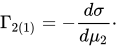
  will represent the amount of water in the vicinity of this surface, per unit of surface, above that which there would be, if the water- vapor just reached the surface without change of density, and this quantity (which we may call the quantity of water condensed upon the surface of the mercury) will be determined by the equation
|
|
(In this differential coefficient as well as the following, the temperature is supposed to remain constant and the surface of discontinuity plane. Practically, the latter condition may be regarded as fulfilled in the case of any ordinary curvatures.)
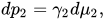
If the pressure in the mixed vapors conforms to the law of Dalton (see pp. 155, 157), we shall have for constant temperature
|
|
where  denotes the part of the pressure in the vapor due to the water-vapor, and
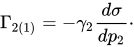
  the density of the water-vapor. Hence we obtain
|
|
For temperatures below 100° centigrade, this will certainly be accurate, since the pressure due to the vapor of mercury may be neglected.
The value of for  and the temperature of 20° centigrade must be nearly the same as the superficial tension of mercury in contact with air, or 55.03 grammes per linear meter according to Quincke (Pogg. Ann., Bd. 139, p. 27). The value of at the same temperature, when the condensed water begins to have the properties of water