UNPUBLISHED FRAGMENTS.
427
In the above case of dissociation the formula would be

|
|
For a coexistent solid phase of the solvent we have for constant pressure


|
|
 being for convenience taken the same in both phases.
Then
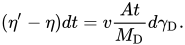
In integrating for small values of  we may treat the coefficients of
  and
and  as constant. This gives

|
|
or if we write  for (the latent heat of melting for the unit of weight of the solvent), we have
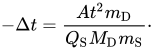
|
|
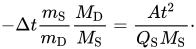
This may be written
|
|
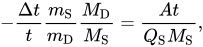
According to Raoult, the first member of this equation has a value nearly identical for all solvents and solutes (supposed definite compounds). This would make the second member the same for all liquids of "definite" composition, when we give  the value for the molecule in the liquid state. I should think it more likely that these properties should hold for the two members of the equation
|
|
which are pure numbers (of no dimensions in physical units). In this form it has a certain analogy with van der Waals' law of "corresponding states."
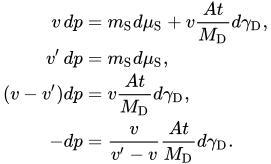
With a coexistent vapor phase of the solvent, we have
|
|