428
UNPUBLISHED FRAGMENTS.
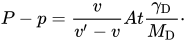
We may regard  as constant in integrating (for small
  ), which gives
|
|
Now
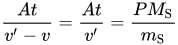
nearly, which gives
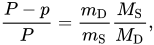
which is Raoult's Law.
Raoult found values about 5 per cent, larger than this, which agrees very well with the fact that  is somewhat larger than
  It is also to be observed that
  relates to the molecules in the solution, but
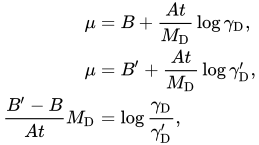
  to the molecules in the vapor. Or, with a coexistent vapor phase of the solutum (alone or mixed with other vapors or gases), we have
|
|
which makes  constant for the same solvent, solutum, and temperature, according to Henry's Law.
So for the galvanic cell which you first consider, I should write

|
|
 being the densities, supposed small, of the cation (a) in the two electrodes, which are supposed identical except for the dissolved (a). Here
  has reference to the solution and
  to the electrodes. It may be more convenient to divide a a into the factors
  , where
  is the weight of hydrogen which carries the unit of electricity, and
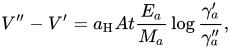
  the weight of (a) which carries the same quantity of electricity as the unit of weight of hydrogen. In other words is Faraday's "electrochemical equivalent" and is Maxwell's "electrochemical equivalent." This gives
|
|
where  is your
  and
and  your
your  [1]
[1]
- ↑ [The valence of the ion].