Page:St. Nicholas, vol. 40.1 (1912-1913).djvu/792
common desire to build a fire. The girls stand in a circle around the gathered fagots, hold their hands aloft, and repeat the fire-maker’s desire:
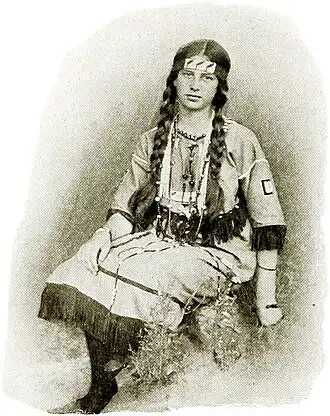
A TYPICAL CAMP-FIRE GIRL AND HER COSTUME.
She is now next to the Guardian, and must be trustworthy, happy, unselfish, a good leader, a good “team worker,” and liked by the other girls. There is one pretty symbolism in the building of the fire that not only brings to us the picturesque primitive methods of the Indians, but carries a lesson with it. The fire, as the instruction book says, “may be started with matches, but better still it may be started with the rubbing of sticks. If directions are carefully followed, it is not difficult to learn this method of starting a fire.” The management wisely recommends this Indian method, which not only takes the girls and the bystanders back to primitive days, but impresses this important lesson: do not wait to be led; do not wait for somebody to inspire you. Create your own original fire of enthusiasm. There are many young people, and older ones too, I fear, who are ready to follow, but slow to originate. They wait till somebody else coaxes and urges or inspires them. This is not the best method. The fire of enthusiasm should be developed by one’s own personal efforts. It is, therefore, wisely directed that this fire in the woods of the Camp- Fire Girls shall, if possible, be started by individual effort, not with borrowed fire or even with matches, for that symbolizes some one else’s work. But what, after all, is the ardor of enthusiasm worth if it does not lead to loftier, spiritual ideals? So the ode sung by the girls standing around the fire leads their thoughts to the Infinite.
After roll-call, reports, bestowing of honors, initiation of new members, songs, toasts, or any other part of the program, the girls rise and repeat in unison: