Page:St. Nicholas (serial) (IA stnicholasserial321dodg).pdf/251
and Gladys E. Chamberlain (age 14), 825 Congress St., Portland, Me.
Wild Animal and Bird Photography. First prize “Elk,” by Harold G. Simpson (age 14), 135 Lynda Ave., N., Minneapolis, Minn. Second prize, “Deer”, by Sidney Gamble (age 14), 521 Glenwood Ave., Cincinnati, Ohio. Third prize, “Blue Heron,” by Lawrence Sherman (age 15), 104 Cleveland St., Orange, N. J.
Puzzle-making. Gold badges, Nell G. Semlinger (age 17), 320 North St., San Antonio, Tex., and George H. Chapin (age 16), 26 Laurel Ave., St. Paul, Minn.
Silver badges, Clara Beth Haven (age 15), 162 Main St., Watertown, N. Y., and Elinor Townsend (age 10), Bolivar, Mo.
Puzzle-answers. Gold badges, Mary Ruth Hutchinson (age 17), 412 Gunnison St., Burlington, Ia., and Helen Hoag, 2140 Collinwood Ave., Toledo, Ohio.
Silver badges, Harriet Bingaman (age 15), 704 Chestnut Ave,, Altoona, Pa., and Nettie C. Barnwell (age 15), 213 Grand Ave., Yazoo City, Miss.
THE REWARD OF THE WEST.
By Margaret Minaker (age 16).
(Cash Prize.)
AN EPISODE OF RUSSIAN HISTORY.
By Robert Walsh (age 14).
(Gold Badge.)
One cold morning, during the time when Napoleon made his unsuccessful expedition into Russia, the landlord of the inn of a small village near Moscow was commanded to bring a good meal to three young flippant French officers, evidently brothers. Complying with this request, he soon appeared with a japanned waiter on which he bore a dozen steaming sausages, some potatoes, and s portion of rye bread.
At the sausages the Frenchmen sneered, at the potatoes scowled, and as for the rye bread, one of them took it up aad threw it in a corner, upon which the impudent trio left the hostelry with a most contemptuous look on their countenances.
The innkeeper was very angry, but he took the sausages and potatoes back to the cook, and the bread he placed in a near-by closet.
Who has not heard of the awful disasters that happened to Napoleon’s Grand Army at Moscow? When they arrived there they found a destitute city, which the Russians had burned rather than leave it to the French for winter quarters. Napoleon had nothing to do but retreat; this was the greatest of all disasters. It was marked by a continuous line of dead, which the ghouls robbed, the ravens picked at, while wolves ate, rather than drank, the frozen blood. Thousands were drowned fording rivers. During all this while the indefatigable Cossacks harassed the flanks, and it is said that Ney’s rear-guard was reduced from thirty thousand to thirty men. And yet their worst suffering was said to be the taunt of the enemy: “Could not the French find graves at home?”
A man in ragged uniform tottered up to the landlord with whom our story begins, and with these words fell at his feet exhausted: “Moscow burned—brothers killed—food!”
He was resuscitated, and as his wild eyes met the rye bread he had but a few days since cast aside, he clutched and ate it; and after a good meal the lieutenant of Napoleon marched on, a sadder and wiser man.
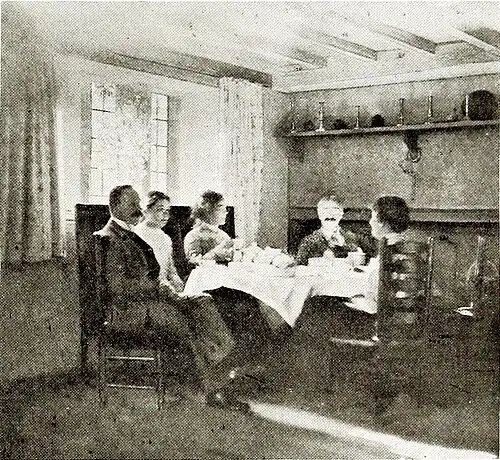
“Home Again.” by Phyllis B. Mudie-Cooke, Age 16. (Gold Badge)
CHARITY’S REWARD.
By Lucille D. Woodling (age 12).
(Gold Badge.)