Page:St. Nicholas (serial) (IA stnicholasserial321dodg).pdf/497
question. We know that lightning goes in its path both ways. It may go both ways at once, or one way closely following the other way. We do not know exactly how, but we do know that the lightning presses the air aside, and the instantaneous waves of air rush to the earth and give us the sensation which we call thunder. If there are a number of discharges of lightning in succession we would have a “roll” of thunder. If but a single discharge the result is a “peal” of thunder. Often the waves of sound strike against a cloud and bound back and help to prolong the noise. These sounds are merely echoes.
The lighting reaches the eye first, as light travels 186,000 miles a second; but thunder is a slow traveler, and travels only about 1120 feet a second, So we need never be afraid of thunder, since it consists of harmless air waves. The danger has long since passed when we hear the noise.
Queer Experience with a Rattlesnake.
Phœnix, Ariz.
Dear St. Nicholas: We are living in the desert several miles from the city, and are much interested in the animals which live around. A curious incident mace us take especial interest in rattlesnakes.
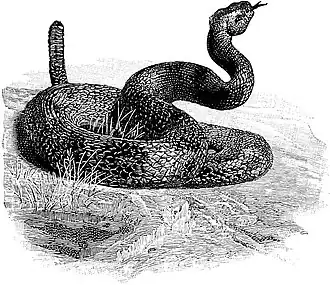
A Rattle Snake Coiled to Strike.
One day papa killed a small one nearly a mile from here. It was from fifteen to eighteen inches long, and had twelve rattles. It was sluggish, and tried only to get away, In talking about it, papa remarked that there was an old superstition that a rattlesnake would hunt the slayer of its mate.
Some time after papa found another snake, close to the porch. When it saw papa, it sprang from the ground up on to the porch, an inch or so above the ground, and began to fight. It struck savagely, and made no effort to get away, but fought until papa killed it. It was about the same size as the other, but had only seven rattles.
Now, we would like to know whether there is any truth in the old superstition I mentioned. If not, why should that snake fight, and all others run away? For papa killed one a short time ago by the house, but it tried its best to escape. I should also like to know whether you can tell a snake’s age by the number of rattles, or whether they lose their rattles when they shed their skin.
Your loving reader,
Your loving reAlberta Cowgill.
There is no truth in the superstition that rattlesnakes will hunt the slayers of their mates. Occasionally, two snakes may be discovered in the same locality, but the killing of one and the subsequent discovery of the other is most incidental. The temper of individual snakes varies greatly. This has been observed by the writer in the capture of large numbers of poisonous serpents. Some captive specimens are always ugly, some are only occasionally vicious, whiles others never show signs of hostile temper. The explanation concerning the hostile attitude of the second snake mentioned in the letter is that it happened simply to be an aged specimen.
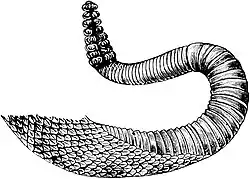
Tail of Rattlesnake..
(Shows rattle with several “rings” and a “button.”)
It is impossible to tell a snake's exact age by the number of “rattles.” From two to three joints of the rattle are grown every year, and after the rattle has attained about eleven rings, about two or three are lost every year, owing to wear. Each time the skin is shed,[1] a new ring of the rattle is uncovered or added.
Raymond L. Ditmars,
RaymCurator of Reptiles.
New York Zoölogical Park.
- ↑ The skins are cast off at least twice every year.