Page:The New England Magazine 1891, 5.1.djvu/7
the merriment. He soon became resident magistrate, and signalized his authority by giving for three years certain wild lands as commons for cattle to those who should belong to the "Church Episcopal Congregation," when formed. The lease was duly signed by himself and by John Farmer, in trust for the people. Such privilege, even if actuated by worldly motives, proved of sacred benefit, for measures were immediately taken to form a Church Association and Corporation, with the proviso that such persons as had decided objections to profess themselves members of the church could by no means become a part of such corporation. The admiral's cattle ranged free in the commons, but on all other licensed and marked cattle were paid the fees which accrued to the benefit of religion,—and large must have been the income thereof,—Owen reading the church services till 1842, when a resident missionary came to live on the island.
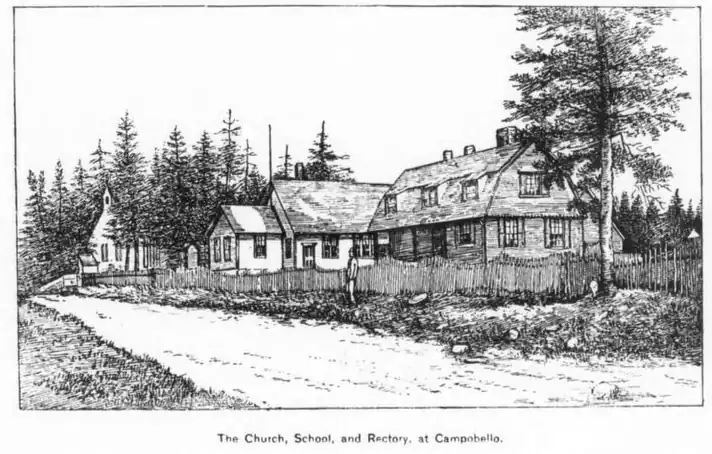
The Church, School, and Rectory, at Campobello.
The church having been fairly established and on the way to growth, Admiral Owen became a builder of bridges, letting out the work at the rate of "$1.12½ per man, per day, the day being ten hours of good and conscientious work for man or yoke of oxen."
With all this progress under William Fitz-William, there still remained unlicensed boys who ran wild, who believed in the uncounted wealth of an iron chest buried deep in the woods by smugglers, and gave their help in finding it. If the chest were ever hidden, it disappeared in uncanny fashion; but the cannon on the hill still remained as sentinels, until some boys took them off "for fun" one dark night and hid them in a ship then in Friar's Bay. 'The captain discovered the theft after he had been two or three days at sea. His honesty and Admiral Owen's anger effected their return after a few months; for the vessel had to bear them to the West Indies and there re-ship them, amid kegs of rum, to Campobello. By that time the admiral's indignation had subsided, and he sent his son-in-law to apologize to the grandmother of the boys, whom he had maligned as special emissaries of Satan. The old lady refused to accept any regrets or apologies. Owen became more indignant than ever at her scornful words, and planted the cannon away from the hill overlooking her house, down on the point of land by his own home, and raised the British flag between them. His children and grandchildren played around them. There