Page:The Strand Magazine (Volume 8).djvu/155
Martin Hewitt, Investigator.
By Arthur Morrison.
VI.—The Stanway Cameo Mystery
 t is now a fair number of years back since the loss of the famous Stanway Cameo made its sensation, and the only a person who had the least interest in keeping the real facts of the case secret has now been dead for some time, leaving neither relatives nor other representatives. Therefore no harm will be done in making the inner history of the case public; on the contrary, it will afford an opportunity of vindicating the professional reputation of Hewitt, who is supposed to have completely failed to make anything of the mystery surrounding the case. At the present time connoisseurs in ancient objects of art are often heard regretfully to wonder whether the wonderful cameo—so suddenly discovered and so quickly stolen—will ever again be visible to the public eye. Now this question need be asked no longer.
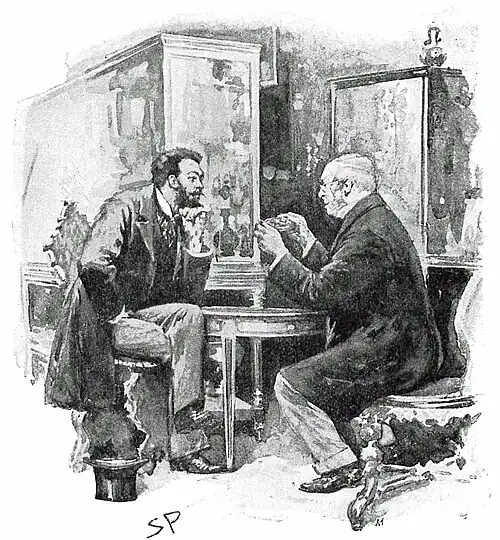
Mr. Claridge.
The cameo, as may be remembered from the many descriptions published at the time, was said to be absolutely the finest extant. It was a sardonyx of three strata—one of those rare sardonyx cameos in which it has been possible for the artist to avail himself of three different colours of superimposed stone—the lowest for the ground and the two others for the middle and high relief of the design. In size it was, for a cameo, immense, measuring seven and a half inches by nearly six. In subject it was similar to the renowned Gonzaga Cameo—now the property of the Czar of Russia—a male and a female head with Imperial insignia; but in this case supposed to represent Tiberius Claudius and Messalina. Experts considered it probably to be the work of Athenion, a famous gem-cutter of the first Christian century, whose most notable other work now extant is a smaller cameo, with a mythological subject, preserved in the Vatican.
The Stanway Cameo had been discovered in an obscure Italian village by one of those travelling agents who scour all Europe for valuable antiquities and objects of art. This man had hurried immediately to London with his prize and sold it to Mr. Claridge, of St. James's Street, eminent as a dealer in such objects. Mr. Claridge, recognising the importance and value of the article, lost no opportunity of making its existence known, and very soon the Claudius Cameo, as it was at first usually called, was as famous as any in the world. Many experts in ancient art examined it, and several large bids were made for its purchase. In the end it was bought