Page:The Strand Magazine (Volume 8).djvu/156
by the Marquis of Stanway for £5,000 for the purpose of presentation to the British Museum. The Marquis kept the cameo at his town house for a few days, showing it to his friends, and then returned it to Mr. Claridge to be finally and carefully cleaned before passing into the national collection. Two nights after, Mr. Claridge's premises were broken into and the cameo stolen.
Such, in outline, was the generally known history of the Stanway Cameo. The circumstances of the burglary in detail were these: Mr. Claridge had himself been the last to leave the premises at about eight in the evening, at dusk, and had locked the small side door as usual. His assistant, Mr. Cutler, had left an hour and a half earlier. When Mr. Claridge left everything was in order, and the policeman on fixed point duty just opposite, who bade Mr. Claridge good evening as he left, saw nothing suspicious during the rest of his term of duty, nor did his successors at the point throughout the night.
In the morning, however, Mr. Cutler, the assistant, who arrived first, soon after nine o'clock, at once perceived that something unlooked-for had happened. The door, of which he had a key, was still fastened, and had not been touched; but in the room behind the shop Mr. Claridge's private desk had been broken open, and the contents turned out in confusion. The door leading on to the staircase had also been forced. Proceeding up the stairs, Mr. Cutler found another door open, leading from the top landing to a small room—this door had been opened by the simple expedient of unscrewing and taking off the lock, which had been on the inside. In the ceiling of this room was a trapdoor, and this was six or eight inches open, the edge resting on the half-wrenched-off bolt, which had been torn away when the trap was levered open from the outside.
Plainly, then, this was the path of the thief or thieves. Entrance had been made through the trap-door, two more doors had been opened, and then the desk had been ransacked. Mr. Cutler afterwards explained that at this time he had no precise idea what had been stolen, and did not know where the cameo had been left on the previous evening. Mr. Claridge had himself undertaken the cleaning and had been engaged on it, the assistant said, when he left.
There was no doubt, however, after Mr. Claridge's arrival at ten o'clock: the cameo was gone. Mr. Claridge, utterly confounded at his loss, explained incoherently, and with curses on his own carelessness, that he had locked the precious article in his desk on relinquishing work on it the previous evening, feeling rather tired and not taking the trouble to carry it as far as the safe in another part of the house.
The police were sent for at once, of course, and every investigation made, Mr. Claridge offering a reward of £500 for the recovery of the cameo. The affair was scribbled of at large in the earliest editions of the evening papers, and by noon all the world was aware 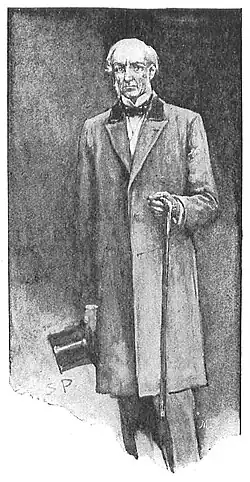
Lord Stanway. of the extraordinary theft of the Stanway Cameo, and many people were discussing the probabilities of the case, with very indistinct ideas of what a sardonyx cameo precisely was.
It was in the afternoon of this day that Lord Stanway called on Martin Hewitt. The Marquis was a tall, upstanding man of spare figure and active habits, well known as a member of learned societies and a great patron of art. He hurried into Hewitt's private room as soon as his name had been announced, and, as soon as Hewitt had given him a chair, plunged into business.
"Probably you already guess my business with you, Mr. Hewitt—you have seen the early evening papers? Just so; then I needn't tell you again what you already know. My cameo is