Punch/Volume 148/Issue 3849
CHARIVARIA.
"The Kaiser," says Professor Lasson, "is as innocent of this War as a little babe." This is the unkindest remark about infants that we have ever encountered.
⁂
Germany is reported to be greatly incensed at our offering only £10 apiece for the return of the two German officers who escaped from the concentration camp in Denbighshire.
⁂
The Press Bureau has issued a communiqué as to what articles may be sent to British prisoners in Germany. We understand that, in addition to those specified, the German Government has no objection to gold and copper being sent in small or even large quantities.
⁂
We learn from an interview that Professor Haeckel, of Jena, is especially angry with us, because we have put Germany to the inconvenience of having to face three fronts. She could have managed two easily, but she was never more than double-faced.
⁂
In a letter from the Front, an English soldier mentions that one day he found that some of his chums had been using his Insect Powder with their steak under the impression that pepper. They suffered no ill effects from it; but this vermindestroyer would without doubt have killed most Prussians.
⁂
The lonely soldier who advertised for correspondents and received, three days later, 3,000 letters, has come to the conclusion that there are worse things than loneliness.
⁂
"Which are the most abused words in journalism?" asks The Observer. We do not know about the others, but "Kaiser" seems to us to come in for a fair share of vituperation.
⁂
Lord Derby, it is stated, has outlined a scheme for a dock labourers' battalion of the Liverpool Regiment, to be formed on trade union lines. The difficulty will be to get the enemy to agree that no battle shall last longer than eight hours.
⁂
Further evidence is to hand to prove that the German is made of sturdier stuff than the Englishman. In Berlin certain citizens are converting the flower balconies of their houses into war balconies by growing vegetables there, including onions.
⁂
"The one section of public opinion in this country which can crush Prussian politics," says Mr. Ramsay Macdonald, "is the Independent Labour Party." The I.L.P. really over-rates its deadliness.
⁂
Interviewed on the subject of the drink trouble a brewer is reported to have said:―"To stop an industry employing indirectly 3,000,000 people in the middle of the greatest struggle we have known would be like building a steam-roller to kill a beetle." A more apt simile would perhaps be "to smash a bottle."
⁂
The heading in The Daily Mirror:―
"MISS BRAITHWAITE'S LEOPARD SKIN"
has, it is reported, had the effect of causing this popular actress to be bombarded with advertisements of complexion tonics.
⁂
The Crown Princess of Germany has given birth to a dear little burglarette.

PLAYING AT WAR.
No, they haven't started yet. They are only trying to decide who shall represent the Germans.
The following announcement was recently given out by the Vicar in a country church:―"The collection today will be for church expenses, and we hope there will be a liberal response as the east wall of the church is in a very precarious state and needs undergirding. We are having a collection, as it would otherwise only fall on part of the congregation. We hope the balance will be on the right side."
A Luminous Statement.
"I am in a position, however, to add one other fact to these data, namely, that during the past few days Italy has entered into closer contact with a view to obtain a more comprehensive survey of the perspective as envisaged in the light of one of the alternatives which open out before her."
Dr. E. J. Dillon in "The Daily Telegraph."
"Thes elf-sacrifice of war was ealt wdith in moving words by the Archbishop of York in preaching again at Hull to-day."
Edinburgh Evening News.
The movement of the words have been overdone.
"The sailors of the Medjidich showed a deportment which is worthy of every praise.
Before the sinking of the ship all breeches were completely removed."―Evening News.
The Turks were evidently quite prepared for a whipping.
Mr. F. T. Jane in "The War by Water:
"If Russia captured Constantinople, it would clear the air of a possible bone of contention between the Allies, on 'dragging chestnuts out of the fire' lines."
Our own practice, when we see a bone of contention floating in the air, is to nip it in the bud, and devil it while the chestnuts are still in the firing lines. But Mr. Jane is perhaps right in putting literary elegance above the mere avoidance of mixed metaphor, which is a purely psychological matter and of no military importance whatever.
The Absorbing Question.
Follow the King's example and give up everything but Punch.
Under the heading, "Why some people drink," The Evening News deals with what it calls "Xxcuses for drunkenness." This quaint spelling is probably a subtle way of indicating the XX which was doubtless one of them.
"During the whole of last night the enemy bombarded the trenches which e ad lost yesterday at the Bois Le Prêtre."
Manchester Guardian.
The enemy's aspirates seems to have shared the fate of his aspirations.
"Several farmers spoke as to the enormous damage which was done by sparrows to wheat crops, and Mr. Jos. Willett, of Nantwich, said that last year in half an acre of wheat not one stork was left with a grain."―Daily Dispatch.
This civil war between sparrows and storks must be stopped.
THE GREEN-EYED MONSTER.
[The Viennese journal, Die Zeit, has been inviting the opinions of people of importance on the cause of Germany's unpopularity. Among others who attribute it to envy, Field-Marshal Rieger replies: "Germany has so many enemies because she is the nation which excels the others. The world, as Schiller said, loves to darken that which shines, and drags in the dust that which is on high. Socrates had to drink hemlock..."
The views of this veteran warrior are developed below.]
UNWRITTEN LETTERS TO THE KAISER.
No. XIX.
(From Piet Maris, now on Commando with the Forces of the Union of South Africa.)
Let me tell you first of all that I'm a Dutch Afrikander and could prove my descent; and, secondly, let me assure you that I have never gone into a piece of work with a more willing heart than into this of destroying so far as may be your power in South-West Africa. I daresay you thought that in the Transvaal and the Free State the memories of our fights with the British would be strong enough to dispose us to range ourselves on your side in this conflict. Well, we have not always loved the British Government, nor have we always abstained from quarrelling with our British neighbours. Some of our folk, too, have nursed old grievances and recent slights until they thought there was no other business in life, and they persuaded a few hot-heads to join with them and sputtered out into what was called a rebellion. We soon settled that, and we settled it ourselves without help from outside, a feat which should have earned for us at the very least a telegram of congratulations from you. However, there was no message—probably you were too much occupied in trampling on the Belgians, and in any case I can't honestly say that we missed it or worried our heads about its non-appearance. The incident opened our eyes, and we saw where our danger lay. Did you really think that we, Dutchmen though we are and stubbornly though we have fought against the British, were going to haul down the Union Jack in order to hoist the black, white and red of the German Empire in its place; that we were going to try and chase the British out of our country in order to let in a host of German soldiers and officials; that, in fact, we meant to abandon our own free institutions in order to live under the heel of the most coercive tyranny that the world has ever seen? No, thank you. We Dutchmen may have our moments of folly, but we're not such fools as all that. We may lack imagination, but then it doesn't require much imagination to realise what your men have done to the Belgians, whom you were solemnly pledged to protect. The stain on your nation is indelible. Years and years hence, when a German wishes to speak of honour and mercy, he will stammer and grow pale, for the blood of the murdered Belgians will choke him as the blood of Danton choked Robespierre.
There's another point which I want to make clear to you. You rail against the British and (until you meet them in the field of battle) make light of their contemptible little army, and all over Germany stout plethoric Germans and their broad comfortable wives, when they meet one another in the street, are begging the Almighty in a set formula to punish England. The sausage tastes sweeter, the black bread becomes almost white and the beer slips down more easily when seasoned with this ceremonial declaration of impotent hate. And in that temper you forget what England did for us. She stood by her scrap of paper and gave us free institutions. Then, when we were ripe for union, she helped to bring us together and left us to build up with our own hands the edifice of our united Government. It isn't perfect, but it's ours, and we can improve it as experience may suggest. We don't boast about it, but we sometimes wonder what sort of institutions we should have had in South Africa if the Master of Potsdam, with his patent Prussian system for giving free expression to the will of the people, had had power here instead of the English, whom he begs God to punish for daring to throw themselves across his path of conquest and domination.
So, you see, we're fighting now for our own, and we mean to see the thing through. We are not unmindful of the seriousness of our task, but we have confidence in Botha both as general and as statesman. We realise that in this part of the continent our manner of government could not long continue if it had to exist under the black shadow of your autocracy. No doubt you promised mountains and marvels to the poor dupes whom you lured into rebellion and then left to their own devices. Even they have begun to see that they have been made your catspaws and that the chestnuts were not to be for them. I wish you could hear the language which they now use about you and your endeavours. You Germans are now known by us for what you really are. When you talk of liberty we think of Alsace; when you praise your culture we counter you with Louvain; and here in South Africa we are determined to rid ourselves of your incubus.
Yours, on commando, Piet Maris.
Mr. Punch is obliged to the countless correspondents who have forwarded their comments upon the following passage in The Evening News' account of the Primsrose wedding:—
"Officiating were the Bishop of Liverpool and a curate of St. Margaret's, the latter in green corduroy velvet."
The prize has been awarded to the first sender of the solution that "the Curate wore green, of course, to match the Bishop's lawn."
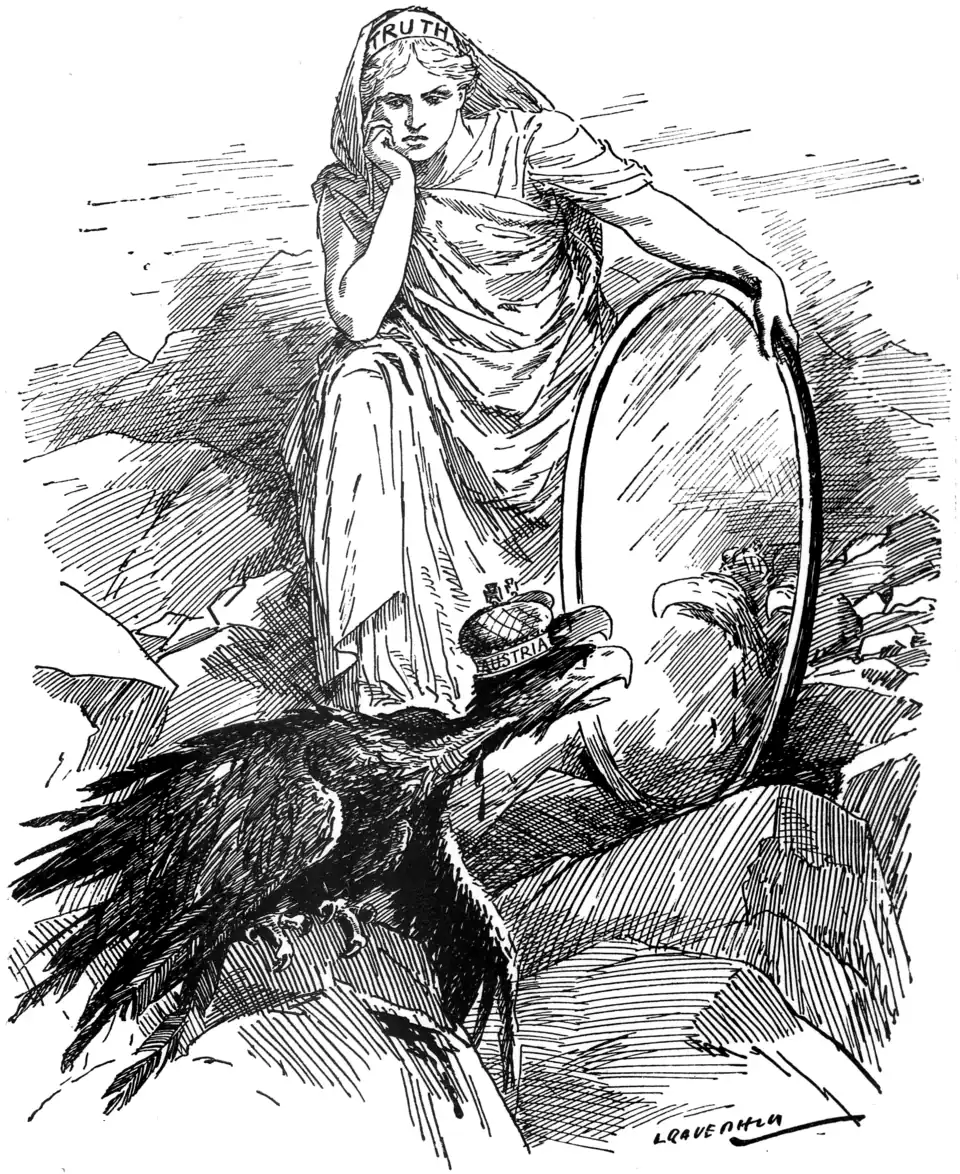
A PAINFUL REFLECTION.
Austria. "HEAVENS! AM I REALLY AS BAD AS THAT? TAKE IT AWAY."
[It seems to be dawning upon Vienna that the armies of Austria have not been consistently victorious.]

Jack Tar on leave. "Yes, it was a desprit affair, and ammunition was running short. Why, at the finish we was firing six-inch shells out of our four-point-sevens!"
OUR WAR-BIRDS.
A correspondent, writing to The Observer, states that he hears every morning a blackbird singing the four opening notes of the refrain of "Rule, Britannia," and wonders "whether the bird has picked it up during the present war." Surely there can be no doubt of this. The writer will, however, be interested to hear that his experience is by no means unique, as is evidenced by the following letters:—
A well-known Headmaster writes as follows:—"Your readers will be glad to learn that the cuckoo has already been heard here (Berkshire), though the date is unusually early. I was seated recently in my garden, enjoying the leading article in The Daily Herald, when I distinctly caught the familiar notes. But conceive my interest and pleasure when, as I listened for a repetition, there reached me instead the first bars of that magnificent air, Deutschland Über Alles, with which the bird had evidently been at considerable pains to familiarise itself. What a needed lesson is here for us all!
P.S.—It is the cuckoo that fouls its own nest, isn't it? or am I wrong?"
Mr. Arnold White says:—"It is a singular fact that regularly every Friday morning, as I sit in my study writing my famous anti-Kaiser causerie for a certain Sunday journal, I am saluted by a remarkably fine blackbird, which from an adjacent bush continues to repeat the refrain, 'Down, Willie! Down, Willie!' without pause or variation. So far as I know the intelligent bird is entirely self-taught."
Dear Sir,—Perhaps you will allow me to add my own experience to those of your other Correspondents. A nest of thrushes having recently been established outside my bathroom window, I have had frequent opportunities for studying the behaviour of the occupants. I was specially interested to note that on the morning after the fall of Przemysl the parent bird, varying its usual attitude and monotonous call, perched on the edge of the nest and whistled the whole of the Russian National Anthem with quite remarkable finish. I was even more struck by the conduct of the young birds, who, though still unsteady upon their legs, rose simultaneously at the opening bar and remained standing throughout the entire performance. Such patriotism on the part of our unfledged songsters is, I think, a truly encouraging sign.
I am, Sir,
Yours, etc.,
A Kipling Lucas.
An Incentive to Matrimony.
"BIRTHS.
FOUR YEARS' REFUND OF INCOME TAX.Brett—March 27, at Montrose, Fortwilliam Park, the wife of the Rev. H. R. Brett, of a son.
Fisher—March 27, at Dunowen, Cliftonville, Belfast, to Mr. and Mrs. Alfred Fisher, a son."—Newry Telegraph.
If the {{sc|Chancellor of the Exchequer{{ will confirm the above announcement Mr. Punch will feel inclined to revise his notorious advice to those about to marry.
The following notice appeared in "Station Orders" issued by the Brigadier-General at Meerut:—
"Found:—On the road to Begamabad, one .303 Blank Cartridge. Apply to the Station Staff Officer, Meerut."
It is comforting to find one person who is determined that the Army shall not go short of ammunition, even if it be only blank.

Elderly Knitting Enthusiast. "Excuse me, young man. Could you tell me what size in socks Admiral Jellicoe takes?"
THE WATCH DOGS.
XV.
Dear Charles,—We've just paid a flying visit to the trenches. Having nothing better to do, we made our way to the place where the noise is and, in batches, spent a couple of nights with the Umpty Umpths in their eligible residential villas known as Cheyne Walk. To get there from the billets you take the high road from Qu'est que c'est que ça to Cela va sans dire and keep on with it until the machine guns open up on your left flank. You then take a sharp turn to the right, until you observe the beam of a searchlight playing across the field in front of you. You then lie flat on the ground and pretend you are not in France at all, and when the searchlight has come to the conclusion that, wherever you are, you are not worth bothering about, you get up and go on, keeping the searchlight well on your right, the machine gun well on your left, and stepping decorously out of the path of any sniper's bullet which happens to be passing.
Proceeding quietly but quickly along the line of least resistance, you are suddenly confronted by a figure emerging from the dark, who tells you to halt or he'll fire. "Et tu, Brute!" you murmur reproachfully, as you halt and wonder to yourself why it is that you have suddenly become so unpopular. The figure says his name isn't Brutus, but that he is come from the trench to guide you to it, and thereupon you throw your arms round his neck, which he takes to mean that you love him and wish never to be parted from him. As to the love, that all depends; you'll be better able to say in the morning when you've seen him in the daylight, but as to the sticking together he is well on the right side there.
"And now," you say, "what about that trench? Shall we be getting on towards it? We love being out here in the open, but we feel we oughtn't to keep your friends sitting up all night for us." He is inclined to be discursive and to go through a list of the casualties which have occurred at the very spot whereon you stand. He then tells you to follow him, and suddenly disappears.
Seeing that there are now searchlights and machine guns in all directions, it doesn't much matter which road you take, so you go straight ahead and hope for the best and fear for the worst and fall into a pit-hole and find the guide. And one by one your men behind you fall into the same hole and use the same suppressed but disgraceful expression with regard to it.
"It is a scandal," you tell the guide in an indignant whisper as you fix your arms round his neck even more affectionately than before,—"it is a scandal, the shocking state of repair in which French turnip fields are kept. Where are the police, where the gendarmerie, where the writers of letters to The Times? In an English field such holes would never be allowed."
He explains that it isn't a hole, it's a trench, and may he have his neck to himself for a bit? You relax your hold and examine the spot to which he has brought you. Felicitating him upon the ingenuity with which one tortuous ditch is made to combine the uses of a roadway, a water-main, a sewer and a home, you bid him good-night and hand yourself over to the Captain. Having introduced yourself to the Captain and apologized for continuing to exist in spite of the desire, apparently universal, to get rid of you, you remark that this is one of the most attractive and well-aired trenches in which you ever remember making a bit of war. You then go along with him to settle your men in, only to find that they have done this for themselves and are already giving valuable advice to the occupants of the place as to how trench-fighting should, and will in future, be conducted.
The Captain then says that trenches are all very well in their way, but dugouts are better, and you resort with him to an elegant pig-sty round the corner. You have not been there long before his servant arrives with a cup of tea; this is followed by a cup of coffee; this is followed by a cup of cocoa, and this is followed by a cup of soup. If you pine for another cup of cocoa, you have just got to go without, because it is now getting on for dawn and your cup (there is only one) is required for your early morning tea. You then settle down as best you can to a wee drappie of whisky from a flask (his) just to keep off your ravaging thirst. And all the time the bullets go pit-a-pat, and no one seems to care as long as there's water boiling for the next brew.
Stepping down the trench to see the sights, you discover the men employed in the constant and reprehensible habit of tea-drinking. The sentries lean against the parapet with their backs to you and appear as men who are watching a dog-fight which has lost for them all its excitement but not all its interest. Every now and then they loose off their rifles into the dim beyond, not in any real hope of hitting anything, but just to show there is ill-feeling. On most nights there is a gentleman opposite who addresses our trench when he comes on duty, "It is I, Fritz, the Bunmaker of London. What is the football news?" They shout out the latest information and pass him over a couple of bullets. This is no doubt because they recollect his buns, over-priced and under-curranted. He replies in kind, feeling perhaps that he has already lost his customer and may as well make a proper job of it.
The rest of the day you spend in admiring the legitimate handiwork of your own artillery and regretting the inexcusable criminality of the enemy's. You improve your trench, you do a little sniping yourself, admittedly killing at least one Bosch with every shot, and defeat the Captain time after time at piquet. He is worried by his responsibilities, you with the thought that so sound a fellow should have been tucked away in a Flanders turnip field for so long. And that is all there is about it.
Yours ever, Henry.
"Speaking of the rôle of Spain in the present war, Herr Ziminerman concluded the interview with the following words: 'The triumph of the Allies in the present war would definitely establish Anglo-French influence in the Siberian Peninsula. Consequently patriotic Spaniards ought to range themselves on Germany's side."-Exeter Express and Echo.
For fear, we suppose, lest the French and English should exile them to the other Peninsula—though not, of course, with Dr. Lyttelton's approval.
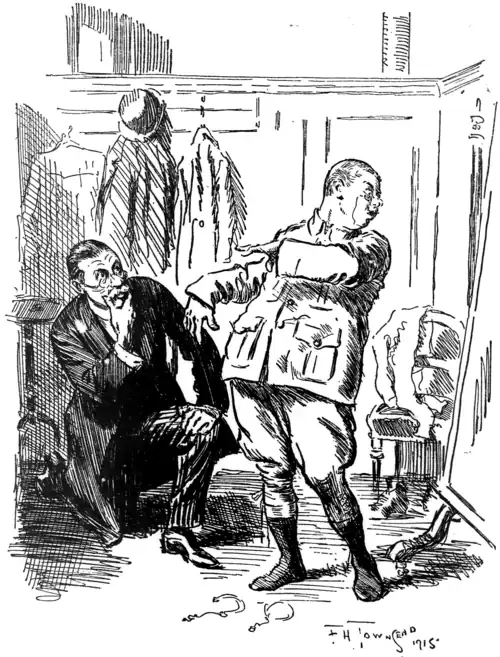
Volunteer Reservist (hoping to be contradicted). "I shall look an awful fool in this uniform."
Tailor. "Well, Sir, you can always wear a mackintosh."
IN PLACE OF ———
The wave of patriotic teetotalism which is washing over the country is certain to bring out a new crop of those non-alcoholic beverages which are so far more delightful and exhilarating than the genuine articles which they counterfeit. Already The Daily Mail, with its encyclopædic sagacity, has discovered and made known to the world the secret of the composition of the KING's barleywater, which, strange to say, is made "by pouring boiling water on to the barley." Next will come the alluring substitutes.
Many years ago an abstainer's beer was put on the market and puffed by a Bishop in some such series of ecstatic sentences as "It looks like beer! It tastes like beer! It smells like beer! But it is not beer!" That probably will be the model for the new encomiasts.—Thus:
Rechabite Claret.
This wine, which has been prepared by a famous chemist from a recipe of his own, is guaranteed to take the place of the best French Bordeaux wines. Absolutely non-alcoholic. Made in two varieties:—
Château Cochineal per dozen 24s.
Château Aniline. " 12s.
Testimonial.
The Bishop of Soda and Man writes:—It looks like claret. It is wet like claret. But it certainly is not claret.
If you want the best whisky substitute ask for "Wilfy Lawson."
Established over a hundred minutes and still going strong.
The Favourite Brand.
Absolutely non-stimulating.
No effects of any kind.
Good old "Wilfy Lawson" on every bottle.
Testimonial.
Dear Sirs,—Your Wilfy Lawson Whisky is perfect as a non-stimulant. I drank two gallons yesterday, with my finger on my pulse all the time, and it did not accelerate it in the least.
(Signed) C. F. G. Masterman.
Cinque Port.
This glutinous and saccharine decoction has been carefully prepared by some of the ablest hands in the country to meet a demand for a non-intoxicating festive beverage during the War. Highly economical, as no one can take a second glass. When thrown away makes excellent beetle destroyer.
The Cinque Ports, which are already famous, are put up in two forms of bottle, with cobwebs and without.
Price (with cobwebs from the best spiders) per dozen 60s.
Without cobwebs 12s.
Testimonial.
Dear Sir,—The wedding of my second son last week was made memorable to all present by a single bottle of your Cinque Port.
Yours faithfully, Rosebery.
All the best known Bottles!
Messrs. Gloster, the famous bottlers, have arranged to meet popular tastes by bottling pure Malvern water in every kind of recognised wine bottles—champagne, hock, claret, etc., with the original labels intact. Consumers will thus be complying with the new and most laudable custom of teetotalism and yet be enjoying the illusion of resorting to the best-stored cellars for refreshment.
Testimonial.
Dear Sir,—Please send another gross of the 1901 Veuve Joyeuse. Our dinner-parties are a great success when these bottles grace the board.
(Signed) Randall Cantuar.
Personal.
Situation required as Butler. Age 50. Highest references required. Thorough knowledge of every kind of water.—Apply, 5, Reservoir Gardens, Bridgwater.
"The Sayer posted on Black List by Police does not refer to W. Sayer, Chimney Sweep, 7, Jarvis Street."—Advt. in "Cape Times."
In the circumstances some misapprehension was perhaps pardonable.
BLANCHE'S LETTERS.
A Recruiting Campaign.
Curfew Hall,
Nr. Puddlebury Parva.
Dearest Daphne,—I've been putting in a most strenuous Easter here! When I invited a houseful of people I added as a P.S., "N.B.—Recruiting." And we've worked like niggers. My own success has been colossal. In the nickiest of khaki-coloured tailor-mades, with a darling little semi-military cap with a bunch of ribbons, just like a real recruiting officer's, I've made the round of all the neighbouring villages—Puddlebury Parva, Much Gapington, and ever so many more, and have pulled in recruits grandly! "Now," I said to the young natives standing about the village streets, "you boys have got to leave your hedging or your digging, or whatever it is you do, and offer yourselves to your country. I'm quite quite sure big, strong, brave fellows like you aren't going to stand by while other men do your fighting for you! So come along with me at once to the recruiting-office!" And they shuffled about and gurgled in their throats and nudged each other and grinned—but they came along!
If you've done nothing of this kind, my Daphne, you can't imagine what a comfy little thrill it gives one to feel one's been the means of turning a slouch and a cloth-cap and a gurgle into a brisk soldier-laddie! The fly in the ointment has been that Beryl and Babs would persist in claiming some of my recruits as theirs. Things might have got a bit difficult, only I was very forbearing with them. "What's it matter who pulls them in so long as they are pulled in?" I said. "Though at the same time you must both know in your hearts that I've got quite three times as many as either of you."
In the evenings we've been giving little recruiting concerts in the various villages; charming little affairs, with a recruiting-office at the side of the platform, and the best seats given to those who went and offered themselves before the concert began. I sang patriotic songs, draped in a flag. Beryl and Babs gave a fencing turn. Clarges gave his "Farmyard Imitations." I don't say that I should have known what animals he was imitating, but he told us each time, so that was all right. The Rector of Much Gapington, a dear man with quite a little reputation as an amateur conjurer, did some of his most wonderful tricks, and, though his hand certainly seemed a little out once or twice and he dropped several things that weren't meant to be dropped, everybody was delighted. Popsy, Lady Ramsgate, in a soft muslin frock with a red-white-and-blue sash and her hair in ringlets, read a long interesting letter from her grandson, Pegwell, at the Front.
But the plat de résistance was Norty's "Adventures of a Flying Man in War Time."
He's a flight-commander now, and was my guest of honour while his Easter leave lasted; but oh! my dear friend, what do you, do you think? When I first saw him I shrieked and had to have bromide and veronal. He's grown a (I feel as if I couldn't write it!)—a beard, Daphne!! "I knew you'd jib at it, Blanche," he said, "but going up so high we have to grow 'em. Knitting's not good enough. Flying men must grow their own mufflers. I promise you, however, that I'll shave it off again when the War's over." "When the War's over!" I screamed. "By that time the horrible thing will be down to your waist, and I'll be dead of a broken heart!" And then Beryl weighed in with one of her very own speeches: "I thought you liked beards, dear Blanche. Your husband wears one." I kept calm. It happens to suit Josiah," was all I said.
By the way, Josiah is really beginning to come home at last now that the seas are clear down there. His adventures, my dear, since he went away last July to look after rubber concessions at the other end of the world! A little trading vessel on which he made one of his efforts to come back caught fire, and they all took to the boats, and Josiah was in a small one by himself, and he drifted on till he came to an island that's not on any map, and there he's been living among palms and cocoa-nuts and natives and fearful things of that kind, and he never knew from one day to another whether they would end by eating him or making him their king (he's not sure which would have been the worse fate!). As far as I can make out his writing, he calls them the Boldoreens. They are about the only real, old-fashioned natives left anywhere now! Their hair is long and stiff and stands straight up from their heads; their dress consists of a little sea-weed (which sounds distinctly charming for a summer toilette), and their money is the leaves of a particular sort of bush. They're quite nice and kind till you offend them, and then they eat you! The fact that Josiah is able to come back proves that he has more tact than I gave him credit for. Daily Thrills and Daily Tidings have both cabled him asking for exclusive rights in the Boldoreens and bee his adventures, They've even been to see me, and when I let out that Josiah has secured a photo of the Head Boldereen the Daily Thrills' man became almost rabid! I've already arranged a series of "Social Lecture-Chats"—Thursdays in May—Harmonic Hall—a song or two—tea and coffee—and Josiah to tell about the Boldoreens to a soft, running piano accompaniment. Tickets, five shillings each, the money to go to the War funds. I feel sure it will be a big thing, and will fetch ces autres in crowds.
D'you know, my dearest, I don't consider that women's wits are being sufficiently used in this War. I don't claim that we ought to have a hand in strategy and large things of that kind, or that we're able to make great big inventions (like Lord Newton, you know, who first thought of locomotives through seeing an apple fall off a tree), but I do claim that some of us are very sharp and think of quite a number of things. You guess what's coming? Yes, your Blanche has thought of something—something that would end this wretched blockade in a few days! Let some ships go out trailing things that would act as magnets to submarines, so that they would fly to them and stick to them in spite of themselves. Then let the ships come back to port with a lot of U-boats stuck fast to the magnets—et voilà! Of course the point is to find out just what would act as a magnet to submarines (Norty suggested a lump of copper or a bag of iron crosses, but that was only par plaisanterie). Anyhow, I shall lay my idea before the Admiralty, and leave them to find out the right kind of magnet.
Ever thine, Blanche.
P.S.—The new skirt has revived a lost art. Before I left town Fallalerie's was crowded every afternoon with people learning to walk again. I got hold of it quicker than any of them. Imaginez-vous, m'amie! After a course of only twelve lessons I could actually take a step several inches long.
MORE THOROUGHNESS.
[The value of the stinging nettle as a vegetable is being emphasised in German War cookery notes.]
How to Help England.
"Several Ladies Required to assist in organising very smart, new Ladies' Club." Advt. in "The Times."

THE CONTINENTAL MANNER.
A number of British navvies have been sent to the Continent to dig trenches. This is the kind of thing that we must expect when they return.
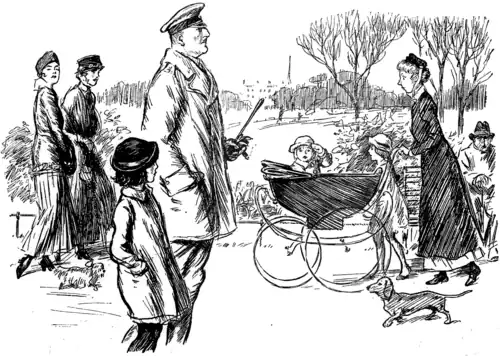
"Look, Dad! There's someone saluting. Oh, I forgot, though; you don't return civilian salutes, do you?"
THE INWARD MOVEMENT IN DRAMA.
The next masterpiece to be given by the Dramatic Delvers' Society on Sunday evening will be Dyspepsia, a Tragedy in Three Acts, of which those who know speak remarkably highly. The scene, somewhat Venetian in character, is laid "on the alimentary canal of an epicure," and the characters represent various foods, etc., consumed by him during a heavy meal. A strong cast has been engaged, amongst them Miss Hilda Trevelyan, who will appear in the somewhat Wendyish part of Pepsine, a little Peacemaker. We gather that the efforts of this benevolent personage are unsuccessful, as in the Third Act we are promised a highly sensational scene in which Curried Lobster (Mr. Fred Terry) conspires with Pêche Melba (Miss Miriam Lewis) to stir the other characters to revolution.
The full cast of Out of the Pit, the new Mental Mystery to be produced at the Court Theatre, is now settled. It should be noted that the entire action takes place in the brain of a man who is seated in the back row of the pit of a theatre at a performance of this kind of play; the chief characters being:—
Darkness. Mr. H. B. Irving.
A Sense of Insufficient Elbow-room. Mr. Fred Lewis.
An Aroma of Orange-peel. Miss Mabel Russell.
The Pride of the Lady who Will Not Remove her Hat. Miss Kate Serjeantson.
A Belief that Originality may be Carried Too Far. Mr. Bourchier.
A Growing Sense of having Wasted Half-a-crown. Mr. Alfred Lester.
"PARIS HERSELF AGAIN.
Till recently the Invalides, where the war trophies are on exhibition, was the only museum open to sightseers. On Saturday the useum of ecorative Art installed in the ouvre pavilions was opened.
Partial reopening of the uxembourg is announced for this week."—Evening News.
The heading is a trifle optimistic. There are still apparently some initial difficulties to be adjusted.
"Strikers Wanted immediately for Government work."—Birmingham Daily Mail.
Recent pronouncements by Lord Kitchener and other members of the Government had given the impression that there was no overwhelming demand for this class of workman.
MR. PUNCH'S APPEAL FOR BELGIAN SOLDIERS.
7, Northumberland Avenue, W.C.
Dear Mr. Punch,—In response to the appeal which you were kind enough to publish on behalf of the Belgian Soldiers, we have received very many cheques from England, France, Switzerland, Italy, Canada, India, the United States, etc.
I thank you most heartily, and would be glad if you would convey my thanks to your many generous readers, advising them that a list of the sums received is published in the Indépendance Belge.
Yours faithfully,
(Signed) Emile Vandervelde,
Minister of State.
Grave News from China.
"The following telegram from the Chief of General Staff, Delhi, has been received by the German Officer Commanding in Hongkong:—
Delhi, Feb. 11, 8.41 p.m.
Situation in India continues to be generally satisfactory. Frontier remains quiet."
South China Morning Post.
The situation in India may be all right, but what about the situation in China, with the Germans in occupation of Hong Kong?

THE ENEMY'S ALLY.

The Aunt. "I shall certainly volunteer to do men's work. But the position must be a dignified one."
The Niece. "I know, Aunt. Go as a butler."
LIFE-SAVING AT SEA.
The publication of a Navy Supplement in his present issue furnishes Mr. Punch with an excuse for appealing on behalf of a cause—closely associated with our sea-service—which is liable to be overlooked among the many claims that the War makes upon his readers. It is the cause of the Royal National Life-boat Association. The extinction of lights and beacons, the removal of buoys, and the presence in many unascertained spots of floating mines have enormously increased the dangers to shipping and added yet further risks to the hazardous work of our Life-boatmen. Since the beginning of the War our Life-boats have on over 60 occasions rendered service to Cruisers, Torpedo Boats, Military Transports, Mine Sweepers, Submarines, etc., and 216 lives were saved from these vessels up to the end of last year. The assistance given to the hospital-ship Rohilla involved the complete loss of one Life-boat and serious damage to three others. The total additional cost up to the 31st of December amounted to over £6,000. No grant whatever is received from the Government, and the whole work of the Life-boat Institution, entailing an expenditure of about £112,000 a year, is supported entirely by Voluntary Contributions.
Subscriptions, greatly needed, should be addressed to The Royal National Life-boat Institution, 22, Charing Cross Road, London, W.C.
How History is Written.
"A number of poor children, some of them the shoeless, had got on the pavement outside the awning, and as Queen Alexandra approached they pushed their heads under the canvas to get a better view. Her Majesty was much amused, and, stooping down, patted some of the heads."—Times.
"As soon as Queen Alexandra arrived she noticed some little dogs poking their heads under the awning, and she laughed and stooped down to pat them."—Evening News.
Personally we prefer The Times' version of the incident.
The Chancellor of the Exchequer says that there is nearly as much alcohol in ginger-ale as in light beer. Clearly dolus latet in gingeralibus!
DAWN
(By our Spring Poet.)

"Please will yet do us a bit o' drill, Sir, 'cos it's Bertam's birfday?"
THE DURATION OF THE PEACE.
(With acknowledgments to Mr. Hilaire Belloc.)
The first question which every one naturally asks his favourite oracle about the present political truce is: How long is it likely to last? Before entering upon this subject, however, let me utter a word of warning. To attempt to estimate the duration of any peace whatever is folly, unless you are the belligerent who puts an end to it. This is a folly into which European countries, with the exception of Germany, very conspicuously fell last year. There is no reason why we should imitate their errors by suggesting any period as the 'end' of this state of peace. No hazardous conclusion at all upon the subject will therefore be attempted.
The doubt that at once occurs is this. If the matter is not susceptible of calculation; if the vaguest attempt at prophecy is gratuitous folly; and if even the wildest guesswork has no finality, is the subject really suitable for discussion in these columns?
Now in the first place there is all the difference in the world between discussing a matter and reaching any conclusion upon it. All I am trying to do in these notes is to indicate a critical moment, round or about or after which period, if hostilities begin again, the end of peace will be in sight, though even after this disaster a state of truce might technically remain. In order to do this, I am compelled to reiterate arguments which I have used so often before that I am almost ashamed to recur to them, but I feel that italicised insistence on the obvious can create an effect when nothing else can.
Moreover I hope to show that, as the end of the winter is now at hand, and as that moment coincides with the beginning of spring, when unexpected accidents might conceivably happen, the days through which we are now passing are exactly the right time to fill in with indeterminate discussions.
Before proceeding to my calculations, however, two really relevant topics must first be eliminated. There is the improbable contingency that the Allies might unexpectedly declare peace, and the only less improbable contingency that the Government, in its desire for efficiency, might take the Opposition to its bosom in a Coalition Ministry. If either of these is admitted, the discussion must at once cease; otherwise it can continue till the point of exhaustion is reached.
If we eliminate those disturbing factors there remain two great alternatives. Either one of the opponents will break the truce, or the truce will continue. I dogmatise upon neither, I merely state them. It is only in the second alternative that any plausible pretext for discussing the duration of the peace can be offered. To resolve the Opposition into its elements is too simple. It leads nowhere. Let us then make, in the fullest possible detail, a broad survey of all even remotely connected side-issues, based upon the widest and vaguest generalizations.
1.—There is first the complete confidence of human nature in the certitude or rather the necessity of its own right judgment; and the presumption that master strokes of strategy and politics will constantly occur to private members which would never cross the minds of our statesmen or generals. I adduce no evidence for this; I have heard it and I believe it.
2.—There is secondly our knowledge of the character of Labour and Capital. Both these are psychological factors which provoke continual, though, alas! restricted discussion.
3.—There is thirdly the element of Geography. This must be expressed in terms of Celt and Cymry. The number of Irish Members who are in the flower of what is generally but very loosely termed their "fighting age" can only be determined by eliminating those who are dead or mad or run over by traction engines. Whatever their mood to-day, or the chance of its changing to-morrow, the only certainty is that something unexpected may be confidently anticipated, but what it may be no one living out of an Irish atmosphere can foresee. Further, there is the question, Will that monument of art and treasure of antiquity, the Eisteddfod, lure the Welsh to sacrifice a cherished plan of campaign, or will it incline them buoyantly to resume the offensive?
With regard to the first let us disabuse our minds of the falsehood that criticism proceeds not from emotion but from reasoned judgment. Manias are the most potent and least doubtful of all the motives which affect us in this country; hence those extraordinary proposals, reiterated for some mystic and incalculable reason, which reappear at regular intervals. The judicial mind may be dismissed as a legal fiction. But Conscriptionists are a reality; so are retired Admirals; so are Whole-Hoggers and Spy-hunters and Aniline-Dyers; and so is the fact that the natural life of this Parliament comes to an end after another six months. Moreover grievances cannot withstand the process of "accretion" for more than a certain time at a certain rate, whatever their original magnitude.
To sum up, then, if we consider only the element of unemployed superiority, and the strain imposed by time, the argument would seem to point to a peace of shorter rather than of longer duration.
But this is only one line of argument. I propose to show that it is entirely stultified by the other two, with which I hope to deal at length next week.
A GENUINE ANTIQUE.
[Messrs. Christie are holding a sale of Art treasures and historical relics in aid of the funds of the British Red Cross Society and the Order of St. John.]
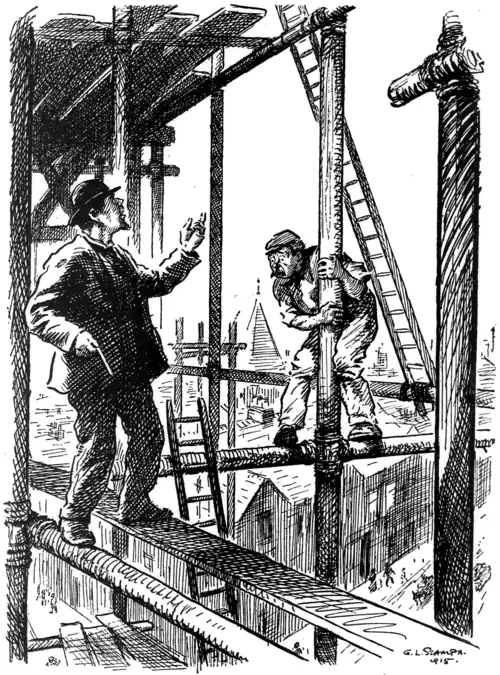
"Jest 'op 'up that ladder, Jim, and see if she's safe."
"Not me, when I can go to the Front an' git all the risks I want—wiv glory!"
THE SUFFERINGS OF SHAW.
[According to the author of a new book on Socrates, Mr. Bernard Shaw, like the Athenian philosopher, is an intellectualist whose "crime is ideas" and whose "profoundly moral aim" is misunderstood by the British bourgeoisie.]
Mr. Lloyd George to the Shipbuilders' Deputation regarding the Drink, 29th March:—
"I was glad from that point of view, but only from that point of view, that Mr. Henderson stated quite clearly at the start that there were no teetotalors amongst you."
A distressing sequel is found in the following extract from The North Mail, 1st April:—
"When a reporter sought for a further reply from shipyard managers yesterday he found them all sitting tight."
WAR-TIME VIGNETTES.
Chez le Photographe.
I had entrusted Madame Olive with my precious snapshots. She was the only photographer in Dunkirk who would promise to develop them tout de suite. When I called at the shop I found the little birdlike creature the centre of a clamorous crowd. Madame was talking hurriedly in a high-pitched voice. "Oui, oui, it will be ready instantly." "But I must have it now," urged a uniformed official. It is for my carte d'identité and I have a train to catch." "Oui, oui, dans un instant."
"Where are my proofs? They were promised a fortnight ago." "I will send them round to you, Mademoiselle." "So you said yesterday—no, I'll wait here." "Très bien, très bien." Où sont nos portraits?" two old souls asked simultaneously. "Are my films ready?" I ventured. "Oui, oui, come down and look at them." Madame seized the opportunity to escape. She drew aside a curtain that divided the studio from the shop. A photographer was posing a workman against a background representing the Garden of Versailles. The man was leaning against a waterfall and facing the camera with a beatific smile. Madame disappeared through the minutest of doors down a spiral staircase. "This way," she cried, and led me into a cupboard. "This is my developing room—look, I have all these plates to develop." "Show me my films," I urged. "But I'm just going to do them. Oh where—oh where did I put your kodak?" "But you said they would be done." "How could they be done? You saw how many people were in the shop. Now I wonder what I did with it? It can't have been your kodak that fell down the stairs. Ah, no, here it is. Now I switch on the red light. There, you see, I put them in the liquid and work them about."
"Madame, madame," came a voice from beyond, "Monsieur wants his picture for his carte d'identité." "Yes, yes, tell him it will be ready in a minute. Where is the plate?" "It is in the little yellow box." "Très bien, très bien; I wonder what has happened to that yellow box? There, now, I leave your films to soak whilst I do some others. See, here is a picture of Granny and Grandpa. It's a pity she's so blurry, and it would have been better if his other shoulder had been in the picture. They should have stood in the centre instead of one at each edge. But then they've been married a long time. Engaged couples are different."
"Madame, madame, Monsieur is getting impatient for his carte d'identité." "Tell him it's just being finished. Oh dear, oh dear, where can it be?" "In the little yellow box, Madame." "But where is the little yellow box? Ah, mon Dieu, mon Dieu, what a life! There, look, yours are coming out. They are going to be excellent. Look at this lady. She's dreadfully smudged—did you ever see such a face? She'll be furious; but in war-time—que voulez-vous?" "Madame, madame, the carte d'identite." "Ah, mon Dieu, mon Dieu, there they are again. Why can't he be patient? Where is the yellow box? Parbleu, it's in my pocket. Tell him you are bringing it up. There, if that isn't vexing; there's something wrong with the plate. He'll have to be done again; nobody could possibly recognise him. Ah, but then it's only for his carte d'identité. What, he says his train has gone? Oh, well, he can have another sitting. He won't? Well, as long as he's satisfied."
"I'd rather develop the photos down here than interview the people upstairs," I remarked. "Yes, yes, they are so exigent. If you leave your films till to-morrow I will print you some copies." Madame seized the tray and we went back into the shop. A newcomer, a sullen and terribly stout woman, had taken her place by the counter. "I have come for my enlargomont," she grunted. "Oui, oui, Madame—it's not back from Paris." "You've had it four months." "Que voulez-vous, Madame? C'est la guerre." "Where is the original?" "Somewhere here in the shop." "But how can they do the enlargement in Paris if the original is here?" "Oh, Madame, I really can't explain—you wouldn't understand if I did." "I'll never come here again. I only came because my family recommended me to come." "Ab, vous voyez—we have always given them satisfaction. Are we to blame for the War? Madame here of the Croix Rouge will tell you how impossible it is to get anything from Paris." "Yes," I assented, "it would be difficult at present to get you enlarged." "Qu'est-ce que je vous ai dit? and you wouldn't believe me." Madame cast an indignant glance at the fat one, who waddled resentfully out of the shop.
She collided in the doorway with a young woman, and after some mutual recriminations Madame was again faced by an angry customer. This time it was a young washerwoman with a brick-red face and a shawl drawn across her ample chest. "You have given mon mari the wrong bébé—this is not my little Albert it is some wretched little girl." "Indeed it isn't," Madame objected strenuously; "it is your little Albert; he wouldn't stay quiet—que voulez-vous?—his face is a little hazy." "I tell you it isn't my Albert; he has a curly head." "Well, it was straight when he came here last week. I remember quite well saying to your mari it was a pity his hair didn't curl." "But the dress—I tell you Albert was breeched." Madame lifted her eyebrows with an air of exasperation. "What have I to do with that? The kodak tells no lies; but if you are dissatisfied cherchez vous-méme." She handed a large drawerful of postcard photographs to the mother. The woman fingered them eagerly, pulling out all the pictures of babies and putting them on one side. "La, la, I have found my bébé," she cried. "Qu'est-ce que je vous ai dit? The other was not my Albert." She hurried out, clutching a picture-postcard. Madame shrugged her shoulders. "They generally choose that one," she said. "It is the picture of my little nephew Charles. Her little Albert's plate was broken. Mais qu'estce qu'on peut? C'est la guerre. Come back to-morrow, Madame, and I will have your pictures printed for you."
The next day was Sunday. The shop was crowded with people disputing their turn to be photographed. The girl behind the counter turned a tearful face to me. "I'll never give them numbers again," she said. "I don't care how muddled they get; Madame blames me quite unfairly." "Can you give me my films?" I interposed meekly. "It's not fair," she sniffled; that marine was number 54 and ———" I turned to Madame. "You promised to print me some copies." "Marie, Marie, what have you done with the films of Madame of the Croix Rouge?" Marie began hastily to search the drawer. "Is this it?" she asked, showing me a picture of two burly soldiers arm-in-arm. I shook my head. "I think it must be yours," declared Madame. "But my snapshots were views," I objected. "One never knows how things will turn out with amateurs," said Madame. "Don't you remember we looked at the films together yesterday? There was one of the market-place and one of———" Madame scratched her head in perplexity. "Ah, mon Dieu, mon Dieu," she exclaimed suddenly, "it was your films that fell down the drain-pipe when they were hanging out to dry. I'm so désolée, mais vous savez they were not very good, and another time———" "My beautiful films gone!" I cried in dismay. Madame gave me a reproachful look. "Qu'est-ce que je peux, Madame?" she cried. "C'est la guerre."
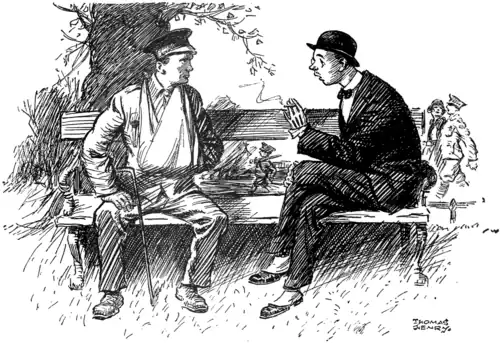
Sympathetic Slacker to wounded Tommy. "Yes, old man, the sudden shock must have been absolutely terrible. I know the sort of thing. Only last night a careless blighter gave me a beastly knock on the nose with his billiard-cue. Horrid shock. I can sympathise with you!"
PUTTEES.
"Puttees," I said to Shopwalker No. 1, who had bowed himself into a note of interrogation.
"Puttees," shouted Shopwalker No. 1.
"Puttees," said Shopwalker No. 2.
"Puttees," Shopwalker No. 3 whispered confidentially into my ear. He led me by devious routes to a place bristling with military trimmings.
"Puttees," shouted Shopwalker No. 3 in a voice that brought me instinctively to attention and caused a timid-looking man to drop six boxes of boots. These shopwalkers ought to be at the Front. They would be invaluable as connecting files.
"Puttees?" murmured the timid man.
"Puttees is the word, and I said it first—the things you twist on to your legs," I said.
"That would be puttees, Sir. What price?"
"Are there different prices for puttees?"
"From two shillings to twelve-and-six."
"What makes the difference?"
"The quality and the shape. There are straight puttees and spiral puttees."
This didn't sound altogether unreasonable, as different people have different shaped calves. However, no man's calves—not even Bailey's—are entirely straight or wholly spiral, so I said, "I think that I would like something between the two to suit a normal leg."
"It isn't so much the shape of the leg as the shape of the puttees that matters. I'm afraid there's no intermediate shape."
"I suppose both shapes go on?"
"Yes, they both go on," he said hesitatingly; "and they do say that the spiral ones stay on. I don't rightly know—I don't profess to understand puttees—I'm really a boot man. I see our Expert is disengaged now, he will talk puttees to you."
The Expert told me all about puttees. I didn't understand any of it then and I don't understand all of it now. I gathered that puttees aren't the simpleminded things they look, and that I had better purchase the more expensive and amenable kind, known as the spiral. I had no wish to be parsimonious over the finishing touches to my uniform, so I agreed to the man's suggestion.
"What colour?" asked the Expert.
"The pretty greeny-greyish tint that is so much in vogue with the Volunteers."
"I'm sorry, we're out of the spirals in that colour. I've just sold the last pair, and there isn't another pair to be bought in London."
"Is there any chance of the khaki colour fading to our tint?"
"Our puttees do not fade."
I knew that if my legs were the wrong colour they would catch the eye of the Sergeant-Major and I should be in perpetual trouble; yet I misdoubted the straight variety and tried to compromise. "I'll take one of the two-shilling straight kind, and if I get on with it all right I'll come back and buy its mate."
"We only sell them in pairs."
I offered to recommend the odd one to a one-legged man of my acquaintance if I didn't want it, but he wouldn't break the set.
In the end I bought a straight pair and have lost about five pounds' weight in consequence. If nature had known when she set up in business that the object of man's legs was to support puttees, she would have put the thicker part of the leg at the lower end. She would have had to sacrifice a certain amount of elegance to utility, but, as it is, she has done that in some cases, though Bailey won't admit it. I don't suggest that my puttees would look neat if I were to wear my legs the wrong way up, but I do think that the puttees would stand more chance of staying up and that the bulgy parts would be more useful for carrying my lunch, gloves and cigarettes.
The Expert told me that I ought to turn the things over like a bandage. I've been practising it and have discovered why so many military men marry hospital nurses. Up to date my record is two-and-a-half twists before I drop the coiled-up end. I've missed the last three Sunday parades owing to puttee troubles. I got up extra early last Sunday and had ten goes before I lost my train.
I've consulted the Sergeant-major, and he says if I don't care to wear my puttees round my ankles like the other men I must stay off parade. I've tried to get permission to wear a pair of pants painted with a spiral dado or frieze to look like puttees, but this has been ruled out of order. However, there's a rumour that the Adjutant's wife is going to start puttee classes, so all may yet be well.
THE LABYRINTH.
For some weeks I had been feeling anxious about Peters. A man of sanguine temperament, he had, though unmarried, always preserved till a short time ago a singularly cheerful outlook on existence. But about the beginning of the year a change came over him. He grew silent and preoccupied. Frequently he travelled down from Town with the rest of us without so much as opening his mouth, he who had been the life and soul of the 5.30. His cheeks, too, lost their rosy colour, and his clothes began to look as if they had been made for somebody else.
The climax came when I saw him one evening, in a fit of deeper abstraction than usual, attempt to enter the guard's van at Liverpool Street in mistake for his own compartment. The guard took him gently by the arm and led him to where I was seated, as it chanced, alone.
"This is your carriage, Sir."
Peters woke from his reverie. "Ah, yes, of course," he said, "my mistake. Very good of you, I'm sure;" and taking a sovereign from his pocket he pressed it into the guard's hand. The latter started, but, regaining in an instant the admirable self-possession which characterises the more responsible of our railway officials, reverently touched his hat and walked away.
The incident shocked me; obviously there was something very wrong with Peters. As soon as we were clear of the station I asked him point blank what was the matter. He turned a dull eye upon me and for a moment or two made no reply. Then he said in a strained voice, "Come round to my house to-night and I will tell you." We finished the journey in silence.
"I'm glad you have come," said Peters at 9.30. "I couldn't have gone on much longer without speaking to someone about it." As he leaned forwards over the fire I noticed with pain the pallor of his face and the nervous twitching of his hands.
"When the War broke out," he went on after a short pause, "I tried to join the army, but they ploughed me in the sight test, though I read the card without a hitch."
"But that's absurd!" I exclaimed.
He smiled sadly. It was just bad luck. Carruthers had passed very successfully in the morning, and as I knew he could see through a brick wall I had asked him to memorise the letters for me. Unfortunately they changed the target in the afternoon. It was a low thing to do, but, at any rate, it settled me. Somehow or other, though, I couldn't get back again into the old groove. I wanted to be actually doing something, you understand. I didn't care what it was so long as it was something. Finally I wrote and consulted my brother-in-law, who is a parson in Bradford. He sent me back by return two pounds of grey wool, four bone needles and a book called The Knitter's Companion."
He stopped and gazed moodily into the fire for a few seconds. "How I cursed that book! Mind you, I don't blame my brother-in-law. He has spent the whole of his life in a town where the inhabitants breathe wool from the cradle and are inured to knitting of the most intricate designs. Probably he never realised the danger to which he was exposing me. He wrote: 'Try pattern Number 29 first, and send to me when completed. I will add it to our next monthly parcel for the troops.' I turned up Number 29. It was an airman's helmet. The printed directions said, 'Cast on 156.' It seemed a simple thing to do, but though I read the whole book through I could discover no instructions on the point.
Next day I bought in Oxford Street a little volume entitled, How to Knit, by One who has done it. I studied this for three nights, and a week later I had cast on 156. That was beginning of the end.
"The next direction was, 'Knit 12 rows plain.' This I managed fairly well, though when I got to the 12th row I found only 95 stitches on the needles. Then the book said, '13, knit 3, purl 2; 14, knit 2, purl 3; 15, knit plain row; 16, knit purl row; repeat the last 4 rows 8 times, decreasing at beginning and end of every 4th row and being careful to keep the pattern straight.' Since then my life has been a hideous dream. I would not give in. Night after night I locked myself in this room and struggled with it, and night after night the thing grew. What it was growing into I dared not guess, but it never had the appearance of a helmet. At last it began to frighten me, and to avoid looking at it I pinned brown-paper over the part I had finished.
One evening, just a week ago, the paper became unfastened and I saw what I had done. I ran upstairs with it, threw it inside the spare bedroom and locked the door on it. Ever since then I have been trying to brace myself to fetch it down again, but I cannot."
I stood up. "Give me the key of the spare bedroom," I said. He felt in his pocket, handed it to me and shrank back into his chair.
"Don't bring it down," he entreated; "I can't face it to-night."
I went upstairs and unlocked the spare bedroom door. Peters' work lay just inside on the floor, plainly visible by the landing light. I am not a nervous man, but I confess at the sight of it I caught my breath. There was something sinister about it. Its awful formlessness seemed the ultimate expression of a desolation deeper than despair. And as I looked the grey labyrinth drew me evilly to itself, and I heard a whisper that came from nowhere, "Take it back to him and leave him." I stepped forward, hesitated and shuddered. Then I picked it up, flung it from me into the grate and put a match to it.
When I went down Peters was standing at the foot of the stairs. He gazed at me without speaking. "I have burnt it," I said.
"Thank heaven!" he muttered and sank weakly to the floor. I put him to bed.
Neither of us has mentioned the subject since that night. Peters is quite his old self again. He has found a new outlet for his energies in making scrap-books for the Gurkhas.
Justice and Mercy.
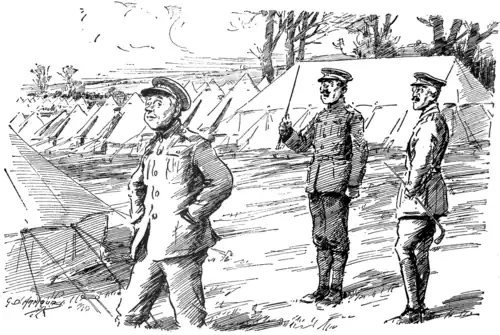
Sergeant (to recruit who has neglected to salute when leaving officer). "'Ere, my lad, come back! You've forgot something. You've forgot to shake 'ands with the orficer!"
OUR BOOKING-OFFICE.
(By Mr. Punch's Staff of Learned Clerks.)
Hugh: Memoirs of a Brother (Smith, Elder) is naturally a book that even the reviewer approaches in something rather different from the critical spirit. This remark must not be taken to mean that it stands in any need of apology. On the contrary, Mr. A. C. Benson has carried out his task not only with tenderness and affection, but with real biographical skill. The result is a character-picture of extraordinary interest and charm, both to those who had the rare pleasure of knowing Robert Hugh Benson personally and to those who only recall him by his books and sermons. The story is intimate to a degree very seldom attained in published writing. No man is a monster of perfection either to his valet or his brother, however deeply they may love him, and the memoir abounds in shrewd touches of gentle humour at the expense of those admirers of Hugh whose hero-worship led them into misinterpretations—those, for example, who spoke of the "rapt and far-away look in his eyes," from which Mr. Benson sagely concludes that his brother was probably bored, and wondering how he could courteously escape to society that might interest him more. It is on these lines that the memoir has been written; one might call it, not too flippantly, biography in a morning coat and slippers. Throughout one gets that impression of high and distinguished courage that for me is always present in the work of Robert Hugh Benson; the scene of his death, almost intolerably poignant in its detail, is a most noble proof of this. Of his humour there are many to many characteristic examples. I like especially the account given here of the pleasure which he used to take in the words of an Anglican who would appeal for charity towards one lately "reconciled" to Rome on the ground that he had never fully recovered from a bicycle accident. A dignified, gentle, and most interesting book.
If I were retained as counsel for the defence by Mr. Ford Madox Hueffer, accused of conspiring to waste your good nature and his own talents (both equally undeniable) by producing The Good Soldier (Lane), I should be very little at my ease as regards the dismal story itself, but eloquent enough in referring to the way in which it is told. I say "told" advisedly, for by a studied neglect of chronology or any kind of consecutiveness, coupled with free licence to change his opinions as he goes along, the author succeeds in transforming himself into a living narrator, presenting as they occur to him, evening by evening at the fireside, the different aspects of a history gone by. It is well done and it could not have been easy to do; but after all there remains something solid in the schoolboy distinction between matter and manner, and the plain fact is that, when all the jig-saw bits are finally fitted in, the picture is so little pleasant that, but for the fun of seeing them drop into place, one would hardly have read to the end. In quiet times I should very much resent the writer's putting forward of Captain Ashburnham as "The Good Soldier." To-day one feels that the title is really too ridiculous, the existence of such a person in the British army, or indeed anywhere else, having become unthinkable; while the narrative of his dealings with the other equally impossible characters of his circle, though set out with a deliberate grace of diction—through which, however, the ugly word is here and there no less deliberately jerked—is simply (and again designedly) sordid. Much better spend your time on a real jig-saw that will give you in the end a pretty picture, say, of little Teddy feeding his rabbits.
The Way of The Red Cross, to which Queen Alexandra has added some gracious and touching words, carries with it the most appealing of all recommendations. Simply and ably told by E. C. Vivian and J. E. Hodder Williams, it is a record of the splendid work done by The Red Cross Society and the St. John Ambulance Association, a record that must move the stoniest heart to pity and the most penurious to the conviction that the relief of pain is the only royal road to contentment of mind. Welcome, too, is the tribute paid to the wonderful work of the Voluntary Aid Detachments. Weariness and suffering nobly and silently borne both by our wounded and the brave men and women who tend them is the moving theme of these pages. No one, it can be said without any qualification, who has the love of country in his heart can fail to be stirred by them to feelings of the deepest thankfulness and the deepest pride—thankfulness that we have such workers eager to give of their best, pride that we have such men to be saved by their services. Messrs. Hodder and Stoughton are devoting all the profits of this book to The Times Fund for the Sick and the Wounded, and there is one way, and only one way, for us to show our gratitude.
Mrs. C. S. Peel, whom you may remember as the writer of that clever and amusing story, The Hat Shop, has now extended her millinery researches to the fashionable dress-maker. As a fact, however, the defect of Mrs. Barnet-Robes (Lane) is, to my thinking, that the glimpses which it affords of life in a Sloane Street modiste's are too brief to be more than tantalising. For the rest the book is in the main a story of contrasted careers (something on the lines of the industrious and idle apprentices), the subjects being two girls, daughters of a certain Ivor Selincourt. Of these only one, Thea, was the child of his legitimate wife, and she, being handicapped with a neurotic disposition and a too luxurious home, fell in love with a man who was already married, and eventually, after a lot of temperamental trouble, she killed herself. Meanwhile Gladys, the child of Ivor's earlier unacknowledged love, climbed from prosperity to fortune, established her mother in Sloane Street, and herself not only enjoyed a capital income as a fashion-plate artist, but eventually married the man of her heart and lived happy ever after. This distribution of fates is at least unlike the usual arrangement of the moralist. Perhaps I was intended to feel more sympathy for Thea than I could actually command. Frankly, she seemed to me not a little tiresome, since there was really no reason, apart from her native cussedness, why she shouldn't have been every bit as happy as her nameless half-sister. But, again, perhaps this was all part of the plan, and intended to show that personality can do more than birth to ensure contentment. Which I knew already. Still, Mrs. Peel has written a story that is at least partly delightful, though I could have wished her to talk a little more shop in it.
To any advocate of "mixed" marriages in India, or elsewhere for that matter, I recommend A Shadow of '57 (Fisher Unwin). Mrs. Scott Moncrieff has the whole problem at her finger tips, and although she gives an almost cruel picture of the Eurasian character it is impossible not to be riveted by the cogency with which it is presented. Like many women-novelists of to-day, Mrs. Scott Moncrieff strikes shrewder blows at her own sex than at mine, but whether this is because she understands it better is not for me to decide. Here, at any rate, we have several women held up for our laughter or our pity, while the men (most of whom are officers) are endowed with a glorious imperturbability that soothes their friends as much as it maddens their enemies. A Shadow of '57 is a "first" book, and the author has only to set her casual style in order to command success. As it is, she has won her place among those novelists (why, I wonder, are the majority of them women?) who know their India by heart, and realize the sacrifices that most Anglo-Indians are called upon to make.
I have just had an excellent interlude with corsairs and galeasses, pikes and calivers, linstocks and morions, turbans and scimitars, all in the Good Queen Bess's spacious days, and personally conducted by Mr. Rafael Sabatini, who is no ordinary tusher. Sir Oliver Tressilian, the Cornish knight who adored fair Rosamund Godolphin (she always contrived to believe the worst of him and so protract the very rough course of his true love), was "trepanned" by order of his half-brother Lionel; had a thoroughly rotten time as a galley-slave in a Spanish vessel; joined forces with some attacking Muslim pirates; became a renegade, the famed Sakr-el-Bahr, The Sea Hawk (which is the name of the book, and Mr. Secker publishes it), the most outrageous and effective corsair of them all; raided his Cornish home; carried off Lionel and Rosamund; narrowly escaped the scimitar of his Muslim and the yard-arm of his English enemies, but duly prevailed over all, and came back to honour in a land whose Queen never took too squeamish a view of piracy. I will confess myself a little bored with the susceptible Basha, Assad-ed-Din, and his intriguing family, but Sir Oliver of the iron thews, with his hereditary Tressilian violence, is a notable hero, a good hater, a stout fighter; and I only hope the credulous Rosamund turned over a new leaf and lived happily with him ever after, which on the whole was more than she quite deserved.

OMNE IGNOTUM PRO MAGNIFICO.
He. "That's my friend Davis. He's in Kitchener's Army, you know."
She. "What is he—a lieutenant?"
He. "No; he's a lance-corporal."
She (greatly impressed). "O-oh, really! Influence, I suppose."
A Hitherto Unrecorded Atrocity.
"Thereupon the German commander ordered the deportation of all foreign Consuls including the Turkish, for weeks, frozen stiff."
Japan Chronicle.
After this treatment of Turkey's representative, the Sultan should now retaliate by giving the Kaiser "the frozen face."