Scott's Last Expedition/Volume 2/Winter Journey
SCOTT'S LAST EXPEDITION
THE WINTER JOURNEY TO CAPE CROZIER
By Dr. Edward A. Wilson, Lieut. H. R. Bowers, R.N., and Apsley Cherry-Garrard
June 27, 1911, to August 1, 1911
The object of this expedition to the Emperor penguin rookery in the darkness and cold of an Antarctic winter was set forth years before in Dr. Wilson's Report of the Zoology of the Discovery Voyage. It was to secure eggs at such a stage as could furnish a series of early embryos by which alone the particular points of interest in the development of the bird could be worked out; for it seemed probable 'that we have in the Emperor penguin the nearest approach to a primitive form not only of a penguin, but of a bird.' These points could not be investigated in the deserted eggs and chicks which had been obtained in Discovery days. Such a journey 'entailed the risks of sledge travelling in midwinter with an almost total absence of light,' for the Emperor is singular in nesting at the coldest season of the year, and 'the party would have to be on the scene at any rate early in July. . . . It would at any time require that a party of three at least, with full camp equipment, should traverse about a hundred miles of the Barrier surface and should, by moonlight, cross over with rope and axe the immense pressure ridges which form a chaos of crevasses at Cape Crozier . . . which have taken a party as much as two hours of careful work to cross by daylight.'
Furthermore, it afforded an opportunity of obtaining an exact knowledge of the winter conditions on the Barrier at its western end, and throughout its dangers and difficulties Bowers kept a most remarkable meteorological record (given at the end of this volume), the substance of which is embodied in this Report. The three travellers also experimented with their sledging rations, each for some time taking a different proportion of pemmican and biscuit, the results of which were used in order to make up the rations for future use.
The journey was planned to last six weeks, with a stay of several days near the rookery, but was shortened by the extreme cold and consequent consumption of their store of fuel, and the tempest which drove the party back from Cape Crozier.
To the report written by Dr. Wilson various notes and details are added in square brackets from Mr. Cherry-Garrard's diary. This diary, be it said, was never written for publication. It was a private record, for private remembrance. It tells of incidents and impressions in their personal bearing, and so telling, incidentally preserves the fuller human colouring that 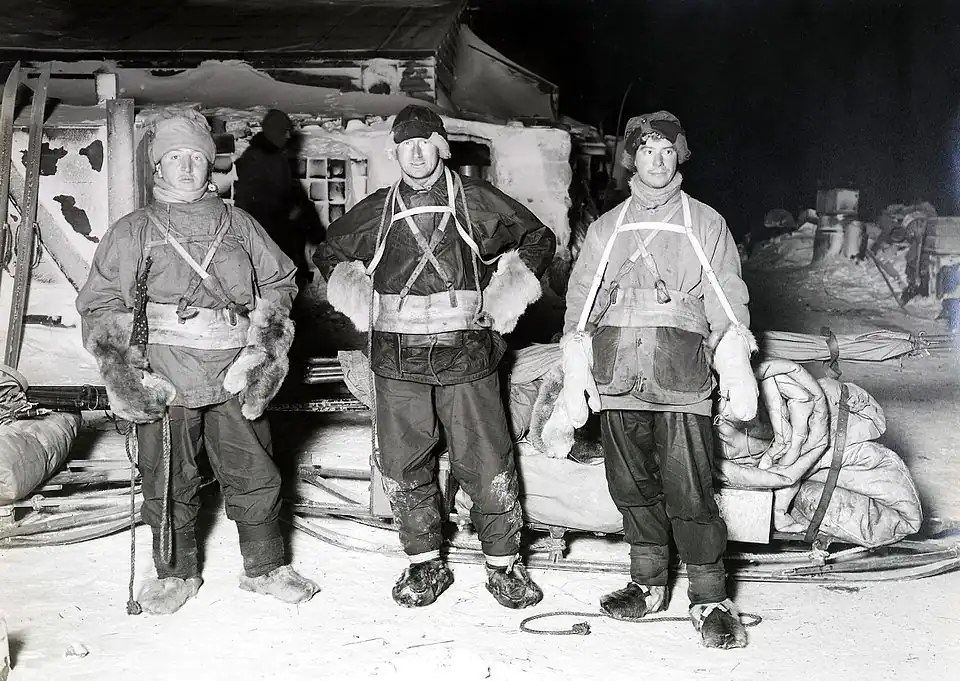
Bowers, Wilson, and Cherry-Garrard about to leave for Cape Crozier has been sedulously stripped away from Dr. Wilson's objective record, written with a more strictly scientific outlook.
Such notes have a manifold value. Every personality receives its own impression of the same incidents, recalls a different aspect, throws sidelights from a different angle. The young traveller records for himself a fresh and vivid personal impression, undiminished by reshaping into the perhaps necessary reticence of an official report. Not least, also, he gives us details about his chief which Dr. Wilson could not or would not have set down.
His own share in the expedition is the more remarkable because, short-sighted as he was, he could not wear his spectacles under such conditions.
With the help of these notes, the reader can fill in somewhat of those lights and shades which the official report, addressed to a Polar explorer, needed not to add. Now that the other two comrades in the adventure are no more, Mr. Cherry-Garrard has been prevailed upon to let his diary be used as it is used here. Let him be assured that his chief fear is groundless—the fear that in allowing such very personal jottings to be quoted, he should be imagined to magnify his own share in the expedition, instead of insisting, as he would have insisted in a public report, on the wonderful work of his friends: the strength, the steadfastness, and the serenity with which they carried it through. There was never an angry word from beginning to end, even in the most trying times. These unpremeditated notes help to make Wilson and Bowers stand out in their true colours.
Tuesday, June 27, 1911.—Leaving the hut at Cape Evans shortly before 11 a.m., Bowers, Cherry-Garrard and I started for our first march, accompanied by Simpson, Meares, Griffith Taylor, Nelson and Gran, who all helped us to drag our two sledges, and by a number of others who came to see us round the Cape.
We made for the western extremity of Big Razorback Island, and halted when it had just closed and covered the Little Razorback. We were then not 100 yards from the actual end of the rock and the sledgemeter read 3 miles 700 yards. Nelson and Taylor left us here and we continued with the other three.
We could now just distinguish the rock patches of Castle Rock and Harbour Heights and we made in a bit to pass as close as possible to the end of Glacier Tongue, where pressure lines were said to be less numerous in the sea ice than farther out. It was so dark, however, that we never saw the end of this Glacier Tongue, and we only knew we had passed it when the lower two-thirds of the Turk's Head Cliffs were suddenly cut off.
We then ran into some very difficult hummocky sea ice with steep-cut drifts, and our rear sledge capsized. It was too dark to avoid them, so Meares, Simpson and Gran remained with us and helped us until we had cleared them. We were then about three-quarters of a mile beyond Glacier Tongue and the sledgemeter read 5 m. 250 yds.
The wind, light southerly airs alternating with calm all the forenoon, now began to blow with some force from the east, and the sky became more and more overcast in the south [a half blizzard, in fact]; so we perPage:Scott's Last Expedition, Volume 2.djvu/31 suaded the three helpers to return from here. After this we had very little trouble with rough ice, and though the loads (about 250 lbs. each) were heavy enough to make us slow, we had a good surface to go on.
We camped for lunch at 2.30 p.m., having made six and one-third miles from Cape Evans. The double tent was easy to pitch, and we began a routine of brushing down the inside, after removing all the contents, every time we broke camp. This routine we continued the whole way to Cape Crozier, and it made a great difference to the collection of ice on the upper two-thirds of the tent. It was the duty of the cook for the day to see to this, and we were each of us cook for one day in turn. The lower third of the tent skirt lining gradually got more and more iced up by trickles from above during the running of the primus, and nothing short of melting it out would have enabled us to keep it clear of ice. We gave up the brushing-down routine on the journey home from Cape Crozier, for we had to burn oil so sparingly that we tied up the ventilator permanently and kept in all the steam and heat we could, to thaw out our finnesko, which we hung in the roof at night. We were so iced up as to our clothes and sleeping-bags that nothing outside made any difference, and the omission of brushing down saved time in getting off.
After lunch we got away at 4 p.m. and made for what we believed to be Hut Point, but in the dark we got a good deal too close in towards Castle Rock, much more than was necessary. Our pace was slow owing to the weights, but the surface was not bad. It was chiefly crusty rough sea ice, salt to the taste still; or it had an inch or two of white crusty snow on the rough, darker sea ice, alternating with broader drifts of hard windswept snow, making long, low mounds over which the sledges ran easily. These seemed here to result from an E.N.E. wind coming from the neck on the promontory, the wind which we caught just after passing the Glacier Tongue, and again off the ridge along Castle Rock, where it blew to force 5, up to 8 p.m., when we camped for the night, having made 9¾ miles from Cape Evans. [Setting this tent in dark is difficult, but not too bad even in that wind. Bill warns me seriously against running risk of frostbite. I find no specs. very hard in setting tent—must be sure not to let any inability arising from this get on my nerves—41 more days we hope.] Castle Rock was here nearly abeam. The wind dropped soon after and we had a clear starlit night.
The temperature for the day ranged from −14·5° to −15°, and the minimum temperature for the night was −26°.
Wednesday, June 28, 1911.—Turned out at 7.30 a.m. The going became very heavy with the two sledges, and we made very little more than a mile an hour over a surface which was all rough, rubbly salt sea ice with no snow on it. Bowers thinks that we were on definitely younger ice than that which we were on farther out yesterday and on our return. He thinks there was a large open lead along the shore which was the last to freeze up, and that this resulted from off-shore winds.
We reached Hut Point at 1.30 p.m., having crossed Page:Scott's Last Expedition, Volume 2.djvu/35 three or four cracks and lines of pressure chiefly radiating from Hut Point itself. The sledgemeter showed 13 m. 1500 yds., but we had not come in a direct line from Cape Evans. We lunched in the hut and had no difficulty with the door, as there was hardly any snowdrift against it.
After lunch we made better going to Cape Armitage, though there was still no snow here on the rough, rubbly ice, but it was not so bad as what we had been on during the forenoon, where the sea ice was still salt and crunchy, with humps everywhere, formed from the old weathered ice and salt flowers, none bigger than one's fist, allowing the feet to crush between them every step at a different angle. After Cape Armitage the surface became hard and snow-covered; and with the best going we met with the whole journey for a short two miles, we quickly reached the edge of the Barrier, finding a good slope of snowdrift where we struck it, and having no difficulty in drawing our sledges up one at a time. There was a snow-covered crack as usual at the top of the drift, not a working crack, and invisible until broken into.
Unfortunately, both in going out and in coming back, we reached the Barrier edge in too bad a light to see whether these snowdrifts were quite continuous all along the edge, but from the fact that they were so at the two different points at which we struck the edge in the dark, I think it is probable that the slope is now continuous pretty well everywhere. We rose about 12 ft. off the sea ice.
Coming down the snow slope off the Barrier was a stream of very cold air which we felt first when we were only a few yards from the foot, and lost very soon after reaching the top. [Got both hands bitten going up Barrier—all ten fingers.]
It was now 6.30 p.m., and we camped at 7, the last half-hour on the Barrier surface being uphill, and very heavy compared with the easy going on the snow-covered sea ice from Cape Armitage. There was no doubt as to the existence of this slope up; we confirmed it on our return, and I take it to be a proof that the Barrier at this point has in recent years broken back at any rate half a mile or a mile farther than it did this year—for the previous broken edges can be supposed to fill up successively in this way and so to produce a gradient without steps.
We had nothing but light variable airs all day with a clear sky. The temp. ranged from −24·5° in the morning by Castle Rock to −26·5° at Hut Point and −47° at the edge of the Barrier.
Thursday, June 29, 1911.—We spent a cold night with temp. down to −56·5° [Frightful cold last night—bad night. Bill has hardly slept for two nights—clothes beginning to get bad], and it was −49° when we turned out at 9 a.m.; but the day was fine and calm on the whole, with occasional light easterly airs only.
Curtains of aurora covered a great part of the sky to the east both morning and evening, and it was one of the chief pleasures of our journey out that we were facing east, where almost all the aurora occurred, and so we could watch its changes as we marched, almost the whole time. Nine-tenths of the aurora we saw was in the east and S.E. of the sky, often well up to the zenith, but always starting from below the Barrier horizon. We never saw any that appeared close at hand.
The temp. remained at −50° all day, and Cherry and I both felt the cold of the snow very much in our feet on the march, he getting his big toes blistered by frostbite, and I my heel and the sole of my foot. A good many of Cherry's finger-tips also went last night at the edge of the Barrier and are bulbous to-day; but he takes them as a matter of course and says nothing, and he never once allowed them to interfere with his usefulness.
The surface to-day was firm, generally; hard and windswept in some places, and soft and sandy in others. The sledges to-day went heaviest on the harder areas for some reason, which was quite exceptional. I think there was a fixed deposit of gritty crystals on the apparently smooth surface. Always after this it was the soft sandy drifts which held us up more than anything else.
We made two or three long sloping gradients to-day in our march going eastward. These also we confirmed on our return journey, when we recrossed three long low waves on about the same line, and I believe them to be the continuation of a series of extensive waves which run out from the point at which the glacier flow from Mt. Terra Nova runs into the Barrier. These waves curve gradually south-westward from the south-easterly direction in which they first join the Barrier. Hodgson and I followed up and roughly charted one of this group of waves in our journey in 1903 when we were examining the tide crack along the south side of Ross Island. They are very long and definite disturbances, and in our march were taken so diagonally that they seemed much longer. The difference of surface was quite noticeable, harder on the ridge summits and softer in the hollows. We have never met with anything like a crevasse on them.
Friday, June 30, 1911.—The surface to-day proved too heavy for us—we were unable to drag both sledges together, so we relayed one at a time, by daylight from 11 a.m. to 3 p.m.—and by candle-lamp from 4.30 p.m. to 7.45 p.m. We made only 3¼ miles in the day. The surface was soft and sandy, and though always crusted, always let one through an inch or two, as well as the sledge runners.
Heavy subsidences were continual all day, and the surface seemed to give way more when we were on the edges of the softer sandy patches. They were not extensive as a rule as far as one could judge, but they were exceptionally frequent—much more so than I have known them in the summer. There was no reason to think they dropped more than ¼ to ½ inch. The temp. to-day ranged from −55° in the morning to −61·6° at lunch and −66° on camping for the night. We had calm weather all day, and some aurora to watch in the E. and from N.E. to S. during the march.
[June 30.—Relaying all day—surface awful. It does not look as if we could pull this off. Last night was record sledging temperature −75° on sledge, −69° under sledge.[1] I was in big bag and most of night shivered till back seemed to break, then warm for half minute and then on again the same thing: turned right over, froze in and got a little sleep. Feet liable to go. One big toe went and I don't know for how long.]
Saturday, July 1, 1911.—We turned out at 7.30 a.m. No dawn was visible, but at 10.45 a.m., when we got away, we were able to relay by daylight, and continued so until 3 p.m. After lunch we relayed by candle lamp from 4.15 p.m. to 7.45 p.m. The surface was like sand, and so heavy that we could only slowly move one sledge along. Subsidences very frequent all day. We made only 2¼ miles in all. [Bill and Birdie very unselfish and helpful—impossible to wear glasses and so I am handicapped.]
Between 5 p.m. and 7 p.m. there was a very fine aurora, large beams making very extensive curtains from E. to S. up to an altitude of 45°, and with characteristic black sky beneath the arches. The colour was a very orange yellow.
Erebus smoke has been difficult to see, no long stream of smoke, but very small puffs apparently going eastward each day.
The min. temp. last night was −69°, and to-day we had −66·6° in the morning and −60·5° at 10 p.m. Light south-easterly airs and north-easterly airs during the march, at these temperatures, forced us all to adjust our noseguards.
Note.—All the temperatures and weather notes in this Report are taken directly from Bowers' record. Bowers also made himself responsible for the sledgemeter records, and for notes on the condition of the ice on Ross Sea when we were at Cape Crozier. He also kept full notes of the auroræ, and did so much generally throughout the journey and with so much persistence notwithstanding the difficulties that beset us, that this Report must be considered as much his as mine. He has moreover read it all through and has materially helped me in making it complete. What I think of him and of Cherry-Garrard as companions for a sledge journey of this kind I have already made known to you, sir, in conversation. It would be impossible to say too much about either of them. I think their patience and persistence from beginning to end was what made five weeks of discomfort not only bearable but much more than pleasant. I have added this note since his revision of the Report.
Sunday, July 2, 1911.—Min. temp. for the night was −65·2°, and this notwithstanding a breeze of force 3 from the S.S.E. with slight drift. The temp. during the day ranged from −60° to −65° with calm, and light airs which again made us adjust nose nips. After their use this day and yesterday, however, they were unnecessary, and some of us never again used them.
A fog bank formed along the Promontory ridge during the afternoon, but rose, and later dispersed to the westward. We all noticed that our frozen fur mits thawed out on our hands while it lasted.
Sunday, July 2, 1911 (continued).—We were again relaying to-day by daylight from 11 a.m. to 3 p.m., and by moonlight instead of candle-lamp from 4.30 to 8 p.m. This was the first we had seen of the new moon. As it passed exactly behind the summit of Erebus it gave us an extraordinary picture of an eruption.
We had a fine aurora in the south low on the horizon as a low curtain and arch, with a very striking orange colour all over.
We made only 2½ miles in the day. [A terrible day. I felt absolutely done up at lunch—three frostbitten toes on one foot—and heel and one toe on the other—burning oil is all that keeps us going now—better night however. We are getting into the swing of doing everything slowly and in mits.
I have pricked six or seven blisters on fingers to-night.]
Monday, July 3, 1911.—The min. temp. for the night was −65°. The weather was calm to begin with and clear, but became gradually overcast all round, starting with a few curve-backed storm clouds over Terror. After lunch however the sky cleared again completely, and we were able to relay by moonlight in the afternoon. We had made only 1½ miles by daylight in the forenoon march, and in the whole day only 2½ miles.
The temp. ranged from −52° to −58·2°.
We had a magnificent display of auroral curtains between 7.30 p.m. and 8 p.m., during which four-fifths of the eastern half of the sky was covered by waving curtains right up to the zenith, where they were all swinging round from left to right in foreshortened, swaying curtains forming a rapidly moving whirl, constantly altering its formation. Some of the lower curtains were very brilliant and showed bands of orange and green and again orange fading into lemon yellow upwards. Bowers noted it as follows: 'Remarkably brilliant aurora working from the N.E. to the zenith and spreading over two-thirds of the sky. Curtain form in interwoven arcs, curtains being propelled along as if by wind; the whole finally forming a vast mushroom overhead and moving towards the S.E. Colours, lemon yellow, green and orange.'
It was such a striking display that we all three halted and lay on our backs for a long time watching its evolutions.
Our sleeping-bags are beginning to show the effect of these low temperatures notwithstanding every care to keep them and our clothing dry. We left Cape Evans with three reindeer-skin bags for use to begin with, and a down bag each as a reserve lining. Cherry's fur bag was a very large one, much too large for warmth at these temperatures. My own was a good fit for warmth, but became so small when wet and frozen up that it broke in every direction. Bowers' bag was the right size for him, but also broke in more than one place later on when wet and frozen. All were as good as could be wished as regards the skins. Cherry has been so cold in his large bag with the hair inside that to-day he has turned it to hair outside, and bent his down bag as a lining to decrease the space.
Bowers' bag, begun with hair outside, is still so in use. My own, begun with hair inside, is still so in use. All are already rather wet and stiff when frozen, but we sleep in them well enough, and have no difficulty in rolling them up and unrolling them at night. [Bill having cold bad nights—feels it a bit I think—I have been half falling asleep at halts, Birdie ditto—surface a little better—foreshortening the mountains. Clothes for day have been so stiff we have to stop in position we just stand in when we get out of tent.]
Tuesday, July 4, 1911.—The min. temp. for the night was −65·4°, but on turning out at 7.20 a.m. we found the sky completely overcast and snow falling, with occasional gusts from E.N.E. to S. and S.S.E. At 9.30 a.m. the temp. had risen to −27·5°, with a wind force of 4 from the N.E.
Nothing was visible anywhere by which to make a course, so we had breakfast and turned in again. We were warm and comfortable all day, but though there were signs of clearing by night time we had to do without a march.
The min. temp. for the day was −44·5°, and during the following night −54·6°.
Everything was obscured round Erebus and Terror by clouds, though later it became possible to see Terror Point, and we knew that we were still out of the direct path of the southerly blizzards which sweep round Cape Crozier.
This lie-in has saturated our clothing through, and our Burberries stiffen outside the tent so much that it becomes almost difficult to get in again through the door. Our feet so far have been almost constantly warm, except on the march when plodding slowly on soft snow. We had then to keep a watchful eye on them to avoid getting frostbitten toes or heels. I regretted having left my puttees behind, as the additional wrapping round the ankles would have been a great protection to the feet.
We are using oil in the double tent now, after cooking is done, to dry and thaw out socks and finnesko before putting them on in the morning. It has seemed to us an almost necessary precaution at these temperatures unless one is prepared to take the damp socks into the sleeping-bag every night, and this with so many weeks ahead of us we are loath to do, as we are trying our best to keep the bags dry in many ways—for instance, we kept our pyjama trousers and pyjama jackets only for night wear to begin with, until they became so wet and stiff that in order to wear them at all they had to be kept on permanently. From the day of the blizzard incident at Cape Crozier back to Cape Evans, neither Bowers nor I made use of our jackets, however, at all—they were stowed away, stiff, in the tank, and so returned home.
Wednesday, July 5, 1911.—At 3 a.m. the whole sky was clearing and at 7 a.m. we turned out. The surface was now worse than we had as yet experienced, and we moved dreadfully slowly with one sledge load at a time. In 7½ hours hauling we only made 1½ miles good.
The min. temp. last night was −54·6°, and by the evening the temp. had dropped to −61·1°. We were then surrounded by a white fog, but could see Erebus and Terror. The cirro-stratus gave a white-looking sky in the moonlight and a fair halo with mock moons and vertical beams and a particularly well-defined mock moon beneath on the horizon.
All day we had been hauling up hill, and we hoped it was Terror Point we were crossing. Settlements of the crust occurred regularly again at short intervals. The surface still shows no sign of windcut sastrugi, and though much of it is wind-hardened and smooth, it appears to be the result of variable winds of no great force, and it is also covered to a very great extent by deep sheets of soft snow, on which the sledges hang up exactly as though they were going over sand. There is no surface marking on this snow except marks resembling horses' hoofs, with edges that have a peculiar planed-off appearance.
Whether harder or softer, the whole surface is crusted and lets one's feet in for a couple of inches, spoiling one's pull on the sticky-runnered sledges.
Thursday, July 6, 1911.—Again a calm day and clear, though a heavy bank of fog lies over the pressure ridges ahead of us, and over the seaward area to the east.
We had relay work again on a very heavy surface, which, however, improved slightly in the afternoon. But the result of 7½ hours' hauling was a forward move of 1½ miles only.
The min. temp. for the night had been −75·3°. At starting in the morning it was −70·2° and at noon −76·8°. At 5.15 p.m., when we camped for lunch, it was −77° exactly, and at midnight it had risen again to −69°, when there was some low-lying white fog and mist to the N. and N.N.W. The butter, when stabbed with a knife, 'flew' like very brittle toffee. Our paraffin at these temperatures was perfectly easy to pour, though there was just a trace of opalescent milkiness in its appearance.
Friday, July 7, 1911.—We got away late, at noon, in a thick white fog, in which it was impossible to see where we were going. We still had to relay, though the surface had distinctly improved. There was no sign of wind sastrugi yet.
After lunch, which we finished about 6.30 p.m., we got an indistinct view of the mountains, and saw we were beginning to close Mt. Terra Nova with Mt. Terror, but the fog came down again at once, and at 9.45 p.m. we camped, as we were unable to guess at all what direction we had been making. We only made one and two-thirds miles good in the day.
The min. temp. for the night from 12 to 2 p.m. had been −75·8. At 2 p.m. it was −58·3°, and at 7 p.m. had risen to −55·4°, a change which we felt as a grateful one both in our hands and feet on the march. [There is something after all rather good in doing something never done before—these temperatures must be world's record.]
Saturday, July 8, 1911.—A day of white fog and high moonlight but without a trace of landmark to guide us. We relayed as usual, four hours in the forenoon, for 1¼ miles, and three hours in the afternoon for one mile only. We were on a better surface, either more windswept or else improved by the rise in temperature, but still deep and soft to walk in, though often with harder crusted areas. Here and there were really hard and slippery windswept snow surfaces occurring under a covering of some inches of quite soft snow, showing the peculiar planed-off appearance which was always associated with horse-shoe impressions and very heavy dragging. We made our course to-day by compass.
The min. temp. for the night was −59·8° and at 10.30 a.m. −52·3°, with south-easterly airs, and −47° at 7.15 p.m.
Sunday, July 9, 1911.—Dense mist, and white fog [the fourth day of fog], and snow falling all day, made relaying impossible, but we found we could manage the two sledges together again on the improving surface.
Our chief difficulty was to avoid gradually and unwittingly mounting the slopes of Mt. Terror to our left, where there are any number of crevassed patches of ice, and running into the pressure ridges on our right. Between these two lay an area of more or less level land ice which was safe going—but in two or three places I knew it was necessary to cross long snow capes running across our path from Mt. Terror—and here, if one wished to avoid very long uphill drags one had to approach the pressure ridges fairly closely—a thing quite easy with daylight, but affording us constant trouble in the dark and fog which hampered us all along this part of our journey.
To-day no landmarks were visible at all. We made a little over one mile in the forenoon and ¾ mile more in the afternoon. It was a great relief to have done so without relaying. The moon was invisible [only a glow where she is] and everything was obscured by fog, but the surface was improving every hour. In the afternoon we ran into crevassed ground, after having suspected we were pulling the sledges up and down several rises of moderate gradient. As we expected this, however, before reaching the second long snow cape, we went on. The surface was again hard and icy in places, with sometimes six inches of snow loose upon it. Our feet went through this snow and slipped upon the ivory-hard surface underneath. This was often near the top of the ridges. In the hollows the surface was deep and soft and crusted.
One could judge much of the nature of the surface, and of the chance of finding crevasses, by the sound and by the feel of one's feet on the snow, without seeing anything at all of the surface one was covering. Occasionally the moonlit fog allowed an edge to be lit up here and there, but the surface is so extraordinarily uniform and featureless that we believe we are still well out of the windswept line of southerly blizzard and still in an area of eddying winds, heavy snowfall, and constant fogs formed by the meeting of cold Barrier air with the warmer, moister air which comes up from the sea ice, and especially from the innumerable fissures of the pressure ridges. We called this Fog Bay.
The moon had again become visible almost overhead, but nothing else, until just as we found ourselves going up a longer rise and a steeper one than usual we saw a grey, irregular, mountainous-looking horizon confronting us close ahead. So here we unhitched from the sledges, and tying our lanyards together into a central knot, we walked up about 50 yards of icy slope interspersed with cracks, and having reached the top found we had another similar broken and irregular horizon ahead of us and another on our left. These were obviously the pressure ridges, and when we stood still we could hear a creaking and groaning of the ice underneath and around us, which convinced us, and later led us to think that the tidal action of the coast here was taken up in part at any rate by the pressure ridges without forming any definite tide crack.
This excursion from our sledges gave us, as we thought, our right direction for the safer land ice, but on turning ourselves with them in that direction, we found we were still running into the same crevassed mounds and ridges, so, finding a hollow with deeper snow in it, we camped for the night, and decided to wait until we could see exactly where we had got to.
The absence of a well-marked tide crack—which had rather puzzled us in the Discovery days—in the crossing of land-ice slopes such as Terror Point (Cape McKay) and the 'second snowcape,' both of which come straight down from Terror and run into the pressure ridges, was a question which we had in our minds all these days. We assuredly did cross several small cracks on these slopes which had the appearance of a certain amount of working, but their breadth was a matter of a couple of inches only, and if tidal they must take up only an insignificant fraction of the movement. They are so small that they may easily have been obscured by snowfall in the old days. Bowers is convinced they are to be considered tidal cracks. I am not so sure myself, and hope to have a better view of them by daylight before deciding whether there is anything to take up tidal movement besides the pressure ridges, which seem to me more than sufficient.
This day the temp. ranged from −36·7° up to −27°, with light airs northerly and southerly.
Some hours after midnight it began to blow and to snow more heavily.
The min. temp. for the night was −24·5° up to noon the next day.
Monday, July 10, 1911.—By noon a blizzard was blowing from the S.S.W., of force 6 to 8, and the air was as thick as could be with snow. This continued all day, and we lay wet and warm in our bags, listening to the periodic movements of the ice pressure, apparently tidal to some extent, beneath and about us.
Tuesday, July 11, 1911.—The temp. at 10 a.m. went up to +7·8° ['a rise of over 80°' from the record minimum], and at 8 p.m. was still +6·8°, with a minimum for the day of +3·2°. The wind came from S.W., force 5 to 9, and very squally. This continued all day with a very considerable snowfall which packed our tent in 1½ to 2 feet all round, as well as all our sledge gear. Cherry is still in his down bag inside the reindeer with fur outside. Bowers still as he started, with fur outside. I turned my bag yesterday from fur inside to fur outside. The rise in temperature and the long lie-in during this blizzard have steamed us and our clothes into a very sodden wet condition, and one wondered what a return to low temperatures would effect.
We have been discussing our respective rations, and they have been somewhat revised as follows:
On July 6 Cherry felt the need for more food, and would have chosen fat, either butter or pemmican, had he not been experimenting on a large biscuit allowance. So he increased his biscuits to twelve a day, and found that it did away to some extent with his desire for more food and fat. But he occasionally had heartburn, and has certainly felt the cold more than Bowers and I have, and has had more frostbite in hands, feet, and face than we have.
I have altogether failed to eat anything approaching my allowance of 8 ozs. of butter a day. The most I have managed has been about 2 or 3 ozs.
Bowers has also found it impossible to eat his extra allowance of pemmican for lunch.
So yesterday—that is, a fortnight out—we decided that Cherry and I should both alter our dietary, he to take 4 ozs. a day of my butter and I to take two of his biscuits, i.e. 4 ozs., in exchange.
This brought Cherry's diet and mine to the same. Bowers continued his diet, taking his extra pemmican when he felt it possible—but this became increasingly less frequent and all the way home he went without it.
Cherry's diet and mine was now, per diem:
- Pemmican. . . . . . . . . . . . . . . . . . . . . . . . . . . . . . . . . . . . . . . . . . . . . . . . . . . . . . . . . . . . . . . . . . . . . . . . . . . . . . . . . . . . . . . . . . . . . . . . . . . . . . . . . . . . . . . . . . . . . . . . . . . . . . . . . . . . . . . . . . . . . . . . . . . . . . . . . . . . . . . . . . . . . . . . . . . . . . . . . . . . . . . . . . . . . . . . . . . . . . . . . . . . . . . . . . . . . . . . . . . . . . . . . . . . . . . . . . . . . . . . . . . . . . . . . . . . . . . . . . . . . . . . . . . . . . . . . . . . . . . . . . . . . . . . . . . . . . . . . . . .
12 ozs. Biscuit. . . . . . . . . . . . . . . . . . . . . . . . . . . . . . . . . . . . . . . . . . . . . . . . . . . . . . . . . . . . . . . . . . . . . . . . . . . . . . . . . . . . . . . . . . . . . . . . . . . . . . . . . . . . . . . . . . . . . . . . . . . . . . . . . . . . . . . . . . . . . . . . . . . . . . . . . . . . . . . . . . . . . . . . . . . . . . . . . . . . . . . . . . . . . . . . . . . . . . . . . . . . . . . . . . . . . . . . . . . . . . . . . . . . . . . . . . . . . . . . . . . . . . . . . . . . . . . . . . . . . . . . . . . . . . . . . . . . . . . . . . . . . . . . . . . . . . . . . . . .16 ozs. Butter. . . . . . . . . . . . . . . . . . . . . . . . . . . . . . . . . . . . . . . . . . . . . . . . . . . . . . . . . . . . . . . . . . . . . . . . . . . . . . . . . . . . . . . . . . . . . . . . . . . . . . . . . . . . . . . . . . . . . . . . . . . . . . . . . . . . . . . . . . . . . . . . . . . . . . . . . . . . . . . . . . . . . . . . . . . . . . . . . . . . . . . . . . . . . . . . . . . . . . . . . . . . . . . . . . . . . . . . . . . . . . . . . . . . . . . . . . . . . . . . . . . . . . . . . . . . . . . . . . . . . . . . . . . . . . . . . . . . . . . . . . . . . . . . . . . . . . . . . . . .4 ozs. (we rarely eat more than 2 ozs.)
Bowers' diet was now:
- Pemmican. . . . . . . . . . . . . . . . . . . . . . . . . . . . . . . . . . . . . . . . . . . . . . . . . . . . . . . . . . . . . . . . . . . . . . . . . . . . . . . . . . . . . . . . . . . . . . . . . . . . . . . . . . . . . . . . . . . . . . . . . . . . . . . . . . . . . . . . . . . . . . . . . . . . . . . . . . . . . . . . . . . . . . . . . . . . . . . . . . . . . . . . . . . . . . . . . . . . . . . . . . . . . . . . . . . . . . . . . . . . . . . . . . . . . . . . . . . . . . . . . . . . . . . . . . . . . . . . . . . . . . . . . . . . . . . . . . . . . . . . . . . . . . . . . . . . . . . . . . . .
12 ozs. Biscuit. . . . . . . . . . . . . . . . . . . . . . . . . . . . . . . . . . . . . . . . . . . . . . . . . . . . . . . . . . . . . . . . . . . . . . . . . . . . . . . . . . . . . . . . . . . . . . . . . . . . . . . . . . . . . . . . . . . . . . . . . . . . . . . . . . . . . . . . . . . . . . . . . . . . . . . . . . . . . . . . . . . . . . . . . . . . . . . . . . . . . . . . . . . . . . . . . . . . . . . . . . . . . . . . . . . . . . . . . . . . . . . . . . . . . . . . . . . . . . . . . . . . . . . . . . . . . . . . . . . . . . . . . . . . . . . . . . . . . . . . . . . . . . . . . . . . . . . . . . . .16 ozs. Extra pemmican. . . . . . . . . . . . . . . . . . . . . . . . . . . . . . . . . . . . . . . . . . . . . . . . . . . . . . . . . . . . . . . . . . . . . . . . . . . . . . . . . . . . . . . . . . . . . . . . . . . . . . . . . . . . . . . . . . . . . . . . . . . . . . . . . . . . . . . . . . . . . . . . . . . . . . . . . . . . . . . . . . . . . . . . . . . . . . . . . . . . . . . . . . . . . . . . . . . . . . . . . . . . . . . . . . . . . . . . . . . . . . . . . . . . . . . . . . . . . . . . . . . . . . . . . . . . . . . . . . . . . . . . . . . . . . . . . . . . . . . . . . . . . . . . . . . . . . . . . . . .4 ozs. (rarely eaten).
Our daily routine was, for breakfast, to have first tea, then pemmican and biscuit; for lunch, tea and biscuit (and butter for Cherry and myself); for supper, hot water and pemmican and biscuit.
We none of us missed sugar or cocoa, or any of the other foods we have been used to on sledge journeys, and we all found we were amply satisfied on this diet. Cocoa would have been pleasanter at night than plain hot water, but the hot water with biscuit soaked in it was very good.
We still carry out the brush routine every time we break camp, to clear away all the rime formed on the inner tent lining. The outer tent is extraordinarily free from frost—and remained so to the day we returned to Cape Evans. The lower skirts of the inner tent, however, are solid with ice.
Towards evening the wind abated considerably, and parts of Mt. Terror came into view, but during the night the wind came on again with much snow and violent gusts, increasing at times to force 10. We were unable to march. The min. temp. for the night was −7·6°.
Wednesday, July 12, 1911.—We were compelled to remain in our bags again all day. Wind from S.W., force 10, and squally up to force 9 all the afternoon, with much drift. Temp. up to +2·9° again in the morning. Towards night there were lulls, and at 3 a.m. the wind ceased. Bowers turned his bag from hair outside to hair inside, his first change since starting.
Thursday, July 13, 1911.—After digging out our sledges and tent, which were pretty deeply buried in drift, we had a really good day's march, making 7½ miles in 7½ hours with both sledges. [Seems a marvellous run.] During our march, in our effort to avoid the pressure ridges on our right, we got imperceptibly somehow too high up on to the slopes of Terror and were held up by a very wide crevasse with an unsafe-looking sunken lid, which we caught sight of in a momentary break of moonlight just in time to avoid it. We turned down its side and found it was one of a number that marked a low mound in the land ice slopes. We made out east again to get once more into the safety limit of land ice on the flat, which seemed very narrow in the dark.
We camped about 8 p.m. Min. temp. for last night was −22·2° and by the evening the temperature had dropped to −28·6°, but there was still a lot of cirro-stratus about, which the blizzard doesn't seem to have cleared away. There were also windy-looking clouds about, with lunar coronæ and occasional halos. During the daylight there was a very striking rosy glow all over the northern sky even up to the summit of Mt. Terror. The whole sky was a rich rosy purple, due to a thin cirro-stratus or alti-stratus I think.
The new surface was very flat, and very windswept, but not cut into sastrugi at all. Most of the new areas are low, flat, soft drifts, or low mounds, slightly rounded at the top and of large area. The softer areas have still the shaved or planed-off appearance with none but the horse-hoof shaped impressions on the surface.
Friday, July 14, 1911.—We made five and one-third miles in all to-day by a good morning march, but an afternoon march cut short by a complete loss of all light. After lunch we once more found we had overdone our easting and had run again into one of the higher pressure ridges. We turned north from it and encountered more crevasses, but by zig-zagging and sounding in advance on a longer trace we succeeded in getting clear of them. We had the Knoll before us at the time while there was light enough to see it. Our moonlight was, however, all but spent, so much of it had been lost in fogs and blizzard and bad weather. We were making for rather east of the Knoll to-day in our endeavour to keep within the flat area of land ice. Sastrugi were increasing rapidly here, and we were now entering the true path of the southerly blizzard.
The min. temp. for the night had been −35°. At 8.30 a.m. it was −17·4°, and in the afternoon and evening it was −24·6°. [The experiences so lightly passed over in the official account were sufficiently thrilling in themselves. The other diary records:
Rather a hair-raising day—very bad night—by hard slogging 2¾ miles this morning—then on in thick gloom which suddenly lifted and we found ourselves under a huge great mountain of pressure ridge looking black in shadow—we went on bending to left when Bill fell and put his arm into a crevasse—we went over this and another and some time after got somewhere up to left, and both Bill and I put a foot into a crevasse—we sounded all about and everywhere was hollow, and so we ran the sledge down over it and all was well. My nerves were about on edge at end of day.]
At the Knoll
Saturday, July 15, 1911.—The min. temp. for the night was −34·5°, but at 10.30 a.m. it was −19·2°, with a breeze of force 3 from the S.S.W. We got a clear view this morning, however, and could see the moraine shelf facing the Knoll, where we had decided to build our stone hut. We had a short, steep, uphill three miles' pull over very hard and deep-cut sastrugi to this spot, and then, rounding the lower end of the moraine, we found ourselves in the Knoll gap and pitched our last outward camp in a large open smooth snow hollow, hard and windswept as to surface, but in places not cut up by sastrugi. This camp lay about 150 yards below the ridge where we proposed to build our stone hut. [Here we are after a real slog—700 feet up, camped on very hard snow with our hut site chosen off to W. on some moraine—we have been discussing what to call the hut which we hope to build under a big boulder on the slope, walling one side of it—Terra Igloo I expect. It seems too good to be true—19 days out, this is our 15th camp—four days' blizzard. Surely seldom has anyone been so wet—our bags hardly possible to get into—our windclothes just frozen boxes. Birdie's patent balaclava is like iron—it is wonderful how our cares have vanished.] We had originally intended building on the Adélie penguin rookery, but so much of our time has been taken up in getting here, and our oil was already so short, that we decided to build as close as we could to our work with the Emperor penguins, and take the chance of doing so in the blizzard area. In the Adélie penguin rookery we should have been out of the blizzards, but five miles from our principal work. We hoped, however, to find something of a lee for our hut, and to put up with the blizzards.
On the ridge top above the snow hollow where we were camped was a low, rough mass of rock in situ with a quantity of loose rock masses of erratics of various kinds, some granite, some hard basalt, and some crumbly volcanic lava lying around. There was also a lot of rough gravel and plenty of hard snow which could be cut into paving-stone slabs. So here we had all the material we wanted, and as the corner under the rock in situ [which, it was hoped, would make a large part of one of the walls] was too solidly iced up with ice and gravel to clear out, we chose a spot [a moderately level piece of moraine] some 6 or 8 yards on the lee side of the actual ridge, a position which we thought would be out of the wind's force itself, but which we eventually found was all the more dangerous for that reason, as it was right in the spot where the upward suction was to be at its greatest. At lunch time, 4.15 p.m., we still had a southerly wind of force 4, with the temp. at −13°, and this wind we found to be due to a more or less constant flow of cold air down from the slopes of Terror.
We had a magnificent outlook from this spot where we were building our hut: To the east we looked out over the Great Barrier with the whole range of pressure ridges laid out at our feet, about 800 feet below [looking as if giants had been ploughing up with ploughs which made furrows 40 or 50 feet high]. To the north and N.E. we had the Knoll, and beyond it a clear open view over the ice of the Ross Sea. And to the south we looked along the path we had come along the slopes of Terror, stretching away towards the Bluff, while on our right these slopes climbed up to the summit of Mt. Terror, which was plainly visible against the sky.
We saw that Ross Sea was completely frozen over. No open leads were to be seen, but much of the ice appeared to be young and thin, with little snow on it. These and the following notes on the ice of Ross Sea were kept by Bowers.
I began the use of my eiderdown bag to-day inside the reindeer bag with the fur outside, and after this made no change till the day we reached Cape Evans again.
Sunday, July 16, 1911.—To-day looking over Ross Sea we saw a cloud of frost smoke drifting eastward along the Cape Crozier cliffs, evidently from an open lead along the coast. Otherwise the sea was covered by an unbroken sheet of ice.
The temp. varied to-day between −20·8° and −28·5°, and we again had the south-westerly breeze of force 3 to 5 coming down our snow slope from Mt. Terror. The weather was clear in the morning, but became hazy with cirro-stratus and fog soon after noon from the south.
We worked at the stone hut all the daylight and as long as we could see by the waning moonlight, and while Cherry built up the walls, Bowers and I collected rocks and piled up the outside of the walls with snow slabs and gravel. We had a pick and a shovel to work with.
[It was quite a question what it was to be called: in his Diary Bill called it 'Oriana Hut,' and the ridge the Oriana ridge: we discussed 'Terra Igloo,' 'Bleak House,' 'The House on the Hill.'
Birdie gathered rocks from over the hill; nothing was too big for him. Bill did the banking up outside. The stones were good; the snow, however, was blown so hard as to be practically ice: a pick made little impression upon it, and the only way was to chip out big blocks gradually by the small shovel.
There was now little moonlight or daylight, but for the next two days we used both to their utmost, being up at all times by day and night, and often working on when there was great difficulty to see anything: one day Birdie was digging with the hurricane lamp by his side.]
The hut was placed so as to escape the force of the southerly wind under the moraine ridge. We were about 800 feet above sea level. Our method of construction was to build four walls of solid rock, leaving a small gap for a door in the lee end. The weather wall was highest, and the breadth of the hut was 7½ to 8 ft., so that the 9-foot sledge rested across from wall to wall as a cross rafter to support the canvas roof. The two side walls were built up to the height of the weather wall at the weather end, but were not so high by a couple of feet at the door end. The length of the hut was about 10 ft.
Against the outer side of the rock-walls were laid large slabs of hard snow like paving stones, each having its icy windswept surface outside. Between the slabs of snow and the rock walls we shovelled moraine gravel. Over all this fell the canvas roof, anchored by lanyards to heavy rocks all round, and battened down to its outer side again by a double banking of ice slabs and gravel; finally, every crevice was packed in by hand with soft snow until the whole wall was uniformly tight all round. The work took us all the light we had of three days to finish. The canvas roof was made so ample in size that it came right down to the ground on the weather side and more than half-way down all the other sides. This, we thought, could not fail to make the walls tight when packed in and over as explained above, but it completely failed to keep out either snow drift or gravel dust when the wind began to blow in earnest later on, for both drift and dust poured in through every crack between the stones of the weather walls and lee walls without shifting any of the more bulky packing at all.
Monday, July 17, 1911.—We continued with the hut and spent the whole of available daylight and moonlight in getting on with the walls, which were all but finished for placing the roof and door. For this we want a calm if possible.
We began work to-day in a light air, but it was blowing again with force 3 from the S.W. from noon onwards, and the temp. all day varied between −19·5° and −23·3°. The sky was overcast. [Birdie was very disappointed that we could not finish the whole thing that day, but there was a lot to do yet, and we were tired out. We turned out early the next day to try and get the roof on, but it was blowing hard. (Tuesday, 18th.) When we got to the top we did some digging, &c., but it was quite impossible to try and get the roof on, and we had to leave it. We realised this day that it blew much harder at the top of the slope than where our tent was pitched. It was bitterly cold up there that morning.]
Over Ross Sea are now two open leads of water like broad irregular streets extending from the Cape Crozier cliffs away to the N.E. and lying more or less parallel to one another.
Tuesday, July 18, 1911.—No leads or open water were visible to-day over Ross Sea. The temp., −26·5° to −27·3°, with S.S.W. wind of force 4 to 5 all day, made work almost impossible at the hut. We got everything ready for placing and fixing the roof, but couldn't do it in the wind. We left the work at noon and turned in to spend a very cold night, a thing which we generally found was the consequence of not having done any hard work or marching during the day. [During this time our bags were getting worse and worse, but were still very possible, and we always looked forward to the days of the 'Stone Age' when the blubber stove should be going and we were to dry everything. When we arrived we had begun our fifth out of six tins of oil, and we were economising oil as much as possible, often only having two hot meals a day.
It was curious how the estimate of how much oil was necessary to our return, diminished as our stock decreased: at first we said we must have at least two gallons to go back with: then about Terror Point a tin and two full primus lamps; until it came down to one full gallon tin, and this is what we actually did use.]
Wednesday, July 19, 1911.—As it was a fine, calm day we decided to use it in an effort to reach the Emperor rookery and get some blubber, as our last can of oil but one was already running low and we had determined to keep the last can untouched for the journey home. We started down at 9.30 a.m., just as dawn appeared on the horizon in the east. We took an empty sledge, with a couple of ice axes, Alpine rope, harnesses, and skinning tools. We had about a mile to go down snow slopes to the edge of the first pressure ridge, and our intention was to keep close in under the land ice cliffs which are very much more extensive now than they were ten years Page:Scott's Last Expedition, Volume 2.djvu/65 ago. Then we hoped to get in under the actual rock cliffs which had always been the best way down to the rookery in the Discovery days. But somehow we got down by a slope which led us into a valley between the first two pressure ridges, and we found it impossible to get back in under the land ice cliffs. Nor had we then seen any other way down from the land ice except by the slope we followed. The rest was apparently all ice cliff about 80 to 100 ft. high. We tried again and again to work our way in to the left where the land ice cliffs joined the rock cliffs, but though we made considerable headway now and then along snow slopes and drift ridges by crossing the least tumbled parts of the intervening pressure lines, we yet came time after time to impossible places [with too great a drop], and had to turn back and try another way. [Bill led on a length of Alpine rope on the toggle of the sledge, Birdie was in his harness on the toggle, and I was in my harness on the rear of the sledge. Two or three times we tried to get down the ice slopes to the comparatively level road under the cliff, but it was always too great a drop. In that dim light every proportion was distorted, and some of the places we actually did manage to negotiate with ice axes and Alpine rope looked absolute precipices, and there were always crevasses at the bottom if you slipped. This day I went into various crevasses at least six times, once when we were close to the sea going right in to my waist, rolling out and then down a steep slope until brought up by Birdie and Bill on the rope.] We tried one possible opening after another, and all led to further impasses until the daylight was two-thirds gone, and we found ourselves faced in a large snow hollow by a chaotic pile of ice blocks and snowdrifts standing almost vertically in our path and all round us, to a height of some sixty feet, and completely stopping all chance of progress forward [a great cul-de-sac which probably formed the end of the two ridges, where they butted on to the sea ice]. Here we had the mortification of hearing the cries of Emperor penguins echoed to us by the rock cliffs on our left. We were still, however, out of sight of the rookery and we had still a quarter of a mile of chaotic pressure to cross [to be caught in the night there was a horrible idea], so we reluctantly gave up the attempt for the day and with great caution and much difficulty owing to the failing light retraced the steps it had taken us about three hours to make. We had been roped together the whole time and had used the sledge continually over soft and rotten-looking snow bridges. It was dark by the time we reached safe ground after clambering about five hours to no purpose. [Birdie was very good at picking the tracks up again. At last we lost them altogether and settled we must go ahead. As a matter of fact we picked them up again, and by then were out of the worst; but we were glad to see the tent again.]
During the day a light southerly breeze had been blowing with a clear sky. The temp. had varied from −30° with south-westerly wind of force 2 at 4 p.m. to −37°, which had been the minimum in the early morning between 3 a.m. and 9.30 a.m.
There was again some frost smoke over the sea ice under the Cape Cliffs and a small shining open lead of water in the offing.
Thursday, July 20, 1911.—We turned out at 3 a.m. in order to get our hut roof fixed on and made safe in calm weather, and we had decided to make another attempt when day came at 9.30 a.m. to reach the Emperor rookery and get the blubber which we now really began to need. We got the roof on the hut and made it all safe. [Little did we think what that roof had in store for us as we packed it in with snow blocks, stretching it over our second 8-ft. sledge which we put athwartships in the middle of the wall. The windward end came right down to the ground, and we tied it down securely to rocks before packing it in. To do this we had a good two feet or more of slack all round, and in every case we tied it to rocks by lanyards at intervals of every two feet. The door was the difficulty, and for the present we left the cloth arching over the stones, forming a kind of portico. The whole was well packed over with slabs of hard snow, but there was no soft snow with which to fill up the gaps between the blocks.] We then had breakfast and got away in good time for the pressure ridges before day broke. We had the same equipment as yesterday, and crampons of the new canvas pattern which Cherry and I found most reliable and comfortable, though Bowers preferred the old pattern used at Hut Point. Going down to-day we made for a different and rather narrow slope leading much more directly down to the foot of the land ice cliffs. We had missed it yesterday in the bad light when walking along the cliff tops looking for a way down, but we had seen it from below [at a place where there was a break in the big ice cliff] and had decided to try for it to-day. It took us down the right direction [twice we crept up to the edge of the cliff with no success, but the third time we found the ridge down], and we got down directly in under the old land ice cliffs which still cover the more southern portions of the basalt cliffs of the Knoll. These ice cliffs are a monument to what wind can do; they are more than a hundred feet high in places and are deeply scooped out into vast grooved and concave hollows as though by a colossal gouge. By following along the foot of these weather-worn and dirty-banded old relics of glaciation one comes by a series of slides and climbs and scrambles to quite recent exposures of dark rock cliffs which were not exposed when I was here ten years ago.
Then, passing along the foot of these, one comes to more and loftier ice cliffs and more and still loftier rock cliffs, and along the very foot of these, in among rock débris and snow drifts and frozen thaw pools, and boulders which have fallen into the trough, we had to walk and climb and slide and crawl in the direction of the sea ice rookery. [We got along till finally we climbed along the top of a snow ridge with a razor-back edge. On our right was a drop of great depth with crevasses at the bottom: on our left was a smaller drop, also crevassed. We crawled along: it was exciting work in the half darkness. At the end was a series of slopes full of crevasses, and finally we got right in under the rock on to moraine.] At one spot we appeared again to have come to an impasse, for one of the largest and most chaotic pressure ridges had actually come up against the rock face of the Crozier cliffs, but we found a man-hole in the space between the ice and the rock which was big enough, and only just big enough, for us to crawl through one by one. [Bill disappeared into the hole, and we followed and managed to wriggle through, working ourselves over a gully the other side by jamming our bodies against one side with our legs against the cliff on the other. In another place we got up another hole between two jams of pressure, rather like an enlarged rabbit-hole. The place was strewn with fallen ice blocks and rocks, and if one fell on us we should have finished, also if the Barrier had just then chosen to give a squeeze.] We had to leave the sledge here. Once past this we were in an enclosed snow pit with an almost vertical wall which required about fifteen steps to be cut to get out of it. From here we had again a series of drift troughs between the rock cliffs and the pressure ridges until at last we got out on to the actual ice foot, overhanging the sea ice by a small overhanging cliff of 10 or 12 feet. This was the lowest point of the ice foot and there was no snow drift running down from it on to the sea ice anywhere. This rather suggests that even this bay ice was not at all old as yet—possibly not even a month old. Farther on round the foot of the Crozier rock cliffs the ice foot cliff was very considerably higher, 20 to 30 feet.
The light was rapidly failing when we at last reached the sea ice, and we had to be very quick in doing what we had to do here. We saw there was no seal in sight. We saw also that there were only about 100 Emperor penguins instead of a couple of thousand as in 1902 and 1903. They were all standing in one compact group under the ice cliffs of the Barrier a few hundred yards from where we had emerged. We decided to get three penguin skins with their blubber and a few eggs. We therefore left Cherry on the ice foot with the Alpine rope to help us up again from the sea ice. Bowers and I jumped down and went off to the Emperors. We saw at once that some of them were crouching with eggs on their feet, as they tried to shuffle away with them without losing their hold. As we hustled them, however, a good many eggs were dropped and left lying on the ice, or were picked up again by the unemployed birds that saw and took their opportunity to seize an egg. We collected six eggs and killed and skinned three birds, and went back to the ice foot where Cherry was waiting to help us up with the rope. We passed the eggs and skins up, and then by climbing on Bowers' back I also got up; but no amount of combined pulling would lift Bowers, as the rope only cut and jammed into the overhanging cliff of ice. He, however, hunted round till he found a place where he helped himself up by cutting steps while we hauled at the same time. It took a little time, but at last we were all up, and at once started back by the way we had come in a very failing light. Bowers had unfortunately got one leg into a crack in the sea ice, and his crampon, finnesko and socks became frozen into a solid mass. Had we been able to bring the sledge Page:Scott's Last Expedition, Volume 2.djvu/74 along to this point the ice foot would have given us no difficulty at all, but we had left it behind at the man-hole. [A whole procession of Emperors came round just as they were coming back from the floe.]
The small number of Emperor penguins collected here at this time is surprising. There were not more than 100 birds, and without forcing all of them to abandon their eggs it was impossible to guess how many had laid or were incubating. It looked to me as though every fourth or fifth bird had an egg, but this is only a guess and may be quite wrong, though I am certain that there were more birds without eggs than with eggs. Why there should be so few birds here this July, when there were so many more here in September and October ten years ago, is difficult to understand. The examination of the three eggs we have brought back with us may throw some light on the question. They may have only just begun to lay, and these may have been the earliest arrivals. Others may yet arrive in numbers and lay this year.
Another possible explanation is that the ice has not remained in, and that the rookery has been dissipated lately; and some support is lent to this possibility by the absence of all snowdrifts on to the sea ice from the ice foot.
I see no way of deciding this question except by another visit to the rookery—either this year in September or October—or next year, preferably in August. The most valuable work probably could be done in August, and a visit would be much facilitated if by any possibility some supply of oil and food could be left at the Adélie penguin rookery by the ship during the coming summer. But I am not blind to the difficulties there may be in her doing this.
A very interesting fact we saw at the rookery this time was that these birds are so anxious to incubate an egg that they will incubate a rounded lump of ice instead, just as before we noticed them incubate a dead and frozen chick, if they were unable to secure a living one. Both Bowers and I, in the failing light, mistook these rounded dirty lumps of ice for eggs, and picked them up as eggs before we realised what they were. One of them I distinctly saw dropped by a bird, and it was roughly egg-shaped and of the right size—hard, dirty and semi-translucent ice. Another was, as I thought, a deformed egg, and as such I picked it up. It was shaped thus:

Ice 'nest-egg' mistaken for a deformed egg.
I also saw one of the birds return and tuck one of these ice 'nest-eggs' on to its feet, under the abdominal flap. I had a real egg in my hand, so I put it down on the ice close to this bird, and the bird at once left the lump of ice and shuffled to the real egg and pushed it in under its flap on to the feet. It apparently knew the difference, and it shows how strong is the desire to brood over something.
Page:Scott's Last Expedition, Volume 2.djvu/77 The three birds that we killed and skinned were very thickly blubbered, and the oil we got from them burnt very well indeed—and much more fiercely than the seal oil. There was about ¾ inch of pure fat under the skin. The birds were in excellent plumage. Bowers noticed there was very little soiled sea ice where they were standing, which also supports the idea of a very recent arrival, or recent freezing of the bay ice, or both.
There was another small group of Emperors wandering by the ice foot down which we came, but none of them had eggs. We saw no others.
The sea was frozen over as far as the horizon. There was a little evidence of pressure in cracks of the sea ice in the bay. Our visit was a very hurried one, unfortunately, owing to the shortness of the light and the risk of getting benighted in the pressure ridges. Subsequent events unfortunately made another visit impossible.
[We legged it back as hard as we could go, two eggs each in our fur mits; Birdie with two skins tied on behind, and myself with one. We were roped up, and climbing the ridges and getting through the holes was very difficult. In one place where there was a steep rubble and snow slope down I left the ice-axe half-way up; in another it was too dark to see our former ice-axe footsteps, and I could see nothing, and so just let myself go and trusted to luck. Bill said with infinite patience, 'Cherry, you must learn how to use an ice-axe.' For the rest of the trip my windclothes were in rags.
We found the sledge, and none too soon. We had four eggs left, more or less whole. Both mine had burst in my mits: the first I emptied out, the second I left in my mit to put in the cooker; it never got there, but on the return journey I had my mits far more easily thawed out than Birdie's (Bill had none), and I believe the grease in the egg did them good. When we got into the hollows under the ridge where we had to cross, it was too dark to do anything but feel our way—which we did over many crevasses, found the ridge and crept over it. Higher up we could see more, but to follow our tracks soon became impossible, and we plugged straight ahead and luckily found the slope down which we had come.
It began to blow, and as we were going up the slope to the tent, blew up to 4; it was such a bad light that we missed our way entirely and got right up above our knoll, and only found it after a good deal of search; meanwhile the weather was getting thick.]
On returning to the stone hut we flenced one of the penguin skins and cooked our supper on the blubber stove, which burnt furiously. I was incapacitated for the time being by a sputter of the hot oil catching me in one eye. We slept in the hut for the first time.
[We moved into the igloo and began a wretched night. The wind was coming in all round. It began to drift, and the drift came in by a back draught under the door and covered everything—bags, socks, and all our gear. Bill started up the blubber stove with the blubber ready in it. The first thing it did was to spurt a blob of boiling blubber into his eye: for the rest of the night he lay, quite unable to stifle his groans, in obviously very great pain—and he told us afterwards that he thought his eye was gone. We managed to cook a meal somehow, and Birdie got the stove going afterwards; but it was quite useless to try and warm the place. The wind was working in through the cracks in the snow blocks which we had used for baulking outside, and there was no possibility of stopping these cracks. I got out and cut up a triangular piece outside the door so as to get the roof cloth in under the stones, and then packed it down as best I could with snow and so blocked most of the drift coming in. Bill said the next evening, 'At any rate things look better to-night—I think we reached bedrock last night'—as a matter of fact we hadn't by some long way. The igloo was naturally very cold, and it blizzed all that night, blowing 6.
The greater part of the next day the wind had fallen, and we got all the drift we could find from the last night—it wasn't much—-and packed in the sides of the igloo.]
The temperature to-day had not been below −28·3°. There had been a southerly wind all day which we had felt at all the more exposed parts of the way down to the sea ice and in the hollows under the cliffs. It gradually freshened in the afternoon and stratus came up from the south. At 8 p.m. it was blowing force 6 from the S.S.W., but the sky was clear to the N.E.
Friday, July 21, 1911.—Our first night in the hut was comfortable enough, though the breeze freshened during the night and increased to force 8, but fell to 5 in the morning. The only thing we did not quite like was the tendency the wind had to lift the canvas roof off its supporting sledge—so we piled large slabs of icy snow on the canvas top to steady it down and prevent this.
The temp. ranged from −20·4° to −23·7°, and though the wind dropped to light airs the weather looked thick and unsettled, with stratus moving up rapidly from the south.
We spent the whole of our daylight in packing our hut with soft snow, until not a crack or a crevice remained visible anywhere on the outside.
Then we brought up our tent from the hollow below, and pitched it, for the sake of convenience, under the lee end of our hut, quite close to the door. My idea in doing this was to get more efficient heat for drying socks and other gear than was possible in the hut. The large open canvas roof of the hut allowed all the heat to escape at once, but in the double tent the intense heat of the blubber stove dried anything hung in the apex in a very short time.
We cooked our supper in the tent, nearly stifling ourselves with the smoke, but the heating effect was immense. [The blubber stove heated the oil so much that we expected every minute that the whole would flare up. It took a lot of primus to start it. We took our finnesko in to try and dry them there with the rest of the gear when we left. Bill and I, however, took our private bags back into the igloo. After dinner we flenced one of the Emperor skins as hard as we could and boiled down the blubber in the inner cooker—very good stuff—nearly filling the stove up.] We then moved to the hut to sleep, believing it to be as safe and as comfortable as it could be made until we got some covering for the roof, such as sealskins. When we turned in there was practically no wind at all, but the sky was overcast. When I turned out three or four hours later there was still no wind; but it came on to blow suddenly soon after 3 a.m., and blew heavily from the S. with little drift at first.
Saturday, July 22, 1911.—By 6.30 a.m. it was blowing force 9 to 10 from the S.S.W., with heavy drift and wind in strong gusts, and when Bowers turned out he found the tent had disappeared, legs, lining, cover and all, leaving the cooker and all the gear we had left in it overnight on the ground. The drift was now very thick and there was nothing to be done but to collect the gear, which Bowers and Cherry did and passed it in to me in the hut. Very little of the gear was lost. All our finnesko were there and were recovered, as well as a quantity of smaller gear. The only losses were the two flat parts of the cooker, which we never found afterwards.
[We were woken up by Birdie shouting through the door, 'Bill, Bill, the tent has gone.' I got out, helped Birdie, and passed the gear which had been in the tent into the igloo, where Bill took it. It was impossible to stand against the wind: Birdie was blown right over; each time we got something it was a fight to get the three or four yards to the igloo door: if the wind had started us down the slope nothing would have stopped us. The place where the tent had been was littered with gear. When we came to reckon up afterwards we had everything except the bottom piece of the cooker and the top of the outer cooker. The former was left on the top of the cooker, the latter was in its groove. We never regained them. The most wonderful thing of all was that all our finnesko were lying where they were left, which happened to be on the ground in the part of the tent which was under the lee of the igloo. Also Birdie's private bag was there, and a tin of sweets.
Birdie brought two tins of sweets away with him as a luxury, for we had no sugar in our ration: one we had on our arrival at the Knoll; this was the second, of which we knew nothing, and which was for Bill’s birthday, the next day. We started eating them on Saturday, however, and the tin came in useful to Bill afterwards.
The roar of the wind in the igloo sounded just like the rush of an express train through a tunnel. As it topped the rise it sucked our roof cloth upwards, letting it down with tremendous bangs. We could only talk in shouts, and began to get seriously alarmed about our roof.]
Inside the hut we were now being buried by fine snow drift, which was coming through the cracks of the walls in fine spouts, especially through the weather wall and over the door in the lee wall. We tried to plug the inlets with socks, but as fast as we closed one the drift came in by another, and heaps of soft drift gradually piled up to 6 and 8 inches on everything. It seems that the strong wind blowing over the roof of the hut sucked it upwards and tried hard to lift it off, producing so much suction into the interior of the hut that the fine drift came in everywhere notwithstanding our day spent in packing every crack and cranny. When there was no more snow drift to come in, fine black moraine dust came in and blackened everything like coal dust. The canvas roof, upon which we had put heavy slabs of icy snow, was lifted clean off and was stretched upwards and outwards like a tight dome and as taut as a drum. There was no chafe or friction anywhere except along the lee end wall top, and there we plugged every space between the canvas and the wall stones with pyjama jackets, fur mits, socks, &c. So long as the ice slabs remained on the top, moreover, there was no flapping and everything seemed fairly secure. Our only fear was that to allow of the admission of so much drift and dust through the weather wall there must have been openings in our packing—and we thought it possible that by degrees the upward tension might draw the canvas roof out. We could not be quite certain that the ice-slabs were not being eaten away. This, however, proved not to be our danger; the slabs remained sound to the end and the canvas buried in the walls did not draw anywhere at all, even for an inch.
The storm continued unabated all day, and we decided to cook a meal on the blubber stove. We felt a great satisfaction in having three penguin skins to cook with for some days, so that we could last out any length of blizzard without coming to our last can of oil.
We got the blubber stove going once or twice, but it insisted on suddenly going out for no apparent reason. And before we had boiled any water, in trying to restart it with the spirit lamp provided for the purpose, the feed-pipe suddenly dropped off, unsoldered, rendering the whole stove useless. [That was the end of the stove; very lucky it ended when it did, for it was obviously a most dangerous thing.] We therefore poured the melted oil into tins and lamps for the journey home in case our candles ran out, and for drying or thawing out socks and mits.
We then considered matters in the light of a shortage of oil and absence of tent. We decided first to go as long as we could without a hot meal so long as the blizzard kept us inactive. We also saw that we could not afford to start our last can of oil with the vague chance of getting a seal and improvising a blubber stove and so staying on here. We still had a fill of oil in our fifth can. As for the tent, we believed we should at any rate find part of it, if only the legs, and we saw no impossibility in improvising a tent cover of some sort from the canvas roof of our hut, even if the tent and lining were both lost.
Lying in our bags in the hut we were very wet, and got wetter from the fine drift every time we moved in or out of them. Everything was buried in a pile of soft, fine drift. But we were not cold. We finished our breakfast on the primus when the blubber stove gave out, and this was our last meal for a good many hours as it happened. [At intervals during the next 24 hours Birdie, who was absolutely magnificent, was up and about, stopping up every crevice where wind or drift was working in with socks, mits, and anything handy. A drift hole was especially bad in the middle of the windward wall, drifting us all up lightly, and putting a lot in Birdie's corner. The only possible thing to do for the roof would have been lashings over it outside, and in that wind that was out of the question. Our position, with the tent gone, was bad.]
We could not understand quite how the tent had been blown away, for we had taken extra precautions in setting it, and had got as nearly perfect a spread as possible. Moreover, it was in the lee of the hut, and we had buried the valance not only with heaps of snow, but with 4 or 5 rocks on the snow in each bay, and to make things quite secure, the last thing before turning in Bowers and I had hoisted the heavy canvas tank, full of gear, almost more than one could lift alone, on to the weather skirt.
We could only think that the same sucking action which lifted our roof also lifted the tent, or that it was twisted off its legs by getting caught sideways by a squall which came partly round the end of the hut corner. Anyhow, as it was gone, we decided to take the earliest opportunity of any light to go and look for it.
Other things happened before this opportunity arrived.
Sunday, July 23, 1911.—Bowers estimated the wind at force 11 and noted it as blowing with almost continuous storm force, with very slight lulls followed by squalls of great violence.
About noon the canvas roof of the hut was carried away, and the storm continued unabated all day, but latterly without much drift.
It happened that this was my birthday—and we spent it lying in our bags without a roof or a meal, wishing the wind would drop, while the snow drifted over us.
The roof went as follows. We saw, as soon as light showed through the canvas in the early morning, that the snow blocks on the top had all been blown off, and that the upward strain was now as bad as ever, with a greater tendency to flap at the lee end wall. And where the canvas was fixed in over the door it began to work on the heavy stones which held it down, jerking and shaking them so that it threatened to throw them down. Bowers was trying all he could to jam them tight with pyjama jackets and bamboos, and in this I was helping him when the canvas suddenly ripped, and in a moment I saw about six rents all along the lee wall top, and in another moment we were under the open sky with the greater part of the roof flapped to shreds. The noise was terrific, and rocks began to tumble in off the walls on to Bowers and Cherry, happily without hurting them, and in a smother of drift Bowers and I bolted into our bags, and in them the three of us lay listening to the flap of the ragged ends of canvas over our heads, which sounded like a volley of pistol shots going on for hour after hour. As we lay there I think we were all revolving plans for making a tent now to get back to Hut Point with, out of the floorcloth on which we lay—the only piece of canvas now left us, except for the pieces still firmly embedded in the hut walls. We were all warm enough, though wet, as we had carried a great deal of snow into the bags with us, and every time we looked out more drift which was accumulating over us would fall in. I hoped myself that this would not prove to be one of the five- or eight-day blizzards which we had experienced at Cape Crozier in days gone by.
Monday, July 24, 1911.—The storm continued unabated until midnight, and then dropped to force 9 with squalls interspersed by short lulls. At 6.30 a.m. the wind had dropped to force 2. At 10 a.m. it was about force 3, and we awaited the moment when there would be light enough for us to look for our tent. Meanwhile Bowers suggested an al fresco meal under the floorcloth as we sat in our bags. We lit the primus and got the cooker going and had a good hot meal, the first for 48 hours, the tent floorcloth resting on our heads.
As it was still dark when we had finished we lay in our bags again for a bit. Daylight appeared, and we at once turned out, and it was by no means reassuring to find that the weather in the south still looked as bad and thick as it possibly could. We therefore lost no time at all in getting away down wind to look for the tent. Everywhere we found shreds of green canvas roof the size of a pocket-handkerchief, but not a sign of the tent, until a loud shout from Bowers, who had gone more east to the top of a ridge than Cherry and I, told us he had seen it. He hurried down, and slid about a hundred yards down a hard snow slope, sitting in his haste, and there we joined him where he had found the whole tent hardly damaged at all, a quarter of a mile from where we had pitched it. One of the poles had been twisted right out of the cap, and the lower stops of the tent lining had all carried away more or less, but the tent itself was intact and untorn.
We brought it back, pitched it in the old spot in the snow hollow below our hut, and then brought down our bags and cooker and all essential gear, momentarily expecting the weather to break on us again. It looked as thick as could be and close at hand in the south.
We discussed the position, and came to the conclusion that as our oil had now run down to one can only, and as we couldn't afford to spend time trying to fix up an improvised blubber stove in a roofless hut, we ought to return to Cape Evans.
It was disappointing to have seen so very little of the Emperor penguins, but it seemed to me unavoidable, and that we had attempted too difficult an undertaking without light in the winter.
I had also some doubt as to whether our bags were not already in such a state as might make them quite unusable should we meet with really low temperatures again in our journey home.
I therefore decided to start for Hut Point the next day. To this end we sorted out all our gear, and made a depôt in a corner of the stone hut of all that we could usefully leave there for use on a future occasion. This depôt I fixed up finally with Cherry the next morning while Bowers packed up the sledge at our tent. We put rocks on our depôt and the nine-foot sledge, and the pick, with a matchbox containing a note tied to the handle, where it could not be missed. We also fixed up bamboos round the walls to attract attention to the spot.
[Mr. Cherry-Garrard’s account of this episode must be quoted in full:
All that day and night it blew 11, with absolutely no real lull; what the wind was in the gusts we shall never know—it was something appalling. We quite lost count of time, but Sunday morning it was just the same. This was Bill’s birthday.
About now we began to realise that the roof must go. The stones holding the door end (leeward) of the roof began to work: drift was coming in, and the place where I had slit up the roof to fold it in over the door was obviously weak: the foodbags did something to remedy this. Bill told us he thought that to turn over, flaps under, would give us our best chance. We could do nothing, and lay in our bags until Birdie told us that the roof was flapping more: he was out of his bag trying to hold the rocks firm, and I and Bill were sitting up in ours pressing against them with a bamboo. Suddenly the roof went—first, I believe, over the door, splitting into seven or eight strips along the leeward end, and then ripping into hundreds of pieces in about half a minute.
We got into our bags as best we could. I remember trying to get Bill into his, as he was farther out than I was; he wouldn't let me—'Please get into your bag, Cherry.' Both Birdie's hands went in getting back to his. We turned our bags over, flaps under, as much as possible, and were gradually drifted up.
It was a most appalling position. I knew that Peary had once come through a blizzard lying in the open in his bag in the summer. I had no idea that human beings could do so in winter in the state in which we were already. I wondered whether it was really worth trying to keep warm. I confess that I considered that we were now come to the end. If we got out of the blizzard and had, as we decided, to try and get back by digging ourselves into the snow for the night, I meant to ask Bill to let us have enough morphia to deaden the pain when, as I think still it must have come, the cold became too much to live. With a steep icy slope below us, ending in an ice-cliff which itself led into the pressure, I don't know whether any of us had much hope of finding the tent—though afterwards as the wind went down we said we had. Without the tent I think we must have died.
I suppose at times all through this blizzard we must have dozed—I remember waking once after this to hear Bill singing hymns—every now and then I could hear a little, and Bill says Birdie was doing the same: I chimed in a bit, but not very much. Early Monday morning there were decided lulls in the wind, and the blizzard had practically blown itself out. Before daylight, while it was still blowing, we turned out and went down the slope to try and find the tent. We could see nothing, and were forced to return. It was now 48 hours since we had had a meal, and we managed about the weirdest meal ever eaten N. or South. We got the floorcloth under the heads of our bags, then got into our bags and drew the floorcloth over our heads and got the primus going in this shelter, and the cooker held by hand over the primus. In time we got both tea and pemmican—the blubber left in the cooker burnt and gave the tea a burnt taste—none of us will ever forget that meal. I enjoyed it as much as such a meal ever could be enjoyed, and that burnt taste will always bring back that memory.
A little glow of light began to come up and we turned out to have a further search for the tent. Birdie went off before Bill and me. I dragged my eiderdown out on my feet all sopping wet; it was impossible to get it back, and I let it freeze—it was soon just like a rock. I followed Bill down the slope when we heard a shout on our right and made for it with hope. We got on a slope, slipped, and went sliding down, quite unable to stop ourselves, and came to Birdie with the tent, outer lining still on the bamboos. We were so thankful we said nothing. The tent was over the ridge to the N.E. of the igloo at the bottom of the steep slope about half of a mile away. I believe that it blew away because part of it was in the wind, and part in the lee of the igloo.
It looked as if it would start blowing again at any moment and was getting thick, and we hurried back with the tent, slithering up and down, and pitched it where we had pitched it on our arrival. Never was tent so firmly dug in, by Bill, while Birdie and I got our gear, such as we could find, down from the igloo. Luckily the wind from the S. and the back-draught from the N. had blown everything inwards when the roof went, and we managed to find or dig out almost everything except Bill's fur mits. These were packed into a hole in rocks to prevent drift coming in. We had a meal in the tent; searched for the parts of the cooker down the slope, but only found a track of small bits of roof cloth. We were very weak. We packed the tank ready for a start back in the morning and turned in, utterly worn out. It was only −12° that night, but my left big toe was frostbitten in my bag, which I was trying to use without an eiderdown lining.
Tuesday, July 25, 1911.—There was a stiff cold breeze of force 4 and temp. −15·3° which came down our slope from S.S.W., with thick weather and heavy clouds moving up from the Barrier in the south. We quickly finished all our final arrangements and got away down into the gut by the pressure ridges, where we found ourselves pulling against a gale rapidly freshening from the S.W. [My job, writes Cherry-Garrard, was to balance the sledge behind: I was so utterly done I don't believe I could have pulled effectively. Birdie was much the strongest of us. The strain and want of sleep was getting me in the neck, and Bill looked very bad.]
This wind became so strong after we had gone a mile that we camped, much against our inclinations, in amongst ice-hard, wind-swept sastrugi [our hands going one after the other], and the gale continued and freshened to force 9 and lasted all night. Bowers here determined that the tent should not go off alone, and arranged a line by which he fastened the cap of the tent to himself as he lay in his bag. The temp. during the day was from −15·3° to −17°, and the whole sky was overcast.
Bowers to-day turned his bag to hair outside. Cherry had a sound sleep in his bag, which he badly wanted.
[I, writes C.-G., was feeling as if I should crack, and accepted Birdie's eiderdown, which he had not used and had for many days been asking me to use. It was wonderfully self-sacrificing of him, more than I can write. I felt a brute to take it, but I was getting useless, unless I got some sleep, which my big bag would not allow. The day we got down to the Emperors I felt so done that I did not much care whether I went down a crevasse or not. We had gone through a great deal since then. Bill and Birdie kept on assuring me that I was doing more than my share of the work, but I think that I was getting more and more weak. Birdie kept wonderfully strong: he slept most of the night; the difficulty was for him to get into his bag without going to sleep. He kept the meteorological log untiringly, but some of these nights he had to give it up for the time because he could not keep awake. He used to fall asleep with his pannikin in his hand and let it fall, and once he had the lighted primus.
Bill's bag was getting hopeless: it was really too small for an eiderdown and was splitting all over the place—great long holes. He never consciously slept for nights—he did sleep a bit, for we heard him. Except for this night and the next, when Birdie's eiderdown was fairly dry, I never consciously slept; except that I used to wake for five or six nights running with the same nightmare—that we were drifted up and that Bill and Birdie were passing the gear into my bag, cutting it open to do so—or some other variation, I did not know that I had been asleep at all.]
All our bags were by this time so saturated with water that they froze too stiff to bend with safety, so from now onwards to Cape Evans we never rolled them up, but packed them one on the other full length, like coffins, on the sledge. Even so, they were breaking or broken in several places in the efforts we made to get into them in the evenings. We always took the precaution to stow our personal kit bags and sleeping fur boots and socks in such parts as would give us an entry to start getting in by. They were all very uncomfortable and our whole journey home was done on a very limited allowance of conscious sleep, while one or other of the party almost invariably dozed off and had a sleep over the cooker in the comparative comfort of sitting on a bag instead of lying inside it.
Wednesday, July 26, 1911.—We got in only half a day's march, as the wind continued until nearly all the daylight had gone. Leaving at about 2 p.m., we made 4½ miles in 3½ hours, and once more found ourselves on a very suspicious surface in the darkness, where we several times stepped into rotten lidded crevasses in smooth, wind-swept ice. We continued, however, feeling our way along by keeping always off hard ice-slopes and on the crustier deeper snow which characterises the hollows of the pressure ridges, which I believed we had once more fouled in the dark. We had no light, and no landmarks to guide us, except vague and indistinct silhouetted slopes ahead, which were always altering and whose distance and character it was impossible to judge. We never knew whether we were approaching a steep slope at close quarters or a long slope of Terror, miles away, and eventually we travelled on by the ear, and by the feel of the snow under our feet, for both the sound and the touch told one much of the chances of crevasses or of safe going. We continued thus in the dark in the hope that we were at any rate in the right direction.
The sky cleared when the wind fell, and the temperature dropped from −21·5° at 11 a.m. to −45° at 9 p.m. We then made our night camp amongst the pressure ridges off the Terror moraine, on snow that felt soft and deep enough to be safe in what we believed to be one of the hollows [and when we camped after getting into a bunch of crevasses and being completely lost, 'At any rate,' Bill said, as we camped that night, 'I think we are well clear of the pressure.' There were pressure pops all night, just as though someone was whacking an empty tank.]
Thursday, July 27, 1911.—We got away with the coming of daylight and found that our suspicions overnight had been true. We were right in amongst the larger pressure ridges and had come for a considerable distance between two of them without actually crossing any but very insignificant ones. Ahead of us was a safe and clear road to the open Barrier to the south, but we wanted to go to the S.W. And as the pressure ridges were invariably crevassed on the summits we hoped that by continuing along this valley we might find some low spot where we could cross the ridge on our right, and again get on the safer land ice. We, however, found no such dip, and after some time decided we must cross the ridge on our right [an enormous pressure ridge, blotting out the moraine and half Terror, rising like a great hill]. In doing so we managed to negotiate several rottenly bridged narrow crevasses [both Bill and I putting a leg down] and one broad one which we only discovered when we were all on it with the sledge, and then Bowers dropped suddenly into one and hung up in his harness out of sight and out of reach from the surface. It was a crevasse I had just put my foot in, but Bowers went in even as I shouted a warning. We were too close to one another in our harness and the sledge followed us and bridged the crevasse. I had hold of Bowers' harness, while Cherry lowered a bowline on the end of the Alpine rope into which Bowers got his foot, and then by alternately hauling on one and the other we got him up again. After this, for the next few days while we were on doubtful ground, I went ahead with 12 or 15 feet of rope on my trace, and so was able to give good warning and to change the course easily if I found we were getting on to bad ground.
[C.-G. gives a fuller account:
Just over the top Birdie went right down a crevasse, which was about wide enough to take him—he went down slowly, his head disappearing quite slowly—and he went down till his head was four feet below the surface, a little of his harness catching up on something. Bill went for his harness, I went for the bow of the sledge. Bill told me to get the Alpine rope and Birdie directed from below what we could do: we could not possibly haul him up as he was, for the sides of the crevasse were soft and he could not help himself. I put a bowline on the Alpine rope, and lying down over him gave him the loop, which he got under his leg. We then pulled him up inch by inch: first by drawing up his leg he could give one some slack, then raising himself on his leg he could give Bill some slack on the harness, and so we gradually got him up. It was a near go for Birdie: the crevasse was probably about 100 feet deep, and did not narrow as it went down.
It was a wonderful piece of presence of mind that Birdie in such a position could direct us how to get him up—by a way which, as far as we know, he invented on the spur of the moment, a way which we have used since on the Beardmore.
In front of us we could see another ridge, and we did not know how many lay beyond that. Things looked pretty bad. Bill took a long lead on the Alpine rope and we got down our present difficulty all right. From this moment our luck changed and everything went for us to the end. This method of the leader being on a long trace in front we all agreed to be very useful. When we went out on the sea ice the whole experience was over in a few days and Hut Point was always in sight—and there was daylight. I always had the feeling that the whole series of events had been brought about by an extraordinary run of accidents, and after a certain stage it was quite beyond our power to guide the course of events. When, on the way to C. Crozier, the moon suddenly came out of the cloud to show us a great crevasse which would have taken us all with our sledge without any difficulty, I felt that we were not to go under on this trip after such a deliverance. When we had lost our tent—and there was a very great balance of probability, to me, that we should never find it again,—and were lying out the blizzard in our bags, I believe we were face to face with a long fight against cold which we could not have survived. I cannot put down in writing how helpless I believe we were to help ourselves, and how we were brought out of a very terrible series of experiences.
When we started back I had a feeling that things might change for the better—and this day I had a distinct idea that we were to have one more bad experience and that after that we could hope for better things. Bill, I know, has much the same feeling about a divine providence which was looking after us.]
We then got on well and soon reached safe land ice, having sounded for and found all the cracks in our path in time to avoid or cross them safely.
We next got on to a very long upward incline, and made good going till we had to camp, having covered 7¼ miles in the day.
The temp. varied from −45° to −47° during the day, but the weather was calm and clear enough later on for us to see something of where we were going.
Friday, July 28, 1911.—We were away before daylight and found ourselves still on the upward slope of a very long gradient facing a gentle breeze, which as usual was flowing down the slope. The Bastion Crater was on our right with the Conical Hill surmounting it, a landmark visible from Observation Hill.
We went on and on up this slope until at last we found ourselves in a calm on the divide with a magnificent view of the Western Range, Mt. Discovery and the Hut Point Peninsula and all the other familiar landmarks showing very clearly in the dim daylight. [I cannot describe what a relief the light was to us.] We then knew we Page:Scott's Last Expedition, Volume 2.djvu/102 were over Terror Point and almost out of the blizzard area. The surface all up this slope was good going, hard but smooth, hardened however by variable winds of no great force, with but few areas of the softer sandy drifts which are the heavy ones to drag over.
Across the divide we went downhill with the air-stream on our backs, and very soon we were once more on the old softer crusty surface of the Barrier itself, with trifling sastrugi and heavier pulling, a surface into which the sledge runners and the feet sank a couple of inches. Subsidences again began and soon became frequent. Bright fine weather, and Terror peak visible all day, as well as Erebus from the time when we first caught sight of it over Terror slope. One of the features of Erebus during the whole of this march was the outstanding old Northern Crater, which stood out boldly against the skyline part of the way down the slope. We lost it, however, at the end of to-day's march.
Bowers turned his bag again to-day from fur outside to fur inside, and so it remained till we reached Cape Evans.
The temperature ranged from −47·2° in the morning to −38° in the evening. At our lunch camp it was −40·3°. We made 6¾ miles in the day.
We were now travelling with a view to getting in all the daylight we could and at the same time with a view to reducing our nights to the shortest possible, for we got but little sleep and were often uncomfortably cold all night. We therefore turned out generally at 5.30 a.m., lunched at 2.30 p.m., and camped at 6 p.m., to turn in between 9 p.m. and 10 p.m.
[Though our sledge, which we called the Pantechnicon, was a mountain, and of a considerable weight, we started to do good marches. We dare not roll up our bags since the blizzard in case they should break. For two nights I got a fair sleep in the new eiderdown, nights which would have been nightmares under ordinary circumstances, but which now put some new life into me. Bill was now having the worst nights—never sleeping as far as he knew. We were not much better. My new eiderdown was already sopping and as hard as iron: I never thawed out the greater part of my big bag. Even Birdie began to shiver in his bag. Sometimes we would have done a great deal not to stop marching and turn in: but we had to turn in each night for six or seven hours, rising about 5 a.m.]
Our hands gave us more pain with cold than any other part, and this we all found to be the case. In the bags the hands, and half-mits and any other covering we liked to use, got soaking wet, and the skin sodden like washer-women’s hands. The result, on turning out, was that they were ready to freeze at once, and even the tying of the tent door became a real difficulty, the more so as the tie had become stiff as wire. Another difficulty in the bags was the freezing of the lanyards after one had tied them inside the bag. Nothing would loosen them save thawing, in one’s already painfully cold hands, and this was often awkward if one wished to turn out quickly. I believe the only satisfactory covering for the hands in these conditions would be a bag of dry saennegras, but we had only sufficient for our feet and it was not tried.
Our feet gave us very little trouble indeed, except on the march, when they were often too cold for safety during slow and heavy plodding in soft snow. We always changed our footgear before eating our supper, and to this we attribute the fact that we seldom had cold feet at night, even at the worst.
Saturday, July 29, 1911.—We got away before daylight and marched a good soft plod all day, making 6½ miles. Subsidences were frequent, and at lunch the whole tent and contents, myself included, as I was cook for the day, dropped suddenly with a perceptible bump, and with so long and loud a reverberation all round that we all stood and listened for some minutes. Cherry said it started when his foot went through some snow under the top crust, not when he was digging through this crust. The central subsidence set off innumerable others all round and these others in continually widening circles, and the noise took quite two or three minutes to die away.
We had no wind to-day, calm and southerly airs only, and a temp. ranging from −42° a.m. to −45·3° p.m.
There was an aurora all night, and at 3 a.m. Bowers noted a brilliant variegated curtain, altitude 30° to 60°, extending from the N.E. to about S.S.W., with much motion in the rays, and with orange and green well defined.
Sunday, July 30, 1911.—We had a day of perfect weather and good travelling and covered 7½ miles. The amount of daylight during this and the preceding two days has been surprisingly great, and enabled us to see a tremendous amount of detail in the hills and snow slopes of the promontory on our right, all of which looked very much nearer than they actually were. The dawn on the eastern horizon was also exceptionally fine in colour, almost pure carmine in a very broad band, changing imperceptibly, but without any intermediate orange or yellow, into green and blue above. The peaks of the Western Range all caught pink lights reflected from the sky, and these shone up against the greyer pink foreglow behind them. None of them caught the actual sunlight yet.
The temp. was low, −55·3° in the morning, −63·2° to −61·8° in the afternoon, and on to the evening, with light easterly and north-easterly airs from time to time. [Apropos of the cold: we now got low temperatures once more, but −60° now hardly called for comment; in fact some nights of −60° we never even inquired the temperature.]
Once we saw a drift swirl suddenly spring into the air about 100 ft. high and sweep along the surface for a long way before it disappeared.
After lunch we had interesting views of the formation and dispersal of fog banks which formed from time to time all along the Hut Point promontory. There appeared to be a line along which the cold Barrier air met the warmer sea ice air of the north side. Fog resulted, which gradually rose and spread, and blotted out all the land ahead of us, and then as rapidly dispersed to the south, leaving the whole sky and air as clear and bright as before. This happened again and again with no formation of cloud south of the ridge.
Eventually, however, the northerly wind came over, rising, and forming a complete overcast beneath which one could see the Western and Southern Mountains and horizon all perfectly clear.
We saw to-day and yesterday, hanging round the summits of Erebus and Terror, some very unusually delicate spider-web-like cirrus cloudlets, coloured dark reddish, and looking like tangled thread or like unravelled silk—they were slight and thin, but very well defined, and they changed very slowly.
Monday, July 31, 1911.—We turned out soon after 5 a.m. and had calm clear weather again ahead of us, though Terror was apparently again in trouble, for it was covered in a cap cloud.
We had good going and had covered 5½ miles in 5½ hours by the time we reached the edge of the Barrier about 1½ miles off the Pram Point ridges.
The surface of the Barrier during this march had to-day become very much harder and more windswept. It was not cut into sastrugi, but polished into low, flatly rounded areas, with only occasional drifts of sandy snow, which dragged heavily and allowed the feet to sink in through a thin crust. The difference this walking on a hard surface made to the warmth of our feet was very noticeable, notwithstanding that the temperature was still −57°.
At the Barrier edge we simply ran down a drift slope on to the sea ice, which had only a few inches of snow covering, six inches at the most as noted by Bowers, and hard and wind-swept. Here again we felt the flow of cold air pouring from the Barrier on to the sea ice, so we camped about 100 yards away to be out of it and had lunch. The temp. here was −43°. The sledgemeter now showed 38 miles from our camp in the Knoll gap at Cape Crozier. From this point to Hut Point was 3 miles, and it was again an excellent hardened smooth snow surface all the way to Cape Armitage, and rather the same rough, crunchy sea ice, with very few snow-covered patches, from Cape Armitage to Hut Point.
By the time we reached the hut the sky had become completely overcast and the temp. had gone up to −27°. It was still quite calm, and the sky cleared again during the night. We camped at the hut. [The last day we had been using our oil to warm ourselves, since we had a half-tin left, having used the first half very sparingly. Birdie made a bottom for the cooker out of an empty biscuit-tin, which was most successful. We cooked on Bill's bag in the middle, generally one of us steadying the cooker with his hands.
It used to be quite a common experience to spill some water or hoosh on to our bags as they lay on the floorcloth. This did not worry us, since it was practically impossible for our bags to be wetter than they were.
During the last four days Birdie quite often fell asleep as he was marching; I do not know that Bill ever did this. I never did so till the last day, when for about an hour I was falling asleep constantly as we marched along—waking when I came up against Bill or Birdie.]
Tuesday, August 1, 1911.—In the hut we pitched Page:Scott's Last Expedition, Volume 2.djvu/113 the dome tent and lit a primus to warm it while we cooked our supper. We had thus a much more comfortable night than the blubber stove could have given us.
[The hut struck us as fairly warm; we could almost feel it getting warmer as we went round C. Armitage. We managed to haul the sledge up the ice foot. We pitched the dome tent in the place where Crean used to sleep and got both primus going in it—for there was plenty of oil there, and we got it really warm, and drank cocoa without sugar so thick that next morning we were gorged with it. We were very happy, falling asleep between each mouthful. After some hours of this we discussed several schemes of not getting into our bags at all, but settled it was best to do so.]
We had three hours in our bags and turned out at 3 a.m., hoping to make an early start to get into Cape Evans before dinner-time. But a strong easterly wind got up and prevented our start, so we continued to doze in the tent as we sat there, in preference to being in our bags.
At 9.30 a.m. the wind dropped, and we got away at 11, but met with a very cold breeze off the land on rounding Hut Point. We walked out of it, however, in a mile or so by getting into the open, and then made a straight course all the way for Cape Evans, deciding not to camp for lunch until we had passed the broken ice off the end of Glacier Tongue by daylight. This took us 5½ hours, and we camped at 4.30 p.m., exactly 8 miles from Hut Point.
The surface was varied, and we were a mile or so farther out all the way on this our return journey than on our outward journey, so it differed rather from the surface we had then.
After leaving Hut Point we had very rough, rubbly sea ice with no snow worth mentioning for two or three miles. What indications there were of wind came from the land and showed north-easterly winds off shore. Their direction, however, very gradually altered till we were crossing them exactly at right angles, indicating due easterly winds from the ridge. Later still and farther on towards the Glacier Tongue and Cape Evans the indications gradually turned to show south-easterly winds. These are the winds which seem chiefly to affect the surface of the strait ice during the winter, and as we got on towards the Glacier Tongue the snow-covering became increasingly greater, as well as the evidence of stronger easterly winds. Extensive flatly rounded, hard-surfaced drifts became more abundant and afforded excellent going, so that when we were about 6 miles from Hut Point we were doing about 2 miles an hour. After this, and especially during the 8th mile from Hut Point, we met with a lot of hummocky cracks where the ice had been pressed up into long ridges and subsequently had been drifted up, forming very difficult sastrugi and providing much trouble for a sledge. We still had sufficient daylight, and after lunch, moonlight, to negotiate these, though it was easy to see how much trouble they might give one in the dark, as they did on our way out.
All the day we were watching the changes in some iridescent clouds which hung low on the northern horizon. The edges were brilliant with pale yellow sunlight, while inside this was a broad band of orange yellow, and inside this again a narrow band of grey surrounding a large and vivid patch of emerald green. There was no trace of the violet and rose pink which characterises the opalescent cirrus clouds one sees later on when the sun is higher in the sky.
On the actual horizon was a band of rich red with purple streaks of cloud on it, giving it a very unusual magenta colour.
After lunch we had good moonlight and a good wind-swept, snow-covered surface—and though there were more of these pressure ridges abreast of Tent Island we had plenty of light to negotiate them.
We had had no wind to-day. The temp. had ranged from −27·3° at Hut Point to −31° off Glacier Tongue.
Off Inaccessible Island at 9.30 p.m. we were met by a northerly breeze of force 3, which continued until our arrival at Cape Evans. [I well remember when we got into the hut here, and we were very keen to get in without any fuss. We got right up to the door before anyone saw us, and then I simply could not get out of my harness.
As we came round the Point, Bill asked us to spread out if anyone came out of the Hut, to show we were all there—a very useful idea.]
This was the thirty-sixth day of our absence.
E. A. Wilson.
So ends the official Report of the Cape Crozier Party, simple and reticent to the last. But again the reader, eager for more colour, will welcome the fuller description of the last march home, the welcome at Cape Evans, and general impressions of travel, which we owe to Mr. Cherry-Garrard's pen.
We just pulled for all we were worth and did nearly two miles an hour; for two miles a baddish salt surface, then big, undulating, hard sastrugi and good going. Several times I fell asleep as we were marching. We had done eight miles by 4 p.m. and were past Glacier Tongue. Then half a mile of bad pressure ice running from Glacier Tongue to Tent Island, and then rather worse going past Inaccessible, where we met a strong northerly wind. Up to now the light from the moon had been good, but now the light was worse and we were very done. At last we rounded the Cape and gradually pulled in and right up to the door, without disturbing anything. As we were getting out of our harness, always a big business in our frozen state, Hooper came out, suddenly said 'By Jove!' and rushed back, and then there was pandemonium.
It was 9.30 p.m., and a good many had turned out of their beds. Everybody hung on to some part of us and got our clothes off: mine next morning weighed 24 lbs. As they heard our story or bits of it they became more and more astonished. We were set down to cocoa and bread and butter and jam: we did not want anything else. Scott I heard say, 'But, look here, you know, this is the hardest journey that has ever been made.' They told us afterwards that we had a look in our faces as if we were at our last gasp, a look which had quite gone next morning. Page:Scott's Last Expedition, Volume 2.djvu/119 Ponting said he had seen the same look on some Russian prisoners' faces at Mukden. I just tumbled into my dry, warm blankets. I expect it was as near an approach to bliss as a man can get on this earth.
Sleeping-bags. (Written August 3, 1912).—The life of a man on such a journey as this depends mainly upon the life of his sleeping-bag. We all three of us took eiderdown linings. Bill's bag proved really too small to take his eiderdown, and on the return journey his bag split down the seams to an alarming extent, letting in the cold air. Latterly in this journey it was by no means an uncommon experience for us to take over an hour in getting into our bags. One night I especially remember when Bill had practically given up all hope of getting his head into his. He finally cut off the flaps of his eiderdown, and with Birdie on one side and myself on the other we managed to lever the lid of the head of the bag open and gradually he got his head into it. I made a great mistake in taking a 'large-sized' bag—though it was a small one. What a man really wants is a large 'middle-sized' bag. The last fortnight, whenever the temperature was very low, I never thawed out the parts of my bag which were not pressing tight up against my body. I have forgotten what Bill's and Birdie's bags weighed when we got in. Mine (bag and eiderdown) was 45 lbs., personal gear 10 lbs. When we started that bag was about 18 lbs.: the accumulation of ice was therefore 27 lbs.
Birdie's bag just fitted him beautifully, though perhaps it would have been a little small with an eiderdown inside. As I understand from Atkinson, Birdie had undoubtedly a greater heat supply than other men ordinarily have. He never had serious trouble with his feet, while ours were constantly frostbitten. He slept I should be afraid to say how much longer than we did, even in the last days. It was a pleasure to lie awake, practically at any rate all night, and hear his snores. Largely owing to the arrangement of toggles, also not having shipped his eiderdown bag, but mainly due to his extraordinary energy, he many times turned his bag during the journey, and thus he got rid of a lot of the moisture in his bag, which came out as snow or actual knobs of ice. When we did turn our bags, the only way was directly we turned out, and even then you had to be quick before the bag froze. Getting out of the tent at night, it was quite a race to get back to your bag, before it began to get hard again. Of course this was in the lowest temperatures.
On the return journey we never rolled our bags up, but let them freeze out straight—arranging them carefully so that they should freeze in the best shape for getting into them again. On the Barrier they were literally as hard as boards, but coming back down the Sound they never got so hard that they would not bend. I cannot say what a self-sacrifice I consider it to have been that Birdie handed over his dry eiderdown to me when we were coming back. At the time a dry sleeping-bag would have been of more value to any of us than untold wealth.
Our bags were of course much worse after lying out a blizzard in them.
Clothes.—The details of our clothes were all taken down by Scott after we got in, and I will not repeat. We all agreed that we could not have bettered our clothing. I was foolish in starting with a vest which I had worn some time and which had stretched. A close-fitting vest would have been much warmer. As it was, on the march on the stillest day there seemed to be a draught blowing straight up my back.
Before we had been many days in these very cold temperatures our clothes used to freeze so stiff in a few seconds after stepping outside the tent, that from our waists upwards we could never move our body or heads from that position until they were thawed out again at the next meal. We therefore got into the way of getting frozen in a position which would be most comfortable. Our arms we moved with a good deal of straining, and getting into our harness was always a long job, all three doing one set of harness at a time. We got into the way of doing everything with mits on and very slowly, stopping immediately our hands were going, and restoring the circulation.
Routine.—We used to turn in for at least seven hours. This was the worst part of the day, and breakfast to me became in consequence quite the best meal. Sometimes I used to feel like shouting that it must be time to get up. Getting under weigh in the morning used to take generally a little under four hours, 3½ hours as far as I can remember was good. Going out we had the primus going a large part of the time, though we turned it low after the meal was cooked. In the worst times we used to light the primus while we were in our bags in the morning and keep it going until we were just getting or had got the mouth of our bags levered open in the evening. We also tried getting the primus into our bags to thaw them out, but it was not very successful. Cooking coming back was a much longer process, since we had to hold the cooker up, having lost its proper stand and the top of the outer cooker—though Birdie's substitute was very good.
After breakfast we would be pretty warm, and having loaded the sledge the next job was to get a bearing on to some star or the moon if anything was visible. This meant lighting matches, always a big business. To light the candle in the tent we used sometimes to have to try three or even four boxes before one would light. Steering was very haphazard generally.
Then into our harness—and then four hours' march or relaying, if possible. The possibility depended on whether our feet got too cold, but the difficulty was to know when they were frostbitten.
Relaying was at first by naked candle—later by hurricane lamp—following back our tracks in the snow for the second sledge. We never could decide which was the heavier. We camped for lunch if possible before we got too cold, since this was always a cold job.
We cooked alternately day by day. The worst part was lighting up. The weekly bag was very cold to handle. Generally (often) we had to take off our finnesko or one of them to examine our feet and nurse them back if they were gone.
Then four hours' march more if possible.
Footgear on as soon as possible on camping. Our night footgear was very good.
Page:Scott's Last Expedition, Volume 2.djvu/125 It is also difficult already, after two nights' rest, with a dozen men all round anticipating your every wish, and with the new comfortable life of the hut all round you, to realise completely how bad the last few weeks have been, how at times one hardly cared whether we got through or not, so long as (I speak for myself) if I was to go under it would not take very long. Although our weights are not very different, I am only 1lb. and Bill and Birdie 3½ lbs. lighter than when we started, we were very done when we got in, falling asleep on the march, and unable to get into our finnesko or eat our meals without falling asleep. Although we were doing good marches up to the end, we were pulling slow and weak, and the cold was getting at us in a way in which it had never touched us before. Our fingers were positive agony immediately we took them out of our mits, and to undo a lashing took a very long time. The night we got in Scott said he thought it was the hardest journey which had ever been made. Bill says it was infinitely worse than the Southern Journey in 1902–3.
I would like to put it on record that Captain Scott considered this journey to be the hardest which had ever been done. This was a well-considered judgment.
A. Cherry-Garrard.
- ↑ Wilson gives this under July 1 for the night of June 30. For the lowest temperature met, see under July 6.