Tarzan and the Lion Man
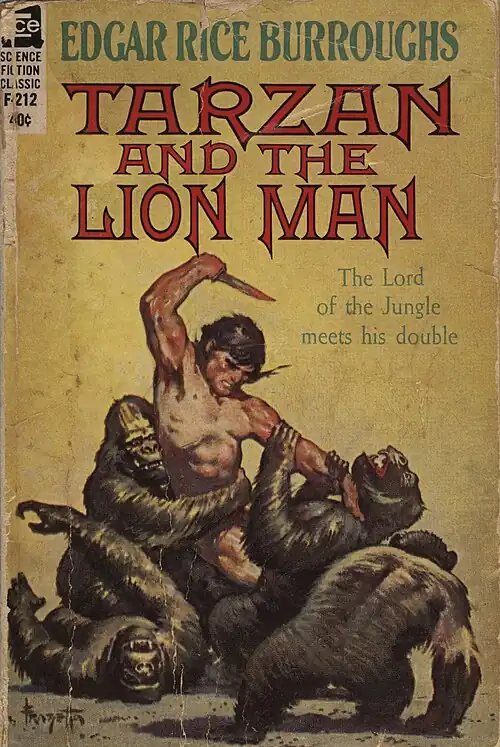
TWO TARZANS IN GORILLA COUNTRY
Tarzan moved stealthily in the trees high above a savage scene. The tempo of the dance had increased. Painted warriors were leaping and stamping around a small group that surrounded the prisoner. As Tarzan gazed at the prisoner he experienced a shock.
It was as though his disembodied spirit hovered above and looked down upon himself, so amazing was the likeness of this man to the Lord of the Jungle.
Who was this man who looked so much like Tarzan as to startle even Tarzan himself and what did he seek in the jungles of Africa?
FOREWORD
If ever Burroughs wrote a tongue-in-cheek Tarzan story, Tarzan and the Lion Man came closest. Several critics have commented that Burroughs often satirized such things as religion, social customs and the like, but it should also be noted that he was not above kidding himself and his fellow men.
In Chapter 5, the suggestion is made that the motion picture hero go out in front of the safari, and clear the way of marauding natives. But the Lion Man is quick to reply that he’d “like to have the author of that story” sent out instead. The Old Master must have smiled to himself as he wrote that dialogue, for through his seventy-four years, he never once set foot in Africa.
Burroughs was also continually pointing out that man is the only creature that is cruel, vindictive, selfish, ambitious and treacherous, while wild animals are not. This is blandly pointed out in the novel, particularly in the latter portions of Chapter 25.
But the crowning satire of the whole novel, even overshadowing the fabulous episode of the gorillas, are the last couple of chapters dealing with Tarzan’s visit to Hollywood, California. They concern the casting of a new Tarzan film, and one John Clayton, Lord Greystoke, Tarzan of the Apes himself. Upon being asked to try out for the part of Tarzan, he is considered by the casting director as “not the type.” Truly, Burroughs must still be chuckling about that little scene.
—Camille Cazedessus, Jr.
Editor, ERB-dom, a magazine devoted to Burroughs and his works.
EDGAR RICE BURROUGHS
TARZAN
AND THE
LION MAN
ACE BOOKS, INC.
1120 Avenue of the Americas
New York 36, N.Y.
This Ace edition follows the text of the first hard-cover book edition, originally published in 1934.
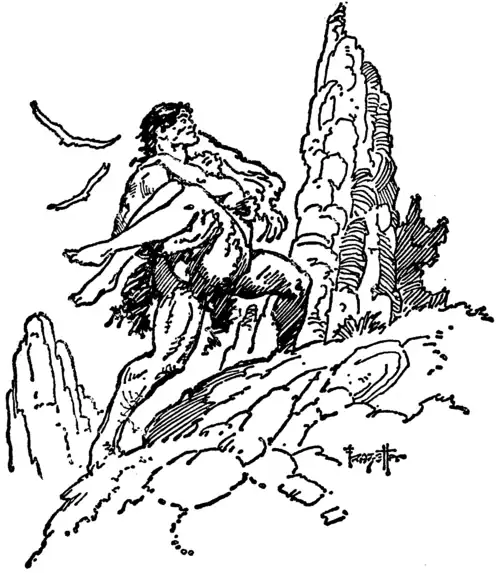
Cover art and title-page illustration by Frank Frazetta.
Printed in U.S.A.
Chapters (not listed in original)
- In Conference
- Mud
- Poisoned Arrows
- Dissension
- Death
- Remorse
- Disaster
- The Coward
- Treachery
- Torture
- The Last Victim
- The Map
- A Ghost
- A Madman
- Terror
- Eyad
- Alone
- Gorilla King
- Despair
- “Come With Me!”
- Abducted
- The Imposter
- Man And Beast
- God
- “Before I Eat You!”
- Trapped
- Holocaust
- Through Smoke And Flame
- Death At Dawn
- The Wild-Girl
- Diamonds!
- Good-bye, Africa!
- Hello, Hollywood!

 This work is a newer edition of a previously copyrighted work that contains new material additions such as the cover image, front matter or end matter.
| Original: |
This work is in the public domain in the United States because it was legally published within the United States (or the United Nations Headquarters in New York subject to Section 7 of the United States Headquarters Agreement) before 1964, and copyright was not renewed.
Works could have had their copyright renewed between January 1st of the 27th year after publication or registration and December 31st of the 28th year. As this work's copyright was not renewed, it entered the public domain on January 1st of the 29th year. The longest-living author of this work died in 1950, so this work is in the public domain in countries and areas where the copyright term is the author's life plus 74 years or less. This work may be in the public domain in countries and areas with longer native copyright terms that apply the rule of the shorter term to foreign works.
It is imperative that contributors ascertain that there is no evidence of a copyright renewal before using this license. Failure to do so will result in the deletion of the work as a copyright violation.
Public domainPublic domainfalsefalse |
|---|---|
| New material: |
This work is in the public domain in the United States because it was legally published within the United States (or the United Nations Headquarters in New York subject to Section 7 of the United States Headquarters Agreement) between 1930 and 1977 (inclusive) without a copyright notice. The longest-living author of this work died in 2010, so this work is in the public domain in countries and areas where the copyright term is the author's life plus 14 years or less. This work may be in the public domain in countries and areas with longer native copyright terms that apply the rule of the shorter term to foreign works.
Public domainPublic domainfalsefalse |