The Biographical Dictionary of America/Barrett, Lawrence
BARRETT, Lawrence, actor, was born at Paterson, N.J., April 4, 1838. He sprang from an obscure family, his father being an Irish immigrant, too poor to educate him properly, but the boy possessed an insatiable craving for reading, and lost no opportunity to study history
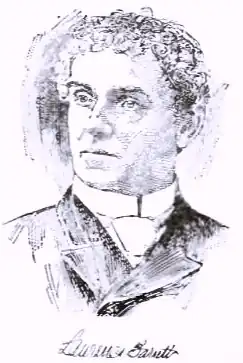 and literature. His first work in a theater was as a call-boy in Detroit, and there his love for the drama was awakened. His spare moments were occupied in reading plays and his acute observation readily grasped the details of the actor’s art. From call-boy he worked his way up to a speaking part, and in January, 1857, though not nineteen years old, he made his first appearance in New York city as Sir Thomas Clifford in the "The Hunchback," playing in the Chambers street theatre. Mr. Burton, who had just opened a new house, afterwards called Winter Garden theatre, was pleased with Barrett’s acting and engaged him to play minor parts in the new theatre. In the season of 1862–'63, he had risen to the part of leading man, supporting Edwin Booth, Mary Provost, Mrs. D.P. Bowers, and others. In 1864 he went south with Lewis Baker, and undertook the management of the old Varieties theatre in New Orleans, La. There he played for the first time such parts as Hamlet and Richelieu, and Eliot Grey in Lester Wallack’s "Rosedale." He made his first trip abroad in 1867, returning in the latter part of that year, and afterward taking a sea journey to California. In February, 1869, he played Hamlet in Maguire’s opera house in San Francisco. While in that city he undertook, in connection with John McCullough, the management of the new California theatre, retaining his interest for nearly two years. He returned to New York in the summer of 1870 and played Cassius at Niblo’s theatre, with E.L. Davenport as Brutus, and Walter Montgomery as Marc Antony. The following winter he played with Edwin Booth at Booth’s theatre, acting Laertes, Othello and Iago, Maurpta to Booth’s Hamlet, Iago, and Richelieu, and also appearing as Leontes in "Winter’s Tale." In June, 1871, he first acted James Harebell in "The Man of Airlie" at Booth’s, and in December assumed the management of the new Varieties theatre in New Orleans, La., remaining in New York to act Cassius in Edwin Booth’s revival of "Julius Cæsar." He went to New Orleans in March, 1872, and played with great success in many roles, among them Hamlet, Richelieu, Shylock, Richard III., Cassius, Raphael in "The Marble Heart," Alfred Evelyn in "Money," Dazzle in "London Assurance," Manuel in "The Romance for a Poor Young Man," Harebell, Romeo, and King Lear. Returning to Booth’s in 1875 he added to his repertoire "Daniel Druce, Blacksmith," by W.S. Gilbert, Mr. Barrett taking the title roll. In 1877 he went to Cincinnati, O., playing "A Counterfeit Presentment," and in 1878 played "A Yorick’s Love" in Cleveland, both Mr. Howell’s plays. In 1881 he went to Chicago, and in 1882 to Philadelphia, attracting large and enthusiastic audiences. He played in the Lyceum theatre, London, in the spring of 1884, and in the fall of the same year again appeared in New York city, having two new plays—"A Blot on the ’Scutcheon," by Robert Browning, and "The King’s Pleasure," by Theodore de Banville. In the fall of 1886 he became the manager of Edwin Booth’s tours, and in 1887–88 and 1888–89 played with that actor in "Julius Cæsar," "Othello," "Hamlet," and other plays. He made four tours of Europe, but was received with some coldness by English audiences. The best critics hesitated to call Mr. Barrett great, or called him great with some reservations. His art was acquired rather than original, and acquired only by the most assiduous labor of an earnest and highly intellectual man. His appearance on the stage cannot better be described than by the words of William Winter, written shortly after Barrett’s death: "His coming was always a signal to arouse the mind. His mental vitality impressed even unsympathetic beholders with a sense of fiery thought struggling in its fetters of mortality and almost shattering and consuming the frail temple of its human life. His stately head, silvered with graying hair, his dark eyes deeply sunken and glowing with intense light, his thin visage, pallid with study and pain, his form of grace, and voice of sonorous eloquence and solemn music (in compass, variety and sweetness, one of the few great voices of the current dramatic generation), his tremendous earnestness, his superb bearing, and his invariable authority and distinction, all those attributes united to announce a ruler and leader in the realm of intellect." Lawrence Barrett was said to be essentially the student and scholar of the theatre, and it is undeniable that he was a man of unusual intellectual power. But the chief characteristic of his nature was his unswerving adherence to what he believed to be right. A biographer said of him, "He never spoke a false word or knowingly harmed a human being in all his life." He was a prominent member of the Players’ club in New York, the author of "Edwin Forrest" (1881), and "Charlotte Cushman" (1889). He died in New York city, March 20, 1891.