The Mathematical Principles of Natural Philosophy (1729)/Appendix
APPENDIX.
To Cor. 2. Prop. 91. Book 1. Pag 303.


Let ; Theref. ; also ; Therefore : And .





Now the force whereby the circle, whose radius is , attracts the body , is as (by Cor. I. Prop. 90.)
And . Also : Th. . Therefore is the fluxion of the attractive force of the sphere on the body , or the ordinate of a curve whose area represents that force. But the fluent of is ; and the fluent of is (by Tab. 1. Form 4. Cas. 2 Quadr. of Curv.) Therefore is the general expression of the area of the curve. Now let , then area = Also let , then area = And the force whereby the sphere attracts the body is as ( or as .


2. The force whereby the spheroid , attracts the body , may, in the same manner, be found thus. Let ,
The force of a circle whose radius is , to attract , is as , (by Cor. 1. Prop. 90.) Now (by the Conics;) and Therefore , or) is the fluxion of the attractive force of the spheroid on the body , or the ordinate of a curve whose area is the measure of that force. Now the fluent of is ; and (by Cas. 2. Form 8. Tab. 2. Quad. Cur.) the fluent of is . Therefore is the general expression for the area of the curve. But is an ordinate to a conic section, whose abscissa is x; and's, σ, the areas NMB, NKA, adjacent to the ordinates BM, AK: Put D=-0.


Let x = a, or PE=PB=BM; then v=6, daa-ann-ds, or PD =4. And let x=α, or PE-PA-AK; then v«, or PD =PB = BM, and the area =at •cc + dd―rr daḍ aɑɑ 2 do =PA=AK, and the area = a + =B. cc+dd-rr
And the attractive force of the spheroid on P, is as (A-B±a-α But 2d = (aα=) BM +AK, therefore 2dr= trapezium ABMK; and D= (5-6=) area AKRMB; therefore D-2dr = mixtilinear area KRMLK C; consequently 2dr-D=-C; therefore 2dx 2 dr -D=-2dC; therefore the attractive force of the spheroid on P, is as 2 AS × S C -2 PSX KRMX 2 SC-PS-AS 2rcc 2dC ccdd—rr Confequently, the attractive force of the spheroid upon the body P will be to the attractive force of a sphere, whole diameter is AB, upon the same body P, as ASXSC²- RSK RMK rcc-dC CC-\-derr AS 3 to 83 or SC² +PS² —AS to 3PS
To Schol. Prop. 34. Book 2. p. 119. l. 20.
For let it be proposed to find the vertex of the cone, a frustum of which has the describ'd property.
Let be the frustum, and the vertex required. (Pl. 19. Fig. 2.)


Now conceive the medium to consist of particles which strike the surface of a body (moving in it) in a direction opposite to that of the motion; then the resistance will be the force which is made up of the efficacy of the forces of all the strokes.
In any line , parallel to the axis of the cone, and meeting its surface in , take of a given length, for the space describ'd by each point of the cone in a given time: Draw perpendicular to the side of the cone, and perpendicular to .


Therefore the line will represent the velocity, or force, with which a particle of the medium strikes the surface of the cone obliquely in .
But the force is equivalent to two forces, the one perpendicular, the other parallel to the side of the cone; which last is therefore of no effect.


And the perpendicular force is equivalent to two forces, the one parallel to the axis of the cone, the other perpendicular to it; which also is destroy'd by the contrary action of another particle on the opposite side of the cone.


There remains only the force , which has any effect in resisting or moving the cone in the direction of its axis.
Therefore the whole force of a single particle, or the effect of the perpendicular stroke of a particle, upon the base of a circumscribing cylinder, is to the effect of the oblique stroke upon the surface of the cone (in ) as to , or as to , or as to .
Now the number of particles striking in a parallel direction on any surface, is as the area of a plane figure perpendicular to that direction, and that would just receive those strokes.
Therefore, the number of particles striking against the frustum, that is, against the surfaces describ'd by the rotation of , and , each particle with the forces , and respectively, is as the circle describ'd by ( or) , and the annulus described by , that is, as to .


But the whole force of the medium in resisting, is the sum of the forces of the several particles.
Therefore, the resistance of the medium, or the whole efficacy of the force of all the strokes against the end of the frustum, is to the resistance against the convex surface thereof, as ( to or as to or as) to . Theref. the whole resistance of the medium against the frustum may be represented by which call ; that is, (putting , then , and ; therefore : Consequently ; But is a minimum; therefore ; consequently . Hence ; and making ; then .






To the same Schol. p. 120. l. 10.




But the sum of these resistances is a minimum. Therefore ,or : But Failed to parse (syntax error): {\displaystyle y=\left ( \overline{Gg}^2 = \overline{Bb}^2 + \overline{yg}^2= \right aa +2ax + xx +bb ) and z=\left ( \overline{Nn}^2 = \overline{Mm}^2 + \overline {vn}^2 = \right ) aa + 2ax + xx + bb;}
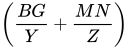
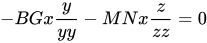
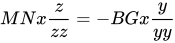
- therefore , and
- consequently ; or Therefore


Consequently, that the sum of the resistances against the surfaces generated by the lineola and , may be the
least possible, must be to as to . Wherefore, if be made equal to , so that the angle may be 45°, and the angle 135°; also , and ; then ; and since is parallel to , and parallel to ; also ; it follows that ; therefore ; also . Consequently . Therefore is to as to .


FINIS.