Troja/Chapter 6
CHAPTER VI.
The Conical Mounds, Called Heroic Tumuli.
§ I. The Tumulus of Achilles.—Another object of special interest was my exploration of eight more of the conical mounds, the so-called Trojan Heroic Tumuli. I began with the excavation of the two tumuli situated at the foot of Cape Sigeum, the larger of which the tradition of all antiquity attributed to Achilles, the smaller one perhaps to his friend Patroclus. But this is by no means quite certain, for, according to Strabo,[1] there were at the foot of Cape Sigeum the tombs of Achilles, Patroclus, and Antilochus, and, as before mentioned, I discovered that one of the large massive windmills to the south-east of Sigeum is actually built on the top of an ancient conical tumulus, which makes up the number three, as stated by Strabo. With regard to the large conical hill on the projecting headland, there can be no question that it is the very tumulus to which tradition unanimously pointed as the sepulchre of Achilles; but we have nothing to guide us as to which of the two remaining tumuli was attributed by the ancients to Antilochus, and which to Patroclus, for the name "tomb of Patroclus," which the smaller unencumbered tumulus now bears, seems to have been given to it less than a century ago by Lechevalier or Choiseul-Gouffier,[2] and the other tumulus, which is crowned by the windmill, has not come under the notice of any modern traveller, and is therefore marked on no map. But for brevity's sake I shall still call the small unencumbered conical hill the tumulus of Patroclus.
That the large tumulus on the jutting headland was considered in the historical times of antiquity as the sepulchre of Achilles, is evident from Strabo,[3] Arrian,[4] Pliny,[5] Lucian,[6] Quintus Smyrnaeus,[7] Dion Cassius,[8] and others. It was situated within the fortified town of Achilleum,[9] which seems to have extended to and enclosed the site of the present little Turkish town of Koum Kaleh; for fragments of marble columns and other architectural blocks, which are found near the surface, denote the existence of an ancient city on that site. The existence of an ancient settlement to the south and east of the tumulus is attested by the masses of ancient pottery with which the ground is covered.
The tumulus of Patroclus is about 350 yards to the south-east of the sepulchre of Achilles, and the third tumulus, on which the windmill stands, is about a thousand yards still farther to the south.[10]
The tomb of Achilles was, according to Choiseul-Gouffier,[11] a century ago vulgarly called "Thiol," whilst now this tumulus, as well as that of Patroclus, are indifferently called "Cuvin" by the villagers. The former tumulus is situated immediately to the north-east of Cape Sigeum, at a lesser height, on the very border of the high table-land which falls off abruptly, and is about 250 yards from the Hellespont.[12] On account of its high situation it can be seen from a great distance out at sea, and it answers therefore very well to the indications of Homer.[13] "Then we the holy host of Argive warriors piled over them (thy bones) a great and goodly tomb on a jutting headland upon the wide Hellespont, that it might be visible far off from the sea, to men who now are, and to those that shall hereafter be born."
In the spring of 1879 the proprietors of these tumuli asked me £100 for permission to explore the tomb of Achilles, and as much for that of Patroclus, but now they had considerably modified their pretensions and asked only £20 for each, whilst I offered only £1. Happily the civil governor of the Dardanelles, Hamid Pasha, came out in April to see my works, and I profited by this opportunity to explain the matter to him, and to convince him that the demand of the proprietors was exorbitant and ridiculous. He thereupon decided that I should at once commence the exploration of the two tumuli, with or without the consent of the proprietors; and that, in case they were not satisfied with £2, or at the utmost £3, he would, after the exploration had been finished, send out an expert to get the damage estimated and ascertain the indemnity the two proprietors were entitled to. Being afraid to come off second best by waiting, the two men now eagerly accepted £3 in full settlement of their claim. But as by the Turkish law they were entitled to one-third of any treasure-trove that might be discovered, they watched the progress of the excavation most vigilantly, and never left it for a moment. But they were greatly disappointed, not I; for, having found no gold or silver in the six tumuli which I had explored before, I had not the slightest hope of discovering any now. All I expected to find was pottery, and this I found in abundance. I assigned to each tumulus a gendarme and four of my very best Turkish workmen, of whom I was sure that they would work just as assiduously without an overseer as with one. The duty of the gendarme was to look sharp that all, even to the smallest potsherds, were carefully collected, and nothing thrown away. On the western slope of the tumulus of Achilles, fragments of the foundation-walls of the farmhouse, which Choiseul-Gouffier saw here, may still be seen peeping out from the ground.
Into both these tumuli I sank shafts from the top, three mètres long and broad. We worked at first only with pickaxes and shovels, with which the débris were thrown out as long as the shafts were less than two mètres deep; afterwards the débris were carried out in baskets. The diameter of the tumulus of Achilles is thirty mètres at its foot, its upper diameter being fifteen mètres; its lowest height is four mètres, its greatest height twelve. It had been explored in 1786 by a Jew, by order and on account of Count Choiseul-Gouffier, who was at that time the French ambassador at Constantinople. The Jew pretended that he had sunk a shaft from the top,[14] and had found the upper part of the tumulus to consist of well-beaten clay to a depth of two mètres; that he had then struck a compact layer of stones and clay, resembling masonry, 0.60 m. deep, that he had found a third stratum consisting of earth mixed with sand, and a fourth of very fine sand, and had reached at a depth of 9.70 m. a quadrangular cavity, 1.33 m. in length and breadth, formed of masonry, and covered with a flat stone, which had broken under the ponderous weight pressing upon it. It is not quite clear whether the Jew meant that the cavity was in the rock or above it; at all events he described the rock as consisting of granite. He pretended to have found in the cavity a large quantity of charcoal, ashes impregnated with fat, several bones, among which were the upper part of a tibia and the fragment of a skull; also the fragments of an iron sword, and a bronze figure seated in a chariot with horses, as well as a large quantity of fragments of pottery, exactly similar to the Etruscan, some of which was much burnt and vitrified, whereas all the painted terra-cotta vessels were unhurt. But as no man of experience or worthy of confidence was present at the exploration, scholars appear to have distrusted the account from the first, and to have thought that the Jew, in order to obtain a large reward, had procured and prepared beforehand all the objects he pretended to have found at the bottom of the tumulus.
In the first place I can assure the reader, that the rock here, as well as everywhere else in the plain of Troy north of Bounarbashi, is calcareous, and that no granite exists here; in the second place, that the Jew made only a small excavation in the southern slope of the tumulus, and that he remained far away from its centre; in fact, so far away from it, that in the shaft, three mètres in length and breadth, which I sunk from the top of the tomb, and precisely in its centre, I found all the different strata of earth, of which the tumulus is composed, perfectly undisturbed. As my shaft remains open, and as I cut steps in it, visitors can easily convince themselves that:
| The | upper | layer, | 0.70 m. | deep, | consists | of black earth. |
| The„ | second | layer,„ | 0.30 m. | deep,„ | consists„ | sand, clay, and small stones. |
| The„ | third | layer,„ | 0.10 m. | deep,„ | consists„ | white and yellow clay. |
| The„ | fourth | layer,„ | 0.30 m. | deep,„ | consists„ | light-coloured clay, with small stones. |
| The„ | fifth | layer,„ | 0.10 m. | deep,„ | consists„ | blue clay. |
| The„ | sixth | layer,„ | 1.70 m. | deep,„ | consists„ | sand and light-coloured clay. |
| The„ | seventh | layer,„ | 0.10 m. | deep,„ | consists„ | black earth. |
| The„ | eighth | layer,„ | 0.20 m. | deep,„ | consists„ | light-coloured clay. |
| The„ | ninth | layer,„ | 3.00 m. | deep,„ | consists„ | light-coloured lumps of clay mixed with pieces of sandstone. |
| 6.50 m. |
Thus we get a total depth of 6.50 m. from the top to the bottom of the tumulus, which differs by not less than 3.20 m. from the depth of 9.70 m. which the Jew pretended to have reached,[15] though in reality he appears to have excavated to a depth of only one mètre. All the Jew's other statements are likewise mere fictions: his description of the different layers of earth of which the tumulus consists is false; and equally false are his assertions that he found a large quantity of charcoal, human bones, Image missingNo. 132.—Arrowhead of bronze or copper without barbs (γλωχίνες). Found in the tumulus of Achilles, Size 3:4; depth about 6 m. and a mass of fragments of pottery similar to the Etruscan, a bronze figure seated in a chariot with horses, or even a quadrangular cavity consisting of masonry; for the tumulus contains nothing of all that, nor ever did contain it. As in all the tumuli of the Troad explored by me in 1873 and 1879, I found in the tumulus of Achilles no trace of bones, ashes, or charcoal—in fact no trace of a burial. Of bronze or copper I found, at a depth of about six mètres, a curious arrowhead without barbs (γλωχίνες), in which are still preserved the heads of the little pins by which it was fastened to the shaft; I represent it here under No. 132. According to Dr. L. Stern[16] this form of arrow-head is the most ancient, and occurs already in Egypt in the time of the XIIth dynasty. A perfectly similar arrow-head was found by Professor Virchow in his excavations in the prehistoric cemetery of Upper Koban.[17] Similar ones were also found at Olympia, as well as on the battlefield of Plataeae and in tombs in Bohemia, as e.g. at Blovica and Korunka, and in Denmark.[18] I also found a fragment of an iron nail.
Of fragments of pottery large quantities were turned up, among which there are two or three pieces of the lustrous black hand-made pottery which is peculiar to the first and most ancient city of Hissarlik. But these potsherds must have lain on the ground when the tumulus was erected. There were also a number of fragments of but slightly baked lustrous grey or blackish wheel-made pottery, which, as before mentioned, occur also in the lowest layer of débris of the Greek Ilium, and which somewhat resemble the Lydian pottery described in the tenth chapter of Ilios. But by far the greater proportion is thoroughly baked wheel-made Hellenic pottery, of very different types and fabric. For example, many pieces of it are o, 008 mm. thick, and have on both sides or only on one side a glazed faint lustrous black colour; or this colour is only on the outer side and extends to about half the height of the vase, the other half having a light-yellow, the inner side a glazed dark-red colour; or the outside is dark lustrous black and the inside dark-brown; or the outside is covered all over with alternate glazed black and dark-red stripes, the inside being unpainted and having the natural light-yellow colour of the clay; or with the latter colour on the inside we see on the outside a glazed brown. For all these terra-cottas no archaeologist will hesitate to claim the ninth century B.C., or even a remoter age, for the appearance of this pottery is so archaic that, even if it had been found among the oldest Mycenean pottery, outside the royal tombs, it would not have appeared out of place there. But there is a quantity of much finer wheel-made Hellenic pottery, from 0,003 mm. to 0,006 mm. thick, which baffles the ingenuity of the most experienced archaeologist, and makes him think at first sight that it is of the Roman time. It is not till after looking at it for a while that he sees the mistake, and begins to refer it piece after piece to the Macedonian period; but afterwards, when he has examined it for a long time most carefully, and compared it with the Mycenean pottery, he at last fully realizes the antiquity of these terra-cottas, and becomes convinced that they belong probably to a time five centuries before the birth of Alexander the Great. What perplexes the archaeologist most are the fragments of a primitive monochrome glazed lustrous black pottery; for, until recently, we were accustomed to consider such as of the Roman or, at the utmost, of the Macedonian age. But I found at Mycenae a fragment of most excellent varnished. lustrous black Hellenic pottery, with an inscription scratched on it, the characters of which prove with certainty that it belongs to the sixth century B.C.[19] The fragment itself is in the Mycenean Museum at Athens, and it will be seen that it is as good as any pottery of that kind made in later times. But such excellent varnished lustrous black terra-cotta ware cannot possibly have been invented at once; it naturally leads us to suppose a school of potters, which had worked for centuries to reach such a perfection in the art, and, if all the other pottery of the tumulus of Achilles can claim the ninth century B.C. as its date, we must necessarily attribute to the same period the fragments of glazed lustrous black ware, which were found there. It should besides be considered, that such perfect pottery as the Mycenean fragment can never lose its beautiful lustrous black colour; whilst on the primitive pottery of the Achilles-tomb the glazed lustrous black colour has in a great many instances been more or less effaced. The other terra-cottas either have on the outside alternate lustrous black and red bands, with a uniform black on the inside, or they are light-yellow on the outside and black on the inside; or they are black on both sides; or they are black on the outside and yellow on the inside; or they have on the outside a light-red colour with a black rim, and are black on the inside; or they have on the outside black bands on a light-yellow or red ground, and inside the natural clay colour; or they have on the outside dark-red bands on a light-red ground, and are inside of a uniform dark-red; or they have on the outside a very rude meaningless lustrous black ornamentation on a light-yellow or red ground, and are monochrome black on the inside. There was further found a whorl of that very slightly baked greyish pottery, already mentioned, which somewhat resembles the Lydian pottery described in the tenth chapter of Ilios; it is ornamented with four incised wedges, which form a cross round the perforation. All this pottery was found scattered about in the débris in sinking the shaft. There is also a fragment of a varnished monochrome red vase, which certainly cannot claim a higher antiquity than the Macedonian period; but, as this was found only a few inches below the surface, it probably comes from sacrifices made here in later times, and cannot be taken into account.
The tumulus described in the Odyssey, XXIV. 80–84,[20] as the tomb of Achilles, situated on the jutting headland on the shore of the Hellespont, can be no other than this mound; and there can be no doubt that the poet had this one also in view, when he makes Achilles order the tumulus of Patroclus to be erected: "I do not, however, advise you to make the tomb too high, but as is becoming; at a future time you may pile it up broad and high, you Achaeans who survive me and remain in the ships with many oars."[21]
§ II. Tumulus of Patroclus.—The passage just cited seems to prove that in Homer's mind there was only one tumulus raised for Patroclus and Achilles. But it is highly probable that the two neighbouring tumuli also existed in the Homeric age, or at least the one which is now attributed to Patroclus. This latter had been excavated in 1855 by Mr. Frank Calvert, of the Dardanelles, in company with some officers of the British fleet. They sank an open shaft in it and dug down to the rock, without finding anything worth their notice. But at that time archaeologists had not yet given any attention to the fragments of ancient pottery. Even when in 1876 I made the large excavations at Mycenae, the delegate of the Greek Government, the Inspector of Antiquities, Mr. P. Stamatakes, pronounced the immense masses of fragments of highly important archaic pottery which were brought to light, and which far exceeded in interest anything of that kind ever found in Greece, to be useless débris, and urgently insisted that they should be shot from the hill with the real rubbish; in fact I could not prevent this being done with quantities of such fragments. It was in vain that I telegraphed to Athens, begging the Minister of Public Instruction, as well as the President of the Archaeological Society, Mr. Philippos Ioannes, to stop this vandalism. Finally I invoked the aid of the Director-General of Antiquities, Mr. P. Eustratiades, and of Professor E. Castorches, and I owe it solely to the energy of these worthy scholars, that the Archaeological Society was at last induced to put a stop to that outrage, and to command Stamatakes to preserve all the fragments of pottery. Since that time people have begun to regard pottery as the cornucopiae of archaeological knowledge, and to employ it as a key to determine approximately the age of the sites where it is found. Science will, therefore, be grateful to me for having saved the really enormous masses of fragments of most ancient Mycenean pottery from certain destruction.For similar reasons I was very anxious to excavate the tumulus of Patroclus again, in order to gather the potsherds, which I felt sure of finding. The diameter of this tumulus at the base is 27 mètres, whilst according to the measurement of Choiseul-Gouffier[22] it was only 16 feet, or 5.33 m.: he must therefore have had a strange mode of measuring; but his whole work[23] is of the same character, and abounds with errors not less absurd and ridiculous. The diameter at the top is 8 mètres; the perpendicular height, 6 mètres. I sank in it from the top a shaft 3 mètres long and broad, and dug it down to the rock. I found this tumulus, from the top down to a depth of 3.45 m., to consist of light-coloured clay mixed with stones; then followed a layer, 0.40 m. deep, of red and light-coloured clay mixed with sand, and afterwards a layer, 0.40 m. deep, of very light-coloured clay; the lowest stratum, 1.25 m. deep, consists of dark brown clay. As we reached the rock at a depth of 5.50 m., it is evident that there was an elevation of the ground 0.50 m. high at the spot.
I found in this tumulus exactly the same archaic pottery as in the tumulus of Achilles, though in a much less considerable quantity; further, a long fragment of a flute of potstone, the lapis ollaris of Pliny, of which also the flutes are made which I found in my excavation in Ithaca and Mycenae.[24] I found here likewise neither human bones, nor ashes, nor charcoal, nor any other traces of a burial. We have, therefore, to add the conical mounds of Achilles and Patroclus to the six other tumuli, which my previous exploration had proved to be mere cenotaphia or memorials. That such cenotaphia or memorials were in general use at a remote antiquity, is proved by various passages in Homer. Thus, Pallas Athené directs Telemachus to erect a cenotaph to his father if he learns his death.[25] Menelaus erects in Egypt a cenotaph to Agamemnon.[26] So Virgil tells us that Andromache, who had married Helenus and become. queen of Chaonia, had erected in the shade of a sacred grove, on the bank of another Simois, a cenotaph in honour of Hector.[27]
§ III. Tumulus of Antilochus.—In spite of all my endeavours, I have not been able to persuade the proprietor of the third tumulus, which is crowned by the large massive windmill, to permit me, for an indemnity of £3, to sink a shaft within the building or to run in a tunnel at the foot of the hillock; for he apprehends that, by this operation, the heavy walls of the mill might fall in. I could only obtain from him permission to dig with the pickaxe small holes in the slope of the tumulus. In these holes I gathered many fragments of the very same archaic pottery which I had found in the tumuli of Achilles and Patroclus. All that remains, therefore, to be done, is to put on record the re-discovery of this tumulus which was so well known in antiquity,[28] and to insert it on the map of the Troad as the Tumulus of Antilochus, in order to distinguish it from the so-called Tumulus of Patroclus. But as Strabo,[29] in describing the shore of the plain of Troy, first mentions Cape Rhoeteum, and then, in succession, Cape Sigeum, the tomb of Achilles, the sepulchre of Patroclus, and in the last place the Tumulus of Antilochus, it is highly probable that this latter was the one farthest from the shore, and, consequently, that the tumulus which is crowned by the windmill was in antiquity really attributed to Antilochus.
§ IV. Tumulus of Protesilaus.-Far more interesting than any of the tumuli explored by me in the Troad, is the mound attributed by the tradition of all antiquity to the hero Protesilaus, who led the warriors of Phylacé in Thessaly against Troy, and not only, on the arrival of the fleet, was the first Greek who jumped on shore,[30] but also the first who was killed, either by Hector,[31] or Achates,[32] or Aeneas,[33] or Euphorbus.[34] His tomb was shown on the Thracian Chersonesus, near the city of Elaeus,[35] where he had a heroum and a celebrated oracle.[36] Of this city very extensive ruins may be seen in the background of the old Turkish fort of Eski Hissarlik,[37] which was abandoned thirteen years ago. It is about two 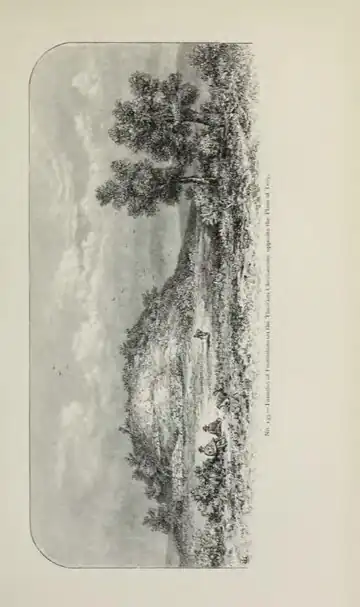
(Upload an image to replace this placeholder.)
Having heard that the proprietor of the tumulus, a Turk in Seddul Bahr, was in prison for the theft of a horse, and feeling sure that I could easily settle the indemnity Image missingNo. 134.—Hammer and Axe of Diorite, with perforation. Size about 1:3: found on the sur face of the tumulus of Protesilaus. later on by the intervention of the kind civil governor of the Dardanelles, Hamid Pasha; being moreover afraid that the ever suspicious and envious military governor of the Dardanelles, Djemal Pasha, might throw obstacles in my way;—I did not lose a moment of my precious time, and, having brought with me pickaxes, shovels, baskets, etc., I at once ordered the four workmen to sink, just in the middle of the summit, a shaft three mètres in length and breadth. I had done exceedingly well to hurry on the work, for the commandant of the fortress of Seddul Bahr reported my doings to the military governor of the Dardanelles, who, not being able to conceive how a man could waste his time in excavating a lonely hillock, suspected that I was merely using the excavation of the Protesilaus-tomb as a pretext for making plans of the fortress of Seddul Bahr, and investigating the lines of torpedoes recently sunk in the Hellespont; and so he issued an order to suspend the excavation. But happily this order arrived only on the evening of the second day. I at once telegraphed and wrote to the German Embassy in Constantinople to seek redress, but all the endeavours of the excellent first dragoman, Baron von Testa, were of no avail. I then proposed that the excavation of the tumulus should be continued at my expense by the commandant of Seddul Bahr, with his own men and one of my Turkish gendarmes; I promised neither to visit the tumulus myself nor to send thither either of my architects; but even this proposal was rejected with disdain. But, happily, in those two days my four workmen had dug down to a depth of 2.50 m., and had found large quantities of most ancient pottery, similar to that of the first and second cities of Hissarlik; some perforated balls of serpentine, of which I represent one under No. 135; a number of excellent axes of
diorite; large masses of rude stone hammers, corn-bruisers, saddle-querns, and other interesting things, among which was the pretty bronze knife which I represent here under No. 136; at its lower end are preserved the heads of the nails with which the wooden handle was fastened on.
I further represent here, under No. 136a, the fragment of a lustrous black vase with a handle of a very curious form.
At a depth of 150 m. we struck a layer of slightly baked bricks, mixed with straw, very similar to the bricks found in the second and third cities of Hissarlik.
The pottery with which the tumulus and the gardens around it are strewn, and which also predominates among the terra-cottas in the hill, is most decidedly identical with that of the first city of Troy, and proves with certainty that here, on the Thracian Chersonese, there lived in a remote prehistoric age a people of the same race, habits, and culture, as the first settlers on the hill of Hissarlik. With the débris of this ancient settlement, and probably long after it had ceased to exist, was erected the tumulus of Protesilaus, to the probable date of which we have a key in the latest pottery contained in the tomb. Now as I find among the pottery a great quantity of a similar type and of a like fabric to the pottery of the second, the burnt city of Troy, and nothing later, we may attribute the tumulus with the very greatest probability to the time of the catastrophe, which gave rise to the legend of the Trojan war. But I must remind the reader, that this is the only tumulus yet found having in it Trojan pottery. The tumulus of Besika Tepeh, explored by me in 1879,[42] contains a large quantity of prehistoric pottery, which appears to be contemporaneous with that of the second city of Troy, or may even be still more ancient, but its material, fabric, and forms, are totally different from anything found at Troy, and it most decidedly denotes a race of people altogether different. The same may be said of the tumulus of Hanaï Tepeh, which I explored together with Mr. Calvert,[43] for here too the pottery is totally different from the Trojan pottery. But Hanaï Tepeh has only the form of a vast tumulus; in reality the débris of which it is composed denote a succession of human settlements.
As the latest pottery contained in Kara Agatch Tepeh is identical with that of the second settlement of Troy, there is nothing to contradict the tradition, that this tumulus belongs to the actual time of the Trojan war; and who then shall gainsay the legend, that it marked the tomb of the first Greek who leaped down on the Trojan shore on the arrival of the fleet? We may find it more difficult to imagine that the name of this hero should have been Πρωτεσίλαος, which means "the first of the army or the people," for, unless we believe in predestination, we must think that he received this name from the glorious feat in which he perished.
With respect to this name, Professor Sayce remarks to me:—
- With Πρωτεσί-λαος, we must compare ναυσί-κλυτος, Ναυσι-κάα, &c., -λαος being "people."
- Πρώτεσι- ought to be a dative plural like ναῦσι, but from a nominative singular πρώτος (like γλυκύς).
- Πρώτεσι- may stand for πρώτεσσι, which may be formed from πρωτεύς, "the chief;" but "People among the first," has no sense.
- Perhaps Πρωτεσί-λαος has been formed after the analogy of ἑλκεσί-πεπλος, not grammatically but analogically. As ἑλκεσί-πεπλος means "trailing the robe," so πρωτεσί-λαος may, ungrammatically, have been supposed to mean "first among the people."
Besides the tumulus of Protesilaus, there certainly existed at the time of the Trojan war the oft-mentioned tumulus of Besika Tepeh, and that called Hagios Demetrios Tepeh, which is a natural rock of a conical shape, exactly resembling the so-called heroic tumuli, and probably considered at all times to be one of them.[44]
Professor Sayce observes to me: "It is very remarkable that, whereas the pottery found in the first two prehistoric cities of Hissarlik does not occur elsewhere in the Troad, it should nevertheless be met with on the European side of the Hellespont on the site of the tumulus of Protesilaus. We may infer from this fact that the first settlers in Troy came from Europe rather than from Asia. Now this inference is curiously borne out by a fragment of the Lydian historian, Xanthus, preserved in Strabo.[45] He there states that the Mysians 'for a time lived about (the Trojan) Olympus; but when the Phrygians crossed over from Thrace, they captured both the ruler of Troy and the neighbouring country, and while they settled here the Mysians settled about the sources of the Caïcus, near the Lydians.' This must have been before the Trojan war, since after it, according to Strabo,[46] the Troad was occupied by Greek colonists, Trêres, Cimmerians, and Lydians, then by Persians and Macedonians, and finally by Gauls."
§ V. The Three Nameless Tumuli on Cape Rhoeteum.—I also commenced with twelve workmen sinking shafts, three mètres long and broad, in the three tumuli on Cape Rhoeteum to the north-east of the tumulus of Ajax,[47] having obtained the permission of the proprietor of the field, a Turk in Koum Kaleh, for £3. But, alas! I had been digging only one day, when this work too was prohibited by the military governor of the Dardanelles. Strange to say, though my workmen had reached in each tumulus a depth of about 1.50 m., not a single fragment of pottery turned up, and thus this excavation remained wholly without result.
§ VI. The so-called Tomb of Priam.—I also sank a shaft, three mètres long and broad, in the tumulus which is situated on Mount Bali Dagh behind Bounarbashi,[48] and is 25 m. in diameter by 2.50 m. in height: it used to be ascribed, by the adherents of the Troy-Bounarbashi theory, to King Priam himself. But I found there nothing else than fragments of that sort of pottery, very slightly baked, wheel-made, exceedingly heavy, glazed, of a gray or blackish colour, which, as before mentioned, is frequent in the lowest layers of débris of the seventh city at Hissarlik, the Aeolic Ilium, and of which also many fragments were gathered in the tumulus of Achilles. The resemblance it bears to the Lydian pottery, described in Chapter X. of Ilios, is but very slight; the only points that both kinds of pottery have in common are, their very slight baking, their colour, and the large mass of mica they contain. For the rest, they are altogether different in form and in fabric; the Lydian pottery being, with rare exceptions, hand-made, whilst all the pottery of Priam's tumulus is wheel-made, and for this reason it is certainly of a later time than the former. As in the nine other "heroic tombs" explored by me, I found here no vestige of either bones or charcoal, and no trace of a burial. Like all the others, therefore, this is a mere cenotaph or memorial.
- ↑ XIII. p. 596.
- ↑ Carl Gotthold Lenz, Die Ebene von Troia nach dem Grafen Choiseul-Gouffier, Neu-Strelitz, 1798, p. 64.
- ↑ XIII. p. 595.
- ↑ Anab. 1, 11, 12; compare Cicero, pro Arch. 10.
- ↑ H. N. V. 33.
- ↑ Charon, 521.
- ↑ VII. 402.
- ↑ LXXVII. 16.
- ↑ See the authors just cited.
- ↑ See the large Map of the Troad at the end of this volume.
- ↑ See C. G. Lenz, Die Ebene von Troia, etc., p. 64.
- ↑ See the large Map of the Troad.
- ↑ Od. XXIV. 80–84:
ἀμφ' αὐτοῖσι δ' ἔπειτα μέγαν καὶ ἀμύμονα τύμβονχεύαμεν 'Αργείων ἱερὸς στρατός αἰχμητάων,ἀκτῇ ἐπὶ προἐχούσῃ, ἐπὶ πλατεῖ Ελλησπόντῳ,ὡς κεν τηλεφανὴς ἐκ ποντόφιν ἀνδράσιν εἴη,τοῖς οἳ νῦν γεγάασιν καὶ οἱ μετόπισθεν ἔσονται.
- ↑ See C. G. Lenz, Die Ebene von Troia nach dem Grafen Choiseul-Gouffier, Neu-Strelitz, 1798, p. 65.
- ↑ See C. G. Lenz, Die Ebene von Troia nach dem Grafen Choiseul-Gouffier, Neu-Strelitz, 1798, p. 65.
- ↑ Rudolf Virchow, Das Gräberfeld von Koban im Lande der Osseten, Berlin, 1883, p. 90.
- ↑ Ibid. p. 90, Table I. No. 21.
- ↑ J. J. A. Worsaae, Nordiske Oldsager, Table 38, No. 192.
- ↑ See this inscription in my Mycenae, p. 115.
- ↑ Cited above, p. 244.
- ↑ Il. XXIII. 245–248:
τύμβον δ᾽ οὐ μάλα πολλὸν ἐγὼ πονέεσθαι άνωγα,ἀλλ' ἐπιεικέα τοῖον· ἔπειτα δὲ καὶ τὸν ᾿Αχαιοίεὐρύν θ' ὑψηλόν τε τιθήμεναι, οἵ κεν ἐμεῖοδεύτεροι ἐν νήεσσι πολυκλήϊσι λίπησθε.
- ↑ C. G. Lenz, Die Ebene von Troia, etc., p. 64.
- ↑ Voyage Pittoresque de la Grèce. Paris, 1820.
- ↑ See Mycenae. p. 78.
- ↑ Od. I. 289–291:
εἰ δέ κε τεθνηῶτος ἀκούσῃς, μηδ' ἔτ᾽ ἐόντος,νοστήσας δὴ ἔπειτα φίλην ἐς πατρίδα γαίαν,σῆμά τέ οἱ χεῦαι, καὶ ἐπὶ κτέρεα κτερείξαι.σῆμά τέ οἱ χεύω, καὶ ἐπὶ κτέρεα κτερείξωπολλὰ μάλ', ὅσσα ἔοικε, καὶ ἀνέρι μητέρα δώσω.
- ↑ Od. IV. 583, 584:
αὐτὰρ ἐπεὶ κατέπαυσα θεῶν χόλον αἰὲν ἐόντων,χοῦ ᾿Αγαμέμνονι τύμβον, ἵν᾽ ἄσβεστον κλέος εἴη.
- ↑ Æneid. III. 302–305:
ante urbem in luco, falsi Simoentis ad undam,libabat cineri Andromache, Manesque vocabatHectoreum ad tumulum, viridi quem cespite inanem,et geminas, causam lacrymis, sacraverat aras.
- ↑ Strabo, XIII. p. 596.
- ↑ Strabo, XIII. p. 596.
- ↑ Il. II. 695-699:
Οἱ δ' εἶχον Φυλάκην καὶ Πύρασον ἀνθεμόεντα,Δήμητρος τέμενος, Ιτωνά τε, μητέρα μήλων,ἀγχίαλόν τ' Αντρῶν ἠδὲ Πτελεὸν λεχεποίην·τῶν αὖ Πρωτεσίλαος ᾿Αρήνος ἡγεμόνευεν,ζωὸς ἐών· τότε δ' ἤδη ἔχεν κάτα γαῖα μέλαινα.
XIII. 681; XV. 705; Philostr. Heroica, II. 15.
- ↑ Lucian, D. M. XXIII. 1; Tzetzes, Lycophr. 245, 528, 530; Ovid. Met. XII. 67; Hyg. Fab. 103.
- ↑ Eustath. p. 326, 5.
- ↑ Dictys Cret. II. 11.
- ↑ Eustath. p. 325, 38.
- ↑ Strabo, XIII. p. 595; Pausanias, I. 34, 2; Tzetzes, Lycophron, 532.
- ↑ Philostr. I. 1; Herodot. VII. 33; IX. 116, 120; Pausan. III. 4, 5.
- ↑ See the large Map of the Troad.
- ↑ In Heroicis.
- ↑ Philostr. Heroica, ΙΙ. 1. Περὶ τῶν τοιούτων ἄκους, ξένε· κεῖται μὲν οὐκ ἐν Τροίᾳ ὁ Πρωτεσίλεως, ἀλλ᾽ ἐν Χεῤῥονήσῳ ταύτῃ, κολωνὸς δὲ αὐτὸν ἐπέχει μέγας οὑτοσὶ δήπου ὁ ἐν ἀριστερᾷ, πτελέας δὲ ταύτας αἱ νύμφαι περὶ τῷ κολωνῷ ἐφύτευσαν καὶ τοιόνδε ἐπὶ τοῖς δένδρεσι τούτοις ἔγραψαν που αὗται νόμον· τοὺς πρὸς τὸ Ἴλιον τετραμμένους τῶν ὄζων ἀνθεῖν μὲν πρωί, φυλλοῤῥεῖν δὲ αἰτίκα καὶ προαπόλλυσθαι τῆς ὥρας—
- ↑ Anthol. Pal. VII. 141, 385.
- ↑ Plin. H. N. XVI. 88.
- ↑ See Ilios, pp. 665–669.
- ↑ See the note in Ilios, p. 720.
- ↑ See Ilios, p. 650.
- ↑ XII. p. 572. Τέως μὲν γὰρ οἰκεῖν αὐτοὺς περὶ τὸν Ολυμπον· τῶν δὲ Φρυγῶν ἐκ τῆς Θράκης περαιωθέντων, εἵλοιτο τόν τε τῆς Τροίας ἄρχοντα καὶ τῆς πλησίον γῆς· ἐκείνους μὲν ἐνταῦθα οἰκῆσαι· τοὺς δὲ Μυσοὺς περὶ τὰς τοῦ Καΐκου πηγὰς πλησίον Λυδῶν.
- ↑ XII. p. 573.
- ↑ See the large Map of the Plain of Troy.
- ↑ See the large Map of the Plain of Troy.