vinculum
English
Etymology
From Latin vinculum (“bond, link”), from vinciō (“bind, fetter, tie”) + -ulum.
Pronunciation
- IPA(key): /ˈvɪŋ.kjə.ləm/
Noun
vinculum (plural vincula or vinculums)
- (obsolete, figurative) A bond or tie that unifies.
- (obsolete, arithmetic) Any symbol used to group some of the terms in an expression, indicating that that part of the calculation should be done before other parts, or that the Roman numeral underneath should be multiplied by 1,000.
- (arithmetic) A horizontal line over the top of some of the terms in an expression, indicating that that part of the calculation is to be done before other parts (in modern mathematical notation confined to use in radicals: ).
- (arithmetic) The horizontal line between the numerator and denominator in a fraction.
- (arithmetic) A horizontal line placed over one or more digits of a decimal expansion to indicate that those digits repeat indefinitely (the repetend).
- (mathematics, complex analysis) A horizontal line placed over a complex number or expression to denote its complex conjugate.
- (mathematics, geometry) A horizontal line drawn over two letters to denote the line segment joining them.
- is the line segment between points and
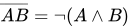
- (logic, electronics) A horizontal line placed over a symbol or expression to denote logical negation (complement).
- (arithmetic, historical) A horizontal line placed over the characteristic (integer part) of a common logarithm to indicate that the characteristic is negative while the mantissa (decimal part) remains positive. Historically used to simplify the use of logarithm tables.
- (anatomy) A ligament that limits the movement of an organ or part.
- (Australia, surveying) A symbol in the shape of an elongated letter "S" (∫) or pair of hooks (⌠⌡) drawn on plans to join non-contiguous sections of land that are to be treated as a single parcel.
- Synonym: (UK) brace






Quotations
- For quotations using this term, see Citations:vinculum.
Synonyms
- (ligament): mesotendon
Derived terms
See also
Further reading
Latin
Alternative forms
Etymology
From vinciō (“bind, fetter, tie”) + -ulum (instrument noun suffix).
Pronunciation
- (Classical Latin) IPA(key): [ˈwɪŋ.kʊ.ɫũː]
- (modern Italianate Ecclesiastical) IPA(key): [ˈviŋ.ku.lum]
Noun
vinculum n (genitive vinculī); second declension
- Any instrument whereby anything is bound or tied up; bond, band, fetter, chain, cord, tie, link
- (figuratively) a bond, obligation, binding force, tie, especially of marriage
- See alternative form vinclum, with quote from Aeneid, 4.59.
Declension
Second-declension noun (neuter).
| singular | plural | |
|---|---|---|
| nominative | vinculum | vincula |
| genitive | vinculī | vinculōrum |
| dative | vinculō | vinculīs |
| accusative | vinculum | vincula |
| ablative | vinculō | vinculīs |
| vocative | vinculum | vincula |
Related terms
Descendants
- Italo-Romance:
- Ibero-Romance:
- Borrowings:
References
- “vinculum”, in Charlton T. Lewis and Charles Short (1879), A Latin Dictionary, Oxford: Clarendon Press
- “vinculum”, in Charlton T. Lewis (1891), An Elementary Latin Dictionary, New York: Harper & Brothers
- “vinculum”, in Gaffiot, Félix (1934), Dictionnaire illustré latin-français, Hachette.
- Carl Meißner; Henry William Auden (1894), Latin Phrase-Book[1], London: Macmillan and Co.
- (ambiguous) to burst one's chains: vincula rumpere
- (ambiguous) to put some one in irons, chains: in vincula (custodiam) dare aliquem
- (ambiguous) to put some one in irons, chains: in vincula, in catenas conicere aliquem
- (ambiguous) to burst one's chains: vincula rumpere
- “vinculum”, in Harry Thurston Peck, editor (1898), Harper’s Dictionary of Classical Antiquities, New York: Harper & Brothers