The Way of Leonardo da Vinci
The Way of Leonardo da Vinci (Italian: Il Sentiero di Leonardo da Vinci), is an ancient route that in medieval times connected Milano to Lake Como and has been discovered by modern wayfarers, who set off on all the all the location of the research and inspiration of Leonardo da Vinci.
The Leonardo da Vinci path is a route excursion consisting largely of paths and mule tracks which starts from Milan, flanks the eastern side of Lake Como, starting from Lecco, passing through Lierna, and ending at San Bernardino in Switzerland. The complete journey is about 240 km long and is usually a journey in stages.
The Path

The trail takes up a series of routes that in ancient times connected the countries of the eastern shore of the lake from Lecco to Lierna and Colico on Lake Como, and that were part of a larger system of connection from Milan to the Alpine passes, such as Settimo pass.
The origin of the path dates back to Ancient Rome, it was used by soldiers for military campaigns, or for the walks of the Roman nobles on holiday in their villas, like Pliny, but it was also used by the Lanzichenecchi soldiers, along the Piani Resinelli di Lierna Lake Como, and connected several fortifications in the area that once communicated with each other through fire and smoke signals.
Starting from Milan, where Leonardo was directly involved in the design of the Piazza del Duomo triburio, just out of Piazza Duomo and passing through Piazza Scala, one can see the monument to Leonardo da Vinci, with the four students on the four sides of the pedestal: Marco d 'Oggiono, the Salaino, the Boltraffio and Cesare da Sesto. At the base, four bas-reliefs depict Leonardo the painter, Leonardo the sculptor, Leonardo the architect-strategist and Leonardo the plumber. Following in the itinerary is the Pinacoteca di Brera, which houses two works by Leonardo: the Head of Christ preparatory to the Last Supper, and a virile profile from the Vitali legacy. Almost at the Bastioni di Porta Nuova, exiting from Milan towards the Martesana, is the famous Conca dell'Incoronata del Naviglio, designed by Leonardo da Vinci.
From Calolziocorte to Lecco, the entry on foot into the natural amphitheater made of mountains and Lago di Lago with the San Martino mountain, the Barro mountain, the Resegone and the Grignetta show the first inspirational landscape of the Mona Lisa painted background. the depiction of the "bridge with semicircular arches on a river out of the lake" is a specific testimony, a copy almost identical to the Ponte Azzone Visconti di Lecco built in 1338 and still fully viable.
The ascent to Piani Resinelli along the Val Calolden allows you to visit the Grotto of Laorca called "Grotta di Leonardo" (further possible place of inspiration for the cave of his painting "La Vergine delle Rocce") and above all to cover the first beginning of mountain ascents long performed by Leonardo da Vinci, towards the Grigne and Valsassina.
The stretch with the most beautiful view of Lake Como goes from Olcio and Génico (Lierna) to arrive at castle of Vezio (Perledo - Varenna) for Fiumelatte, studied by Leonardo and present in his Codex Atlanticus. The view of this landscape also seems to have inspired the painting of the Mona Lisa.
The passage under the Mount Grigna and the Grignetta shows a wild panorama made of vertical sculptors with rocky pinnacles, gorges, over 900 caves and cavities called "abysses" (including the famous "W le Donne"), a setting that lit up in Leonardo da Vinci his curiosity as a geologist. In his research, Leonardo surveyed the ancient mule track that connected Lake Como to the Valsassina starting from Lierna or from Mandello, passing through Cainallo to reach Primaluna, where the serpentine road of the stepped road leading down to the hollow of the Grotta Ferrera, the probable as Leonardo wrote "The Busa look the lake il lago which goes under 200 steps" (“Busa di verso il lago la quale va sotto 200 scalini”). At Bellagio on the Lecco side, Leonardo mentioned Fiumelatte and its very short namesake “fiume Lacc, il quale cade da alto più che braccia cento dalla vena d’onde nasce”.
The passage under the Mount Grigna and the Grignetta shows a wild panorama made of vertical sculptors with rocky pinnacles, gorges, over 900 caves and cavities called "abysses" (including the famous "W le Donne"), a setting that lit up in Leonardo da Vinci his curiosity as a geologist. In his research, Leonardo surveyed the ancient mule track that connected Lake Como to the Valsassina starting from Lierna or from Mandello, passing through Cainallo to reach Primaluna, where the serpentine road of the stepped road leading down to the hollow of the Grotta Ferrera, the probable as Leonardo wrote "Busa di verso il lago which goes under 200 steps". At Bellagio on the Lecco side, Leonardo mentioned Fiumelatte and its very short namesake "Lacc river, which falls from above more than a hundred arms from the vein of waves".
In San Bernardino in Switzerland, the Mesolcina valley was explored by Leonardo in his investigation period concerning the studies on geology and the formation of mountains starting from the seabed, whose movement he compared to the movement of blood inside the body human.
Currently some stretches of the route are on paved roads, near or within built-up areas.
The guides indicate the division of the path into a different number of stages; the presence of the railway stations of Lecco-Tirano line makes it possible for hikers to establish stages of different lengths.
 The Last Supper in Milan
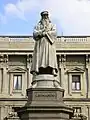 Statue of Leonardo da Vinci in Piazza Scala in Milan
 Leonardo's Museum in Milan
.jpg.webp) Azzone Visconti Bridge Lecco Lake Como present in the Mona Lisa
Azzone Visconti Bridge Lecco Lake Como present in the Mona Lisa.jpg.webp) The Bellagio Promontory, which inspires the silhouette of the Mona Lisa, seen from Leonardo's Path in Lierna Lake Como
The Bellagio Promontory, which inspires the silhouette of the Mona Lisa, seen from Leonardo's Path in Lierna Lake Como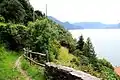 The Sentiero di Leonardo da Vinci, Lake Como
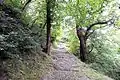 Track of Sentiero di Leonardo on the Lake of Como
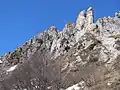 Monti Grigna, between Esino Lario and Lierna
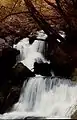 Source of the Fiumelatte of the Atlantic Code of Leonardo
In addition to the Cenacle, the Vigna di Leonardo and the Castello Sforzesco, the section of major international interest is between Lecco, which was the backdrop to several of his works, the Ponte Azzone di Lecco in the background of the Mona Lisa, the Laorca cave at Lecco where he painted the Virgin of the Rocks, the passage of Lierna that overlooks the promontory of Bellagio, and Fiumelatte on the border of Lierna to reach Varenna.
The name
The name "path of Leonardo da Vinci" is of recent invention and can be traced back to 2019, or rather to the 500th anniversary of Leonardo da Vinci, which saw the birth of a path dedicated to him, which intends to focus on the territories and places that from Milan to Lake Como to reach the nearby Switzerland of the Cantoni Grigioni and Ticino, saw Leonardo da Vinci as the protagonist with his activity as a painter, artist, nature scholar, geologist, mountaineer, engineer and inventor.
Oltre a Milano, ai Navigli Grande e Pavese, alla Martesana, al corso dell’Adda, il ramo orientale del Lago di Como, da Lecco, Lierna a Fiumelatte, furono gli ambiti da lui più esplorati e studiati.
Sporting events
A marathon called Trail del Viandante takes place on the part of the Sentiero del Lago di Como from 2014 on an annual basis.[1]
Links
- Camino de Santiago
Bibliography
- Renato Ornaghi, Il Sentiero di Leonardo. 240 km da Milano a San Bernardino. Luoghi, temi, percorsi, ospitalità, Opificio Monzese delle Pietre Dure, 2019, ISBN 8896174112
References
External Links
- The Map of the Path of Leonardo da Vinci from Milan to Switzerland via Lecco and Lierna
- The Sentiero di Leonardo, Milano - Lake Como