Annibale Bugnini
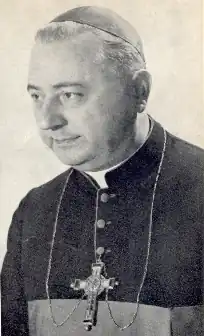
Annibale Bugnini CM (1912 – 1982) was an Italian Catholic archbishop who served as secretary of the commission that worked on the reform of the Roman Rite following the Second Vatican Council. Both critics and proponents of the changes made to the Mass, the Liturgy of the Hours and other liturgical practices consider him to be the dominant force in these efforts. He was a member of the Vincentians.
Quotes
- [...] the path opened up by the Second Vatican Council is destined to radically change the face of traditional liturgical assemblies, in which, according to centuries-old custom, the liturgical service is performed almost exclusively by the clergy, and the people too often “attend” as silent spectators. Patient work of education will be needed to make people understand that the liturgy is the action of the whole people of God. The consequence will not only be liturgical, but will also have a beneficial influence on the development of the sense of the Church and the emergence of various ministries at the service of the community.
- [...] la via aperta dal Concilio è destinata a cambiare radicalmente il volto delle tradizionali assemblee liturgiche, nelle quali, per consuetudine ormai secolare, il servizio liturgico è compiuto quasi esclusivamente dal clero, e il popolo vi «assiste» troppo spesso come estraneo e muto spettatore. Un paziente lavoro di educazione dovrà far comprendere che la liturgia è azione di tutto il popolo di Dio. E la conseguenza non sarà solo liturgica, ma influenzerà beneficamente lo sviluppo del senso della chiesa e il sorgere di vari ministeri a servizio della comunità.
- From La riforma liturgica, p. 53. As quoted in Pietro Damiano Scardilli, I nuclei ecclesiologici nella costituzione liturgica del Vaticano II, Editrice Pontificia Università Gregoriana, Roma, 2007, p. 200. ISBN 978-88-7839-103-1.
- [...] la via aperta dal Concilio è destinata a cambiare radicalmente il volto delle tradizionali assemblee liturgiche, nelle quali, per consuetudine ormai secolare, il servizio liturgico è compiuto quasi esclusivamente dal clero, e il popolo vi «assiste» troppo spesso come estraneo e muto spettatore. Un paziente lavoro di educazione dovrà far comprendere che la liturgia è azione di tutto il popolo di Dio. E la conseguenza non sarà solo liturgica, ma influenzerà beneficamente lo sviluppo del senso della chiesa e il sorgere di vari ministeri a servizio della comunità.
- (Referring to the Novus Ordo Missae) In some respects, it is truly a new creation, given that the image of the liturgy presented by the Second Vatican Council is completely different from that which the Catholic Church has had until now.
- In certi punti, di una vera nuova creazione, dato che l’immagine della liturgia data dal Concilio Vaticano II è completamente differente da quella che la Chiesa cattolica ha avuto finora.
- A. Bugnini, Dichiarazione alla stampa (4 gennaio 1967), in «La Documentation Catholique », n. 1491 (1967), col. 824. As quoted in La S. Messa e la rivoluzione liturgica (May 3, 2015)
- In certi punti, di una vera nuova creazione, dato che l’immagine della liturgia data dal Concilio Vaticano II è completamente differente da quella che la Chiesa cattolica ha avuto finora.
Quotes about
- I celebrated Mass according to the new liturgical directives of 1965, but never according to the definitive ones of 1968, which bear the signature of Monsignor . [...] The Faith is the teaching of the Church throughout the centuries, in accordance with the teaching of the Apostles. [...] I give you another definition, that contained in the anti-modernist oath of St. Pius X: the submission of the intellect and will to the Revelation of God, because God is the supreme authority and cannot err. Interviwer: And do you really think that Paul VI and John Paul II substantially changed this fundamental core of the Faith? Mgr. Lefebvre: I think they give another definition of the Faith. For them, Faith is a religious sentiment, an interior, subjective act. [...] The conscience is made to obey Revelation, not for itself. The problem is that for the last popes—speaking in Christian terms— the “subject” comes before the “object.” Whereas for the Tradition of the Church, the exact opposite is true: the object precedes the subject.
- Mgr. Marcel Lefebvre, Guillermo R. Zorraquin Vivot, Siete Dias Ilustrados (Argentinian journal), n°. 528, 29 July – 4 August 1977, pp. 4-9 (in Spanish). Quoted in FPPX South America. URL archived on 18 May 2019