Marcel Lefebvre
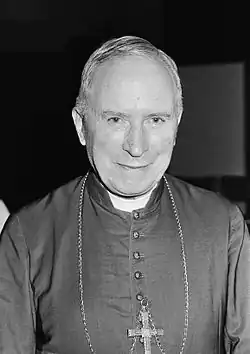
Marcel Lefebvre (1905-1991) was a Roman Catholic archbishop and the founder of the Saint Pius X.
Quotes
- Interviewer: You often say that more than a question of liturgy, today it is a question of faith that opposes us to the current Rome. Mgr. Lefebvre: Of course, the question of liturgy and the sacraments is very important, but it is not the most important. The most important question is that of faith. For us, it is settled. We have the faith of always, that of the Council of Trent, of the Catechism of Saint Pius X, of all the Councils and of all the Popes before Vatican II.
- Interview to Fideliter' ' , n° 79, January-February 1991. URL archived on 24 July 2014
- This is what Tradition means to them, the famous living tradition, the only reason for our condemnation. Today they no longer try to prove that what they say is in accordance with what Pius IX wrote, with what the Council of Trent promulgated. All this is over, outdated, as Cardinal Ratzinger says.
- Interview to Fideliter, n° 79, January-February 1991. URL archived on 24 July 2014
- Now there is the tyranny of authority, because there are no more rules. One can no longer refer to the past. [...] We are dealing with people who have a different philosophy from ours, a different way of seeing things, influenced by all the modern and subjectivist philosophers. For them, there is no fixed truth, there are no dogmas. Everything is evolution. This is a completely Masonic conception. It is truly the destruction of the faith.
- Interview to Fideliter, n° 79, January-February 1991. URL archived on 24 July 2014
- [A practical agreement with the Holy See would give] ample space to the apostolate, perhaps, but in ambiguity, following two opposing directions at the same time, which would have ended up causing us to rot. (1988, before the Ecône episcopal consecrations)
- Mgr. Alfonso de Galarreta, Mgr. Bernard Tissier de Mallerais, Mgr. Richard Williamson, Translation of the Letter to Superior General Bishop Bernard Fellay and the General Council of the Fraternity, 7 April 2012. URL arcchived on 9 May 2013
- The majority does not make the truth; it is the truth that must make the majority.
- La majorité ne fait pas la vérité, c’est la vérité qui doit faire la majorité.
- Ils l'ont découronné, Mgr Marcel Lefebvre, éd. Fideliter/Clovis, 1987, p. 91
- We accept what is in accordance with perennial teaching, we receive what is ambiguous in accordance with perennial teaching, and we reject what is contrary to it.
- Ce qui est conforme à l’enseignement pérenne nous l’acceptons, ce qui est ambigu nous le recevons selon cet enseignement pérenne, ce qui est opposé nous le rejetons.
- Samuel Pruvot, Monseigneur Fellay s'exprime sur Vatican II, Famille Chrétienne, 14 February 2009
- On Pinochet's dictatorship, 13 April 1987: ‘As soon as a man stands up to save his country from communism and restores Christian order, everything is done to discredit him. There is no country where people can move around as freely as in Chile.’
- Sur la dictature de Pinochet, le 13 avril 1987 : « Dès qu'un homme se lève pour sauver son pays du communisme et qu'il rétablit l'ordre chrétien, on fait tout pour le discréditer. Il n'y a pas un pays où l'on puisse circuler aussi librement qu'au Chili.
- Mgr Lefebvre, Mgr Lefebvre, Le Monde 2, nº 274, 13 April 1987, p. 59
- Voting socialist is voting against God. The socialist programme, he said, is terrifying for the souls of children. Economically, it will probably be a disaster, but what is worse is the control it will have over people's minds. Money is nothing compared to souls, and sin will spread everywhere. [...]
- Voter socialiste, c'est voter contre Dieu. Le programme socialiste, a-t-il précisé, fait frémir pour l'âme des enfants. Économiquement ce sera probablement la catastrophe, mais ce qu'il y a de pire, c'est la mainmise sur les esprits. L'argent c'est peu de chose à côté des âmes et le péché va se répandre partout. [...]
- Mgr Lefebvre, Mgr LEFEBVRE : voter socialiste c'est voter contre Dieu, Le Monde, 23 June 1981
About Islam
- I spent fifteen years in Dakar with three million Muslims, one hundred thousand Catholics and four hundred thousand animists, and if during those fifteen years we were able to convert ten Muslims, that was the maximum. I mean truly convert them, make them switch from Islam to Catholicism. I'm not saying that there wasn't some Catholic influence thanks to our schools, where we had up to 10-15% Muslims. I didn't want any more than that, otherwise they would have imposed Islam in our schools. Once they are strong, they impose themselves, take the lead and try to convert others. When they are weak, they listen and keep quiet. The young people who went to our schools were certainly influenced, and it is very possible that some of them wanted to be baptised. But it is very difficult for a young man to convert to Catholicism because he is driven out of his family and knows that he even risks being poisoned. [...] Only university students manage to convert because they are independent. They know that their future is secure; they no longer need their families and will leave for Europe, where they can convert. But converting someone who is part of their family is practically impossible. By inspiring the Islamic religion, the devil has truly prevented the conversion of millions of people.
- Je me suis trouvé pendant quinze ans à Dakar avec trois millions de musulmans, cent mille catholiques et quatre cent mille animistes, et si pendant ces quinze ans on a pu convertir dix musulmans, c'est un maximum. Je veux dire les convertir vraiment, les faire passer de l'islam au catholicisme. Je ne dis pas qu'il n'y ait pas eu une certaine influence catholique grâce à nos écoles où nous avions jusqu'à 10 à 15% de musulmans. Je n'en voulais pas davantage, sinon ils auraient imposé l'islam dans nos écoles. Une fois qu'ils sont forts, ils s'imposent, prennent la tête du mouvement et essayent de convertir les autres. Quand ils sont faibles, ils écoutent et se taisent. Les jeunes gens qui ont été dans nos écoles ont certainement été influencés, peut être certains d'entre-eux ont-ils désiré le baptême c'est très possible. Mais c'est très difficile pour un jeune homme de se convertir au catholicisme, car il est chassé de sa famille, il sait qu'il risque même d'être empoisonné. [...] Il n'y a que ceux qui sont étudiants en université qui arrivent à se convertir parce qu'ils sont indépendants. Ils savent que leur avenir est assuré; dont ils n'ont plus besoin de leur famille et partiront en Europe, ils peuvent se convertir. Mais convertir quelqu'un qui est dans sa famille, c'est pratiquement impossible. En inspirant la religion islamique; le démon a véritablement empêché la conversion de millions d'hommes.
- C'est moi l'accusé qui devrait vous juger, Mgr Marcel Lefebvre, éd. Clovis, 1997, p. 208
- And if Muslims were granted all freedoms, polygamy would have to be allowed in the States. Islam is not just about Muslims kneeling in the streets at prayer time; it is also about the threat of submission, i.e. of becoming ‘Dhimmi’ for all those who are not like them. Can we accept this in Catholic states? Can we accept that these states do not defend themselves?
- Et si toutes les libertés étaient accordées aux musulmans, c'est polygamie qu'il faudrait admettre dans les États. L'islam, ce n'est pas seulement les prosternations à genoux que les musulmans font dans les rues au moment de la prière; c'est aussi la menace de la soumission, c'est-à-dire de « Dhimmi » pour tous ceux qui ne sont pas comme eux. Peut-on admettre cela dans les États catholiques? Peut-on admettre que ces États ne se défendent pas ?
- C'est moi l'accusé qui devrait vous juger, Mgr Marcel Lefebvre, éd. Clovis, 1997, p. 40
- A Muslim proverb says: ‘Kiss the hand you cannot cut off.’ Yes, only force can intervene. When force is present, then they kiss the hand. But when they have the force, then they cut off the hand. It has always been this way.
Recently, as reported in the newspapers, Egyptian Muslim communities decreed that any Muslim who converts to Catholicism will be executed. The representatives of these Muslim communities wanted this to be included in the constitution, or at least to see this decision enshrined in official agreements. That's how the newspapers reported it, because it was something official: any Muslim who converts to another religion will be put to death.
- Yes, we forget this, but that is what Islam is all about. For Muslims, there is only Islam and everyone must submit to it, either by becoming a Muslim or by being a slave to Islam. One or the other. That is how they proceeded, enslaving all those who did not want to submit. Let us remember the religious orders: the Trinitarians and the Order of Our Lady of Mercy, which were founded to rescue Christians held captive as slaves by Muslims. They raided the coasts of France, Spain and the entire Mediterranean, kidnapping Christians and taking them home as slaves. This is still in their minds.
- If you ask a bishop in France whether we should try to convert Muslims, whether they are in France or elsewhere, or convert animists, Buddhists... Oh no! We must not convert them. On the contrary, we must strengthen them in their religion, make them understand the beauty of their religion. It is unbelievable, but it is nevertheless the reality.
- Father Maurice Avril, who is in Salérans, was persecuted by the bishops and had all kinds of trouble because after the Algerian War, he took care of the Harkis who were lucky enough to escape and take refuge in France. The Harkis had fought to defend French Algeria and wrest it from revolutionary control.
- Tens of thousands of them were massacred when De Gaulle handed Algeria over to the representatives of the FLN. The latter, of course, could not stand the Harkis who had fought alongside French troops to liberate French Algeria from terrorism and revolutionary rule. Those who were unable to flee to France on boats were tortured, massacred, buried alive and burned alive. What an abominable crime those who took such responsibility will have on their conscience! These were people who had devoted themselves, ready to die to defend French Algeria, just as some of them had come to fight in France in 1939-40, then during the Liberation when they landed in Italy, Corsica and Provence, and later against communism in Indochina. They were abandoned to the mercy of a cruel enemy who subjected them to the most abominable torments. It was a terrible tragedy. Many of their children remained in France; only the adults were sent back. Father Avril, who was a priest in French Algeria, took in more than a hundred of them. He educated them, raised them and took good care of them. The children of these Harkis found themselves in the hands of a priest who took care of their education and who, very gently, tried to convert them—without forcing them, of course—but through persuasion. Seeing the dedication of this priest and those who helped him, they eventually came to understand the beauty of the Catholic religion, and most of them ended up converting. This did not sit well with several bishops, who sent letters of disapproval to Father Avril: leave the Muslims alone; do not convert them! But who are these bishops?
- Un proverbe musulman dit: « Baise la main que tu ne peux pas couper ». Oui, il n'y a que la force qui peut intervenir. Quand la force est présente, alors ils baisent la main. Mais quand ce sont eux qui disposent de la force: alors ils coupent la main. Cela a toujours été ainsi.
Récemment, les journaux l'ont rapporté, les communautés musulmanes égyptiennes ont décrété que tout musulman qui se convertirait au catholicisme serait exécuté. Les représentants de ces communautés musulmanes voulaient absolument voir figurer cela dans la constitution, ou tout au moins voir cette décision consacrée par des accords officiels. C'est ainsi que les journaux l'ont publié, parce que c'était quelque chose d'officiel: tout musulman qui se convertirait à une autre religion subirait la peine de mort.
- Eh oui, on l'oublie, mais c'est cela l'islam. Pour les musulmans, il n'y a que l'islam et tout le monde devrait s'y soumettre, soit en devenant musulman, soit en étant esclave de l'islam. L'un ou l'autre. C'est ainsi qu'ils ont procédé en réduisant en esclavage tous ceux qui ne voulaient pas se soumettre. Souvenons-nous des ordres religieux: les Trinitaires et l'œuvre de Notre-Dame de la Merci, qui ont été fondés pour aller délivrer les chrétiens captifs qui étaient retenus esclaves chez les musulmans. Ils razziaient les côtes de France, d'Espagne et de toute la Méditerranée, enlevaient des chrétiens dont ils faisaient chez eux des esclaves. Cela est encore dans leur esprit.
- Si on demande à un évêque de France s'il faut essayer de convertir les musulmans, qu'ils soient de France, ou qu'ils soient ailleurs, de convertir les animistes, les bouddhistes... Ah mais non! Il ne faut pas les convertir. Au contraire, il faut les affermir dans leur religion, leur faire comprendre les beauté de leur religion. C'est invraisemblable, mais c'est cependant la réalité.
- Le R.P. Maurice Avril, qui est à Salérans, a été persécuté par les évêques et il a eu tous les ennuis possibles parce qu'après la guerre d'Algérie, il s'était occupé des Harkis qui avaient eu la chance de pouvoir s'échapper et se réfugier en France. Or, les Harkis avaient fait la guerre pour défendre l'Algérie française et l'arracher à l'emprise révolutionnaire.
- Plusieurs dizaine de milliers d'entre eux ont été massacrés au moment où De Gaulle à lâché l'Algérie aux représentants du FLN. Ces derniers, évidemment, ne pouvaient pas sentir les Harkis qui avaient combattu avec les troupes françaises pour délivrer l'Algérie française du terrorisme et de l'emprise révolutionnaire. Ceux qui n'ont pas pu s'enfuir sur les bateaux pour la France ont été torturés, massacrés, enterrés vivant, brûlés vifs. Quel crime abominable porteront sur leur conscience ceux qui ont pris une pareille responsabilité ! Des gens qui s'étaient dévoués, prêts à mourir pour défendre l'Algérie française, comme certains d'entre eux étaient venus combattre en France en 1939-40, puis lors de la Libération en débarquant en Italie, en Corse, en Provence, puis contre le communisme en Indochine: on les a abandonné entre les mains de l'ennemi cruel qui leur a fait subir les tourments les plus abominables. Un drame affreux. Beaucoup de leurs enfants sont restés en France, on a renvoyé seulement les adultes. Le Père Avril, qui était prêtre en Algérie française, en a recueilli plus d'une centaine. Il les a éduqué, élevés; il s'en est bien occupé. Les enfants de ces Harkis se sont trouvés entre les mains d'un prêtre qui s'occupait de leur éducation, et qui, tout doucement, essayer de les convertir- sans les obliger bien sûr- mais par la persuasion. Eux mêmes, voyant le dévouement de ce prêtre et des personnes qui l'aidaient, ont fini par comprendre les beautés de la religion catholique et la plupart d'entre eux ont fini par se convertir. Cela n'a pas été du goût de plusieurs évêques qui ont envoyé des lettres de réprobation au Père Avril: il faut laisser les musulmans : il ne faut pas les convertir ! Mais que sont ces évêques ?
- C'est moi l'accusé qui devrait vous juger, Mgr Marcel Lefebvre, éd. Clovis, 1997, p. 305
Interview of Siete Dias Ilustrados, 29 July 1977
- Guillermo R. Zorraquin Vivot, Siete Dias Ilustrados (Argentinian journal), n°. 528, 29 July – 4 August 1977, pp. 4-9 (in Spanish). Quoted in FPPX South America. URL archived on 18 May 2019
- I was a member of the preparatory commissions appointed by Pope John XXIII, and together with the other members—distinguished cardinals and good theologians—we prepared the preliminary outlines that were to serve as a basis for the scholars of the assembly. The preparation of these outlines, which were to be approved and promulgated as authoritative documents of the Church's teaching, required time, reflection, and consultation of ecclesiastical sources and documents. All this had to be taken into account. But then, in the first session of the Council, a group of bishops and cardinals, using modern techniques of pressure, managed to remove the exhaustive work that had been done. Thus, being subject to time constraints and internal regulations, new discussion outlines had to be prepared in other commissions set up in a completely arbitrary manner. Imagine the difficulties this entailed and bear in mind the decisive activity of certain cardinals and bishops, those who were called “coming from the banks of the Rhine,” gathered in the Idoc group, all imbued with modernism and liberalism and who, in addition, could count on a well-financed superstructure of offices, press, distribution, etc.
- Interviewer: By saying this, aren't we running the risk of undermining the Holy Spirit's assistance to the Council? Mgr. Lefebvre: I said that Vatican II was a purely pastoral council, and for this very reason it is clear that the two popes who presided over its sessions did not intend to commit the dogmatic Magisterium of the Holy Church to the even. It is therefore in this perspective that the inspiration of the Holy Spirit in the documents produced by the Council must be considered. The liberal orientation of the Council cannot be attributed to the Holy Spirit; it would be blasphemous, sacrilegious.
- I see only one type of ecumenism: that promoted by the Council, which emphasizes respect and collaboration with false religions, placed on the same level. This is a new concept that has been imposed and is in contradiction with Tradition. In place of the “missionary” Church, the new “ecumenical” Church has appeared. The Assisi meeting consecrates this new Church, and this is enormous, scandalous. [...] If salvation is possible even without conversion to Christ in the Church, and while continuing to worship one's false gods, what meaning does mission still have? Then all religions are equal, good... If this Pope had lived at the time of the Roman persecutions of the early centuries, perhaps Christianity would have found a respectable place in the Pantheon of religions.
- I celebrated Mass according to the new liturgical directives of 1965, but never according to the definitive ones of 1968, which bear the signature of Monsignor Bugnini. [...] The Faith is the teaching of the Church throughout the centuries, in accordance with the teaching of the Apostles. [...] I give you another definition, that contained in the anti-modernist oath of St. Pius X: the submission of the intellect and will to the Revelation of God, because God is the supreme authority and cannot err. Interviwer: And do you really think that Paul VI and John Paul II substantially changed this fundamental core of the Faith? Mgr. Lefebvre: I think they give another definition of the Faith. For them, Faith is a religious sentiment, an interior, subjective act. [...] The conscience is made to obey Revelation, not for itself. The problem is that for the last popes—speaking in Christian terms— the “subject” comes before the “object.” Whereas for the Tradition of the Church, the exact opposite is true: the object precedes the subject.
- There are some conciliar texts that are clearly in conformity with Tradition and pose no problem: I am thinking of Lumen Gentium, but also of other documents such as those on priestly formation and seminaries. Then there are ambiguous texts, which nevertheless can be correctly “interpreted” in a certain way according to the previous Magisterium. But there are also texts that are frankly in contradiction with Tradition and cannot be “integrated” in any way: the Declaration on Religious Freedom, the Decree on Ecumenism, and the one on the Liturgy. Here agreement becomes impossible. [...] It is the Declaration on Religious Freedom that is the real bone of contention, because the introduction of this liberal principle into the Church has led to other errors. The break with Tradition in this case is evident: eleven Popes, from Pius VI to Pius XII, condemned liberalism, and the Council approved it. No one can convince me that there is no contradiction.
- The Prefect of the Congregation for the Doctrine of the Faith [Cardinal Ratzinger] asked me to put my opinions and doubts on this subject in writing. I did so, and in November 1985 I sent him a 150-page typewritten study. In January 1986, he replied that he had received these documents and appreciated their philological care.
- 'Interviewer: You have a certain tendency to see ‘conspiracies’ everywhere. Five days before being suspended a divinis, in a letter to Paul VI, you denounced ‘a secret agreement between high-ranking ecclesiastical dignitaries and Freemasons, established before the Council. Mgr. Lefebvre: But all the American newspapers wrote that, before the Council, Cardinal Bea, founder of the Vatican Secretariat for Ecumenism, had met with the leaders of the most influential Jewish-Masonic lodge at the Astoria Hotel in New York and asked them what they expected from the Council. And they replied: ‘A declaration on religious freedom’.
- (About Pinochet) I am not saying that his regime is perfect, but at least we find Christian principles as the fundamental program of his political orientation. He is a man of justice and order and favors the presence of the Catholic Church, even if the Chilean bishops—what a paradox!—are not at all grateful to him. [...] When Pinochet recently escaped an assassination attempt, [...] people shouted, “Thank you, Holy Virgin, for protecting the general's life.
- Who can say what events the future holds for us? Perhaps a world conflict will break out and the situation will change radically. [...] Those who provoke the schism are those who change the Faith. I am certain that I belong to the Catholic Church of all times, the eternal Church.
- The meeting in Assisi is a very serious matter. And if the Pope, whose function is to confirm the Faith, no longer fulfills his duty, what is to be done? The situation has reached the highest degree of gravity. I see no similar precedents in the history of the Church.
- What value can an excommunication decided by the current liberal government of the Church have? For more than a century, conservative popes have condemned and excommunicated the Lamennais, the Buonaiuti, the Loisy, because they were liberals and modernists. Today, it is they who hold power in the Church, and they want to excommunicate traditionalists, that is, true Catholics.
Interview of 8 June 1978
- Note: The interview precedes the first priestly ordinations in the Society of Saint Pius X, after the Holy See withdrew its ecclesiastical approval of the Society in 1975, which had been granted on November 1, 1970.
- Transcript from Interview of 8 June 1978. URL archived on 18 May 2019
- I would like to know whether I am dealing with the Catholic Church or with another Church. A counter-Church, a counterfeit of the True Church. I sincerely believe that we are dealing with a counterfeit of the True Church and not with the Catholic Church! Because they no longer teach the Catholic faith, they no longer defend the Catholic faith! [...] All these cardinals who are in the Vatican congregations are sitting in the seats of their predecessors, and all the secretaries who are in the congregations are sitting in the seats of their predecessors. But they are not continuing their predecessors; they no longer have the same faith, the same doctrine, nor the same morals as their predecessors. It is not possible. And their great error is mainly ecumenism. (at minutes 0:45-1:48)
- And I will say to them, what do you think of the anathemas of the Council of Trent? What do you think of the anathemas of the bull Auctorem Fidei on the Council of Pistoia? What do you think of the Syllabus? What do you think of Pope Leo XIII's encyclical Immortale Dei What do you think of Pope St. Pius X's letter on Zion? What do you think of Pius XI's encyclical Quas Primas? Of Pius XI's “Mortalium Animos,” rightly opposed to ecumenism, to false ecumenism...In light of all this, let them answer me. Let them say if they still agree with this Magisterium of the Popes, with these official documents that define our faith. These are not just any documents. They are not private speeches, private conversations of the popes; they are official documents that commit the authority of the Pope. (at minutes 2:00-2:50)
- Then one can and must believe that the Church is occupied, occupied by this counter-Church that we know well, that the Popes knew perfectly well and that the Popes have condemned over the centuries, from now back to four centuries ago. The Church has never ceased to condemn this counter-Church that was born and developed with Protestantism, and which is at the root of all modern errors, which has destroyed all philosophy, which has led us to all the errors we know and which the popes have condemned: liberalism, socialism, communism, modernism, Zionism... we are dying from it! We are dying from it! The Popes have done everything to condemn this, and now those who sit on the seats of their predecessors who condemned these things are in agreement with this liberalism, with this ecumenism. (at minutes 4:00-4:40)
- This cannot be accepted! And the more things become clear, the more we must realize that this program was developed in Masonic lodges, that all these errors were developed in Masonic lodges. It is becoming increasingly clear that there is indeed a Masonic lodge in the Vatican. And now when we go to meet a secretary of a Vatican congregation, or a cardinal sitting on a seat where there used to be holy cardinals who had the Faith and defended the Christian faith, who were men of the Church... now we find ourselves in front of a Freemason. So, is it the same thing? They demand the same obedience. Before, obedience to the Faith was required, to take the anti-modernist oath. A profession of faith was required. Now, what faith do those people ask us to profess? It is no longer the same. They say: Obedience, obedience! Yes, but obedience to the Church. Obedience to what the Church has always commanded! Yes, obedience to the faith of the Church. But obedience to Freemasonry, no. That's it, that's for sure! (at min. 4:45:6:15)
- Lately, I have been given documents that appear to be completely true, documents that show the correspondence between Monsignor Bonini and the Grand Master of Freemasonry on the entire liturgical reform. The Grand Master of Freemasonry asks Bonini to apply the reform of the apostate priest Roca, who had already predicted everything that had to be done when the Vatican was occupied by Freemasonry. [...] The Grand Master asks Bonini to apply the principle of “naturalization,” the naturalization of the Incarnation, that is, to de-supernaturalize the Incarnation, and thus we arrive at naturalism, and therefore we must apply the principles of local languages, the multiplicity of rites, the multiplicity of the liturgy, and to make the liturgy totally confused, to instill confusion everywhere, and opposition between the different rites. And Bonini replies that he is in complete agreement, and that it will take some time, perhaps ten years. But that at the end of the ten years we will get there. And that with the trust placed in him by Cardinal Lercaro and Pope Paul VI, he is sure of success, and he names all those in the Curia who are affiliated with Freemasonry. He names them and says he will be able to work with them. But some of them must be placed in certain congregations so that [...], in order for the work to be successful, all the congregations must be infiltrated with members of Freemasonry, whom he names: so-and-so, so-and-so, so-and-so... “We must get rid of that one because he is against us... we must get him out...” "the Congregation of the Sacraments must be suppressed," and he managed to put everything under the Congregation of Rites, he managed to put everything under his authority. Everything he says in the letter to the Grand Master of Freemasonry. So what should we do? We certainly want to obey. We are the most obedient to the Church, to everything the Church has always taught and wanted. But not to men who want the destruction of the Church. (at min. 6:17-9:00)
- The enemy is within the Church. Pope St. Pius X announced it. La Salette announced it. Fatima announced it. Everything had been announced! We have known for a century and a half that he would be introduced into the Church. Well, he is already there, he is already there. Let them not come and ask us to suspend ordinations. Who is asking not to ordain? Who is asking not to form good priests anymore? The Holy Spirit or the Devil? It is clear. Is it normal in the Church to ask a bishop not to form good priests? Is such a thing normal? [...] They know that the doctrine taught there is the true doctrine: they know it perfectly well, they wrote it in the visitors' report, an excellent report in favor of the seminary. That is what Cardinal Garrone told me when he asked me to come to Rome. He said to me: “The report is good, we know that the seminary is good.” But then why close the seminary? Simply because we do not want to follow the Masonic orientation of ecumenism, all those orientations that have been forged by the Masonic lodges. [...] This does not come from the Holy Spirit [...] It is a Masonic lodge that has managed to penetrate the Vatican and has taken everything into its own hands. And it obviously cannot listen to us. It is obvious: we are an obstacle to their plan, to their plan to destroy the priesthood, the Mass, the liturgy. It is obvious! It is obvious! And must we obey? I believe in my conscience before God, when I am told, “Reflect well in your conscience before God on what you are doing.” [...] I truly believe that by doing what I am doing and ordaining the priests that I will ordain, I believe that I am serving the Church. I would not do it if I thought for a moment that it could be contrary to the good of the Church. (at min. 10:07-11:58)
Interview to the Catholic Press (1978)
- Interview of the Catholic Press (1978), radiospada.org (via chiesaepostconcilio.com). URL archived on 26 June 2016
- [On the issues of religious freedom and “The Church in the Contemporary World”] Cardinal [Giuseppe] Frings from Germany, Cardinal [Franz] Koenig [from Austria]. These figures had already met and discussed these resolutions before the Council, and their specific aim was to compromise with the secular world, to introduce Enlightenment and modernist ideas into Church doctrine. [...] I did everything I could to stop these decisions, which I consider contrary to and destructive of the Catholic Faith. The Council was legitimately convened, but for the purpose of spreading all these ideas. Interviewer': Were there other Cardinals who agreed with you? Mgr. Lefebvre: Yes. There was Cardinal [Ernesto] Ruffini [of Palermo], Cardinal [Giuseppe] Siri [of Genoa], and Cardinal [Antonio] Caggiano [of Buenos Aires]. Interviewer: Were there any bishops who supported you? Mgr. Lefebvre: Yes. Many bishops supported my position. Interviewer: How many bishops? Mgr. Lefebvre: There were more than 250 bishops. They had also formed a group for the purpose of defending the true Catholic Faith.
- At this time, it is important to remind Catholics around the world that obedience to the pope is not a primary virtue. The hierarchy of virtues begins with the three theological virtues of Faith, Hope and Charity, followed by the four cardinal virtues of Justice, Temperance, Prudence and Fortitude. Obedience is a derivative of the cardinal virtue of Justice. Therefore, it is far from being ranked first in the hierarchy of virtues. Some bishops do not want to give the slightest impression of disobeying the Holy Father. I understand how they feel. It is clearly very unpleasant, if not very painful.
- More than a century ago, secret societies, Illuminati, humanists, modernists, and others, of whom we now have all the texts and evidence, were preparing for a Vatican Council in which they would infiltrate their own ideas for a humanist church. [...] The Second Vatican Council was planned by liberals; it was a liberal council; the Pope is a liberal, and those around him are liberals.
- Dialogue is contrary to Catholic doctrine. Dialogue presupposes the meeting of two equal and opposing parties; therefore, it can in no way have anything to do with the Catholic Faith. All this confusion leads to compromises that destroy the doctrine of the Church, to the misfortune of humanity and of the Church itself.
- The idea that all truths are equal, all religions are equal, and therefore all morals have equal dignity, that every conscience is valid in its own way, that everyone can judge theologically what they can do, all these are humanistic ideas of total laxity without any discipline of thought, which lead to the position that everyone can do as they please. All this is absolutely contrary to our Catholic Faith.
- When they go to a modernist church, they do not find the sacred, the mystical character of the Church, all that is truly divine. What leads to God is divine, and they no longer encounter God in these churches. Interviewer: Why should they go to a place where God is absent? Mgr. Lefebvre: The faithful perceive this very well, and the liberal cardinals and their advisors have seriously underestimated the loyalty of the majority of the faithful to their true Faith.
- In vernacular language, it is said that the Precious Blood was shed “for all,” whereas in the Latin text (even the latest revised Latin text) it is said that the Precious Blood is “for many” and not “for all.” [...] The new Offertory prayers do not express the Catholic notion of sacrifice. They simply express the concept of a mere sharing of bread and wine. For example, the Tridentine Mass addresses the prayer to God: “Accept, O holy Father, almighty and eternal God, this Immaculate Victim which your unworthy servant offers to You, my living and true God, in reparation for my countless sins, offenses, and negligence.” The new Mass says: “We offer this bread as the bread of life.” There is no mention of sacrifice or victim. Interviewer: Could you cite a translation that actually contradicts Catholic dogma? Mgr. Lefebvre: Yes. For example, in the Latin text, the Virgin Mary is called Semper Virgo, “Ever Virgin.” In all modern translations, the word “ever” has been removed. This is very serious, because there is a big difference between ‘Virgin’ and “Ever Virgin.” It is very dangerous to tamper with translations of this kind.
- Latin is also important for maintaining the unity of the Church, because when people travel, and people travel more and more abroad nowadays, it is important for them to find the same echo that they heard from a priest at home, whether in the United States, South America, Europe, or anywhere else in the world. They are at home in any (Catholic) church. It is their Catholic Mass that is being celebrated. They have always heard the Latin words since childhood, their parents before them, and their grandparents before them.