Félix Ravaisson-Mollien
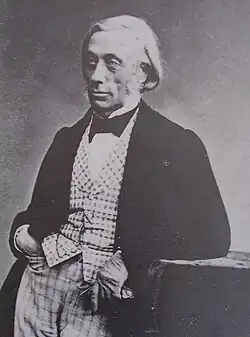
Jean Gaspard Félix Lacher Ravaisson-Mollien (23 October 1813 - 18 May 1900) was a French philosopher and archaeologist.
Quotes
Saggi filosofici
- Félix Ravaisson, Saggi filosofici, preface and translation by Adriano Tilgher, "Tiber" Arti grafiche, Roma, 1917.
- An attempt has been made to prove, by means of selected passages from Pascal's Pensées, an apology for Christianity which he left in draft form, that by sacrificing reason to faith he denied the possibility of all philosophy. I propose to show, not as others seem to have done successfully, that Pascal was not a sceptic, but that in his “'Pensées”' there are, if not a system comparable in scope and detail to those of Descartes, of a Spinoza, a Malebranche or a Leibniz, at least the ideas that constitute the principles of a true philosophy. I propose to show equally that these ideas are in perfect agreement with Pascal's beliefs, and that there is no reason to be surprised by them, because there are none more suitable for harmonising, and even intimately uniting, Christianity and philosophy in their highest parts. (La filosofia di Pascal, p. 131)
- Pascal contrasts the objects of mathematics with other objects that are completely different, which he does not group under a common name, but merely enumerates and describes, although it is easy to recognise what he might have called, if he had had the language of his time, things of an aesthetic and moral nature; and at the same time he characterises with precise features the faculties of the mind to which these two kinds of objects respectively belong. No one else, in fact, had a clearer awareness of the difference between the two orders of things and faculties, whose contrast corresponds to that of matter and spirit; no one else had such a correct and vivid sense of the special nature of the two orders, and knew their consequences so well. (La filosofia di Pascal, p. 144)
- Leibniz noted that things can be compared either in terms of what one contains of the other, which is to compare them by their quantity, or in terms of their similarity to one another, which is to compare them by their qualities. To reduce a question of measurement to a question of order or arrangement is therefore to move from the point of view of quantity to that of quality, to move from a lower genus, where deduction is appropriate, to a higher genus, where only intuition has a place [...]. (La filosofia di Pascal, p. 153)
Quotes about
- [...] the person of Ravaisson himself is like the act, the fulfilment of the thought which, in his written philosophy, aspires to realise itself. He immediately distinguished himself by a grace, a distinction, a smiling serenity that never disappeared. He attracted people with his good grace and impressed them with his fundamental affinity with the noble and the great. He spoke with absolute simplicity and probity, concerned only with thinking correctly and expressing his thoughts faithfully and naturally, without ever allowing a word of effect or rhetorical artifice to enter his mind. He spoke about everything and was interested in the small pleasures of the world as well as the great questions of philosophy and life. But in all things he saw the link between the ideal and the real. Like the ancient Greeks, he saw the divine in everything. (La filosofia di F. Ravaisson, pp. 115-116)
- Émile Boutroux, La natura e lo spirito, translation by G. Papini, Carabba Editore, Lanciano, 1920.
- Above all, [Félix Ravaisson] was a writer. He expressed himself in broad, flexible, simple and wise phrases, elegant and solid with an air of abandon, and the logical relationships between ideas and the aesthetic harmony that coordinates them and the creative action that brings forth the details, conditions and elements from the whole and from the beginning. His style is the very soul grasped in his inner life and in the secret movement through which it gives itself and spreads. (La filosofia di F. Ravaisson, p. 116)
- Émile Boutroux, La natura e lo spirito, translation by G. Papini, Carabba Editore, Lanciano, 1920.
- The whole person of Ravaisson was the manifestation of one unique thing: his intimate union of thought and heart with spiritual and eternal realities. Deep down, he did not believe in death because he was convinced that what passes away has its being only in what remains. He saw things and people not only in their ideas, like Plato, but in their source, which is infinite love, superior to the Idea and unfailing. He not only professed his doctrine with conviction, but lived it. (La filosofia di F. Ravaisson, p. 116)
- Émile Boutroux, La natura e lo spirito, translation by G. Papini, Carabba Editore, Lanciano, 1920.
External links