mel
English
Pronunciation
- IPA(key): /mɛl/
Audio (Southern England): (file) - Rhymes: -ɛl
- Homophones: Mel, mell
Etymology 1
Shortening of melody.
Noun
mel (plural mels)
- (psychoacoustics) A unit of pitch on a scale of pitches perceived by listeners to be equally spaced from one another.
Further reading
Etymology 2
From Latin mel (“honey”). Doublet of mell.
Noun
mel (uncountable)
Anagrams
Albanian
Etymology
Borrowed through Vulgar Latin from Latin milium.
Pronunciation
Audio: (file)
Noun
mel m (definite meli)
Breton
Etymology
From Proto-Celtic *meli (“honey”) (compare Welsh mêl, Old Irish mil), from Proto-Indo-European *mélid, whence also Latin mel (“honey”).
Pronunciation
- IPA(key): /mɛl/
Noun
mel m
Catalan
Pronunciation
Etymology 1
Inherited from Vulgar Latin *melem m or f, from Latin mel n.
Noun
mel f (plural mels)
Derived terms
Related terms
- mel·lífer
- mel·liflu
Etymology 2
Inherited from Late Latin mēlum, variant of mālum (“apple”).
Noun
mel m (plural mels)
Etymology 3
Pronoun
mel
Further reading
- “mel”, in Diccionari de la llengua catalana [Dictionary of the Catalan Language] (in Catalan), second edition, Institute of Catalan Studies [Catalan: Institut d'Estudis Catalans], April 2007
- “mel”, in Gran Diccionari de la Llengua Catalana, Grup Enciclopèdia Catalana, 2025
- “mel” in Diccionari normatiu valencià, Acadèmia Valenciana de la Llengua.
- “mel” in Diccionari català-valencià-balear, Antoni Maria Alcover and Francesc de Borja Moll, 1962.
Classical Nahuatl
Pronunciation
- IPA(key): [ˈméːɬ]
Noun
mēl inan
- second-person singular possessive singular of ēlli; (it is) your liver.
Cornish
Etymology
From Proto-Brythonic *mel, from Proto-Celtic *meli (“honey”) (compare Welsh mêl, Old Irish mil), from Proto-Indo-European *mélid, whence also Latin mel (“honey”).
Noun
mel m
Derived terms
- arth mel (“sun bear”)
- gwenen mel (“honeybees”)
- kriben vel (“honeycomb”)
- mel kriv (“raw honey”)
- melvis (“honeymoon”)
Mutation
| unmutated | soft | aspirate | hard | mixed | mixed after 'th |
|---|---|---|---|---|---|
| mel | vel | unchanged | unchanged | fel | vel |
Note: Certain mutated forms of some words can never occur in standard Cornish.
All possible mutated forms are displayed for convenience.
Czech
Pronunciation
- IPA(key): [ˈmɛl]
Verb
mel
- second-person singular imperative of mlít
Dalmatian
Etymology
Numeral
mel
Danish
Etymology
From Old Norse mjǫl, from Proto-Germanic *melwą, from Proto-Indo-European *melh₂- (“to grind, rub, break up”). Related to male (“grind, crush”), mølle (“mill”) (via Latin), and to muld (“soil”).
Pronunciation
Noun
mel n (singular definite melet, not used in plural form)
Declension
| neuter gender |
singular | |
|---|---|---|
| indefinite | definite | |
| nominative | mel | melet |
| genitive | mels | melets |
Further reading
- “mel” in Den Danske Ordbog
- “mel” in Ordbog over det danske Sprog
Dhuwal
Noun
mel
Galician
Etymology
From Old Galician-Portuguese mel, from Vulgar Latin *melem m or f, from Latin mel n.
Pronunciation
- IPA(key): [ˈmɛl]
Noun
mel m (plural meles)
Derived terms
References
- Ernesto Xosé González Seoane, María Álvarez de la Granja, Ana Isabel Boullón Agrelo (2006–2022), “mel”, in Dicionario de Dicionarios do galego medieval (in Galician), Santiago de Compostela: Instituto da Lingua Galega
- Xavier Varela Barreiro, Xavier Gómez Guinovart (2006–2018), “mel”, in Corpus Xelmírez - Corpus lingüístico da Galicia medieval (in Galician), Santiago de Compostela: Instituto da Lingua Galega
- Antón Luís Santamarina Fernández, editor (2006–2013), “mel”, in Dicionario de Dicionarios da lingua galega [Dictionary of Dictionaries of the Galician language] (in Galician), Santiago de Compostela: Instituto da Lingua Galega
- Antón Luís Santamarina Fernández, Ernesto Xosé González Seoane, María Álvarez de la Granja, editors (2003–2018), “mel”, in Tesouro informatizado da lingua galega (in Galician), Santiago de Compostela: Instituto da Lingua Galega
- Rosario Álvarez Blanco, editor (2014–2024), “mel”, in Tesouro do léxico patrimonial galego e portugués (in Galician), Santiago de Compostela: Instituto da Lingua Galega, →ISSN
Gothic
Romanization
mēl
- romanization of 𐌼𐌴𐌻
Istriot
Etymology
From Vulgar Latin *melem m or f, from Latin mel n.
Noun
mel
References
- AIS: Sprach- und Sachatlas Italiens und der Südschweiz [Linguistic and Ethnographic Atlas of Italy and Southern Switzerland] – map 1159: “il miele” – on navigais-web.pd.istc.cnr.it
Latin
Etymology
From Proto-Italic *meli, from Proto-Indo-European *mel-it (“honey”), with the athematic suffix *-it that indicates comestible substances (compare Proto-Indo-European *h₂élbʰ-it (“barley”) or Proto-Indo-European *sép-it (“wheat”)). Cognate with Ancient Greek μέλι (méli), Gothic 𐌼𐌹𐌻𐌹𐌸 (miliþ), Old Armenian մեղր (mełr), Hittite [script needed] (milit), Luwian [script needed] (mallit-).[1]
Pronunciation
- (Classical Latin) IPA(key): [ˈmɛɫ]
- (modern Italianate Ecclesiastical) IPA(key): [ˈmɛl]
Noun
mel n (genitive mellis); third declension
- honey
- 8 CE, Ovid, Fasti 3.743–744:
- colligit errantēs et in arbore claudit inānī
Liber et inventī praemia mellis habet.- Liber gathers the wandering [bees] and confines them in a hollow tree,
and he has the rewards of discovering honey.
(See Liber – the Greek Dionysus or Roman Bacchus – and The Discovery of Honey by Bacchus.)
- Liber gathers the wandering [bees] and confines them in a hollow tree,
- colligit errantēs et in arbore claudit inānī
- c. 189 BCE, Plautus, Truculentus 371, (ed. by Friedric Leo, Plauti Comoediae vol. 2, 1896, Berlin: Weidmann):
- Heia, hoc est melle dulci dulcius.
- Ah! This is sweeter than sweet honey.
- Heia, hoc est melle dulci dulcius.
- (figuratively) sweetness, pleasantness
- c. 35 CE – 100 CE, Quintilian, Institutio Oratoria 3.1.5:
- Sed nos veremur ne parum hic liber mellis et absinthii multum habere videatur
- But I fear that this book will have too little sweetness and too much wormwood.
- Sed nos veremur ne parum hic liber mellis et absinthii multum habere videatur
- (figuratively, term of endearment) darling, sweet, honey
Declension
Third-declension noun (neuter, i-stem).
| singular | plural | |
|---|---|---|
| nominative | mel | mella |
| genitive | mellis | mellium mellum |
| dative | mellī | mellibus |
| accusative | mel | mella |
| ablative | melle mellī |
mellibus |
| vocative | mel | mella |
Synonyms
Derived terms
Related terms
Descendants
- Vulgar Latin: *melem m or f (see there for further descendants)
References
- “mel”, in Charlton T. Lewis and Charles Short (1879), A Latin Dictionary, Oxford: Clarendon Press
- “mel”, in Charlton T. Lewis (1891), An Elementary Latin Dictionary, New York: Harper & Brothers
- “mel”, in Gaffiot, Félix (1934), Dictionnaire illustré latin-français, Hachette.
- Carl Meißner; Henry William Auden (1894), Latin Phrase-Book[1], London: Macmillan and Co.
- somebody's darling: mel ac deliciae alicuius (Fam. 8. 8. 1)
- somebody's darling: mel ac deliciae alicuius (Fam. 8. 8. 1)
- ^ De Vaan, Michiel (2008), “mel”, in Etymological Dictionary of Latin and the other Italic Languages (Leiden Indo-European Etymological Dictionary Series; 7), Leiden, Boston: Brill, →ISBN, page 370
Malay
Etymology
Pronunciation
- IPA(key): /ˈmel/ [ˈmel]
Noun
mél (Jawi spelling ميل, plural mel-mel)
Derived terms
- e-mel
- mel elektronik
- mel udara
Further reading
- “mel” in Pusat Rujukan Persuratan Melayu | Malay Literary Reference Centre, Kuala Lumpur: Dewan Bahasa dan Pustaka, 2017.
Middle English
Alternative forms
Etymology
From Old English mǣl, from Proto-West Germanic *māl, from Proto-Germanic *mēlą.
Pronunciation
- IPA(key): /mɛ̝ːl/
Noun
mel (plural meles)
Descendants
References
- “mēl, n.(2).”, in MED Online, Ann Arbor, Mich.: University of Michigan, 2007.
Norwegian Bokmål
Alternative forms
- mjøl (also Nynorsk)
Etymology
From Danish mel, from Old Norse mjǫl.
Noun
mel n (definite singular melet)
Derived terms
References
- “mel” in The Bokmål Dictionary.
Norwegian Nynorsk
Verb
mel
- present of mala
Old Galician-Portuguese
Etymology
From Latin mel, from Vulgar Latin *melem m or f, from Latin mel n.
Pronunciation
- IPA(key): /ˈmɛl/
Noun
mel m (uncountable)
- honey
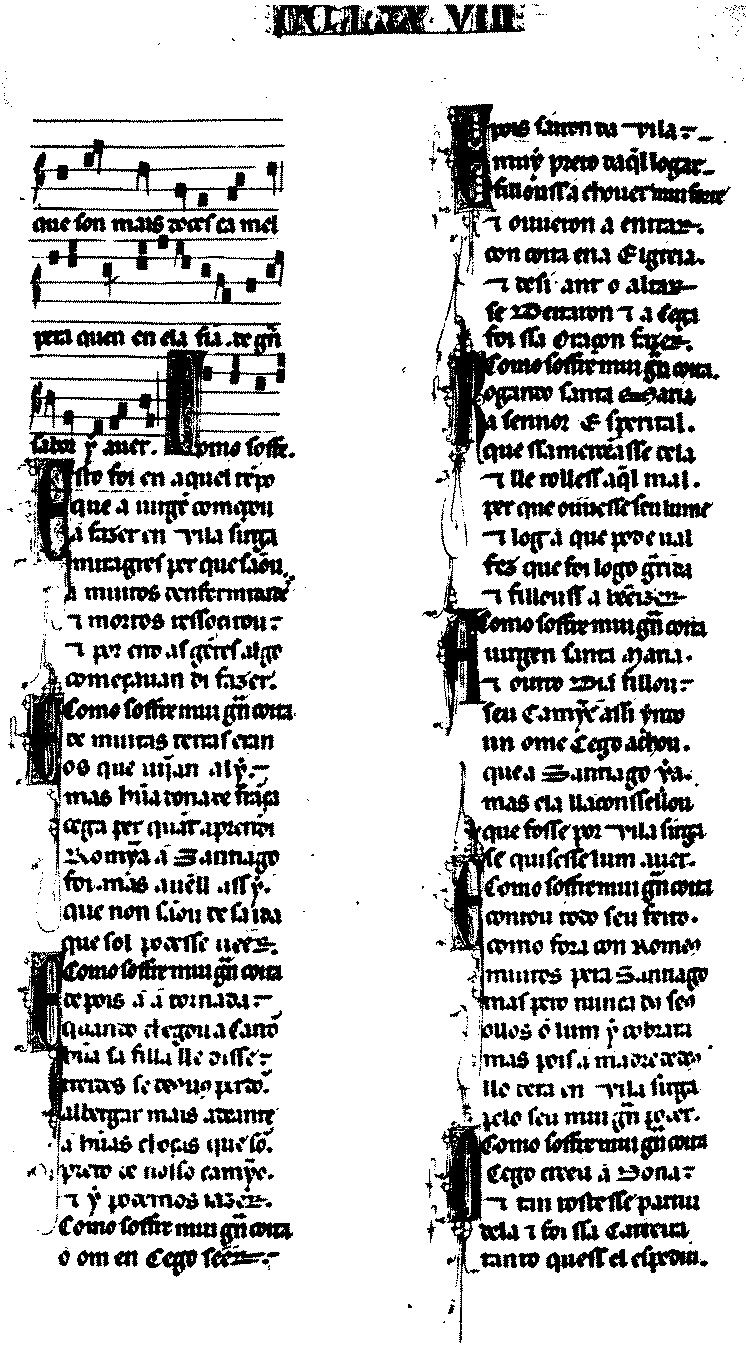
- a. 1284, Alfonso X of Castile, Cantigas de Santa Maria, Códice de los músicos, cantiga 278 (facsimile):
- […] que ſon mais doceſ ca mel […]
- […] which are sweeter than honey […]
Descendants
References
- Xavier Varela Barreiro, Xavier Gómez Guinovart (2006–2018), “mel[[:>:|:>:]]”, in Corpus Xelmírez - Corpus lingüístico da Galicia medieval (in Galician), Santiago de Compostela: Instituto da Lingua Galega
- Ernesto Xosé González Seoane, María Álvarez de la Granja, Ana Isabel Boullón Agrelo (2006–2022), “mel”, in Dicionario de Dicionarios do galego medieval (in Galician), Santiago de Compostela: Instituto da Lingua Galega
- Antônio Geraldo da Cunha (2020–2025), “mel”, in Vocabulário histórico-cronológico do Português Medieval (in Portuguese), Rio de Janeiro: Fundação Casa de Rui Barbosa
Old Welsh
Etymology
From Proto-Brythonic *mel, from Proto-Celtic *meli, from Proto-Indo-European *mélit.
Noun
mel m
Descendants
Portuguese
Etymology
Inherited from Old Galician-Portuguese mel m, from Vulgar Latin *melem m or f, from Latin mel n. Cognates include Galician mel m and Spanish miel f.
Pronunciation
- (Brazil) IPA(key): /ˈmɛw/ [ˈmɛʊ̯]
- (Portugal) IPA(key): /ˈmɛl/ [ˈmɛɫ]
- (Southern Portugal) IPA(key): /ˈmɛ.li/
Noun
mel m (countable and uncountable, plural méis or meles)
- honey
- Synonym: mel de abelha
- 2012, Luís Fernando Veríssimo, “A tia que caiu no Sena”, in Diálogos Impossíveis, Rio de Janeiro: Editora Objetiva, →ISBN, page 61:
- A conversa era sobre parentes, os parentes estranhos, interessantes ou, por qualquer razão, notáveis de cada um. Alguém já tinha contado que um parente comia favo de mel com abelha dentro.
- The conversation was about relatives, each one's weird, interesting or, for some reason, remarkable relatives. Someone had already said that a relative [of his] ate honeycomb with the bee inside.
- (chiefly Cape Verde, Madeira, São Tomé and Príncipe) molasses
- Synonyms: mel de cana, melaço
Usage notes
- In many regions where the sugarcane industry is or was of particular importance, the word mel without any adjectives often refers to molasses, which most other dialects call melaço or mel de cana (literally, “cane honey”) instead. In those regions, bee's honey is often specifically called mel de abelha.
Derived terms
Romanian
Etymology
Noun
mel m (plural meli)
Declension
| singular | plural | ||||
|---|---|---|---|---|---|
| indefinite | definite | indefinite | definite | ||
| nominative-accusative | mel | melul | meli | melii | |
| genitive-dative | mel | melului | meli | melilor | |
| vocative | melule | melilor | |||
Romansch
Alternative forms
Etymology
From Vulgar Latin *melem m, from Latin mel n.
Noun
mel m (plural mels)
Synonyms
- (honey): mel d'avieuls
References
- AIS: Sprach- und Sachatlas Italiens und der Südschweiz [Linguistic and Ethnographic Atlas of Italy and Southern Switzerland] – map 1159: “il miele” – on navigais-web.pd.istc.cnr.it
Volapük
Etymology
Borrowed from French mer (“sea”), with the 'r' turned into 'l'.
Noun
mel (nominative plural mels)